
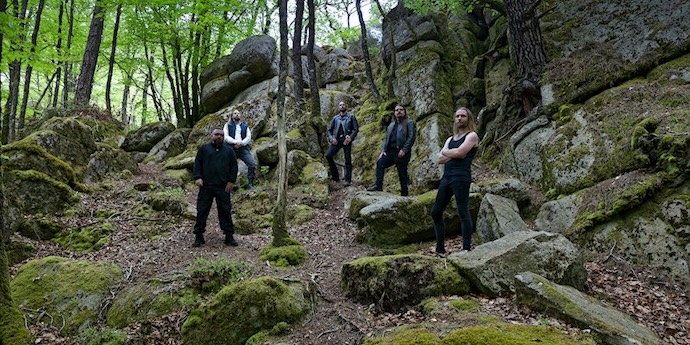
(We present Comrade Aleks’ interview of Gregory Person from the Breton black metal band Möhrkvlth, whose new album Gwenojennoù An Ankounac’h is set for release by the Antiq label on May 5th.)
In the eight years since the release of their first album, the French band Möhrkvlth has seen almost a complete lineup change. However, this hasn’t stopped the new members from following the masterplan of the band’s lead guitarist Gregory Person, and another full-length work entitled Gwenojennoù An Ankounac’h is here. Their atmospheric black metal with notes of depression, lyrics in Breton, and very light hints of traditional music influences may be considered as authentic, and indeed it’s one of the most interesting and memorable black metal discoveries of this spring.
Antiq Records focuses on albums with stories behind them, and so do I, thus let me introduce you to Möhrkvlth further through this interview with the band’s founder.

Hi Grégory! Accept my congratulations on the release of Gwenojennoù An Ankounac’h. How busy are you with its promotion?
Hi No Clean Singing and Readers! Thanks! We really are spreading the word since the end of 2025, when we found Antiq label to release it. And this spring we are broadcasting the music, contacting some medias like you for chronicles and/or interviews.
Möhrkvlth was founded in 2014, what was your vision back then? What kind of musical and lyrical influences did you search to embody in your songs?
I started to practice the guitar in 2010 when I was 25, my first melodies were Transilvanian Hunger. I wanted first to play some true black metal with epic and atmospheric parts, trying to not sound like another band but keeping the codes. I was not thinking about lyrics as I prefer the singer to write it, thus I only thought about composing the music, searching for transcendental vibes. The first singer Hiron proposed to write the lyrics in Breton language as he speaks it and to develop about our legends, history, the Celtic and pagan universe that is often about death.
You recorded the debut album A-dreñv Ar Vrumenn in 2018. How successfully do you think all these concepts were channeled through it?
We managed to create what we wanted and we found through it each aspect described above. The foundations of Möhrkvlth have been laid with this album, and even in 2016 when we released a 4-track demo in a true black metal vein in Breton language.
There’s almost a six-year gap between the debut and your new album Gwenojennoù An Ankounac’h. Was it only lineup changes that slowed you?
In fact it is an almost eight-year gap! There are a lot of reasons that can explain all these years between A-dreñv Ar Vrumenn and Gwenojennoù An Ankounac’h…: the pandemic, we were far apart from each other, some members were too busy, and then big health problems have arisen. When I was able to get back to music I searched for local musicians to make things easier and now we are very active and motivated, therefore we should not wait 8 years for the third album!
It’s obvious that you stay true to your Breton roots, and I guess that Möhrkvlth isn’t the first band from your region who cherish its origin. I even recall the long disbanded Stangala, a lovely doom-piece who performed lyrics in the mother’s tongue. How would you resume the main cultural aspects which make you differ from the rest of France, a huge country with a long history?
Glad to know you like Stangala, there are a lot of influences from rock/stoner to black metal passing by folk instruments and melodies. Using Breton language and themes according to its history with Möhrkvlth gives an idea about who we are, why we are doing that: to transmit through the music our unforgettable flame, the soul of our land. Brittany existed before France, we think it is primordial to pay homage to our ancestors and to teach it by art.
Can you name other Breton metal bands who perform songs in the native tongue?
In the black/folk metal scene we have the almighty Belenos, Heol Telwen, Aes Dana, Hanternoz. In other rock/metal/experimental genres we can mention Brieg Guerveno or Plantec.
The album’s title translates as “Paths of Forgetfulness”. What message do you put into it?
We can translate it by “The Paths Of Oblivion” (better than Forgetfulness but in French both have the same meaning). The message is that we almost lost any idea of where we come from, of our rich past, of who fought for us, of our martyrs… But not in a political standpoint, it is in an introspective purpose.
Ah, also what about the band’s name? Looks like “Death Cult”, isn’t it?
Yes, we say “Mort Culte” but it is written Möhrkvlth. I wanted it to be hard to assimilate visually, like black metal is hard to assimilate musically at first glance.
It’s impossible to avoid asking about the band’s lyrics, as you also adapted a poem by Breton poetess Añjela Duval. I always appreciate such moves, as it helps to stretch listeners’ own level of perception, so can you tell more about her and her influences on Möhrkvlth?
Añjela Duval represents the forgotten people, loneliness, the hard life of peasantry, the attachment to the land, the hard but simple life keeping spirit and body where it must stay. She is part of the revival of Breton language which was forbidden at school until the 50s but until the 70s in reality due to Jules Ferry’s laws in 1882-83. You were severely punished (humiliated, physically and mentally) by the teachers if you spoke Breton at school. Consequently the parents stopped teaching Breton to their children.
What are the other lyrics like?
Every song has its own story, but there is a common thread throughout the album about World War I, previous wars and battles, about heroes who were thrown to the wolves/sent into the lion’s den, fighting and dying without any recognition. But the album remains poetic throughout, not only with “Va C’heriadenn” from Añjela Duval.
The main body of the Gwenojennoù An Ankounac’h material is highly intensive and extreme to some point, no doubt. At the same time, you keep to high poetry and even the artwork radiates peaceful atmosphere. How do all these elements, music, lyrics and visual, work together for you?
You’ve grasped the general concept of Möhrkvlth. We find beauty in hardness and we can find too some inner peace after playing or listening to some extreme material. The most difficult thing is to create a synergy between these concepts, which can sometimes seem antinomics.
You have a brief instrumental interlude “Recueillement” in the album, and taking it into account and the general motive of the album, I’d like to ask if you ever have thought about embracing folk themes in your songs? I guess there was a sort of short folk-alike melodies in “Pour Une Couronne De Chrysanthèmes” and “Noz Ar Re Grouget” as well.
Folk music is part of Brittany, it is in our genes. It can be glimpsed at times even if it was not intentional to play folk-alike parts. Möhrkvlth can be described as a black metal band who explores this heritage without being experimental. We mix some true black metal, atmospheric black metal, infused with a bit of near-dsbm and folk.
“Noz Ar Re Grouget”… “A Night of Hanged Men”, right? What inspired you to write a song like this? What’s the story behind it?
We can traduce it as “A Night Of Hanged People”. In the song “Pour Une Couronne De Chrysanthèmes” Breton soldiers died fighting for France without any chance to survive. In “Noz Ar Re Grouget” it is people sentenced to death for an act of treason. Is it because they refused to fight?… In any case the result is death…
What are your plans for the rest of 2026?
We are planning to play some shows in Brittany first and then further, maybe abroad in 2027. And we already are composing new stuff. This is a true rebirth for Möhrkvlth, stronger than ever, watch out for us in the coming months and years!
https://mohrkvlthofficial.bandcamp.com/
https://www.facebook.com/mohrkvlth/
Cool interview and great songs. I never knew about the Breton language.
This is one of the best atmospheric black metal albums I’ve heard in a while.