
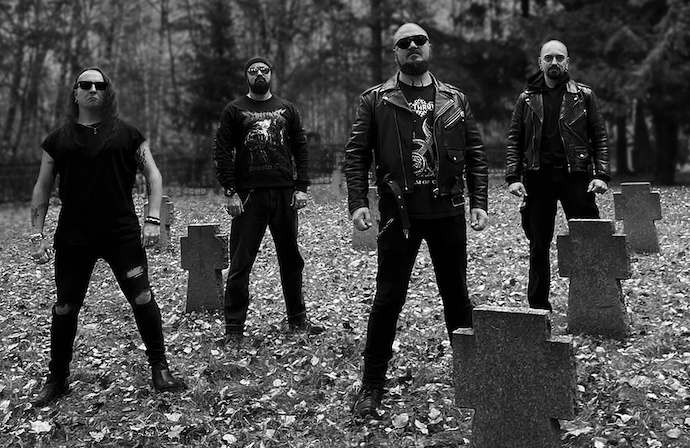
(Today is the day when Xtreem Music releases a new album by the band Grond, and to coincide with that long-awaited event we’re publishing Comrade Aleks’ in-depth interview with Grond frontman and founder Kist. Below you will also have a chance to stream the album in full.)
Moscow-based Grond are stalwarts of the death metal underground and dedicated worshipers of Lovecraftian Horrors. After a huge break the band returns with a new full-length album, and needless to say it’s their most mature, most sophisticated, and most cold-blooded work to date.
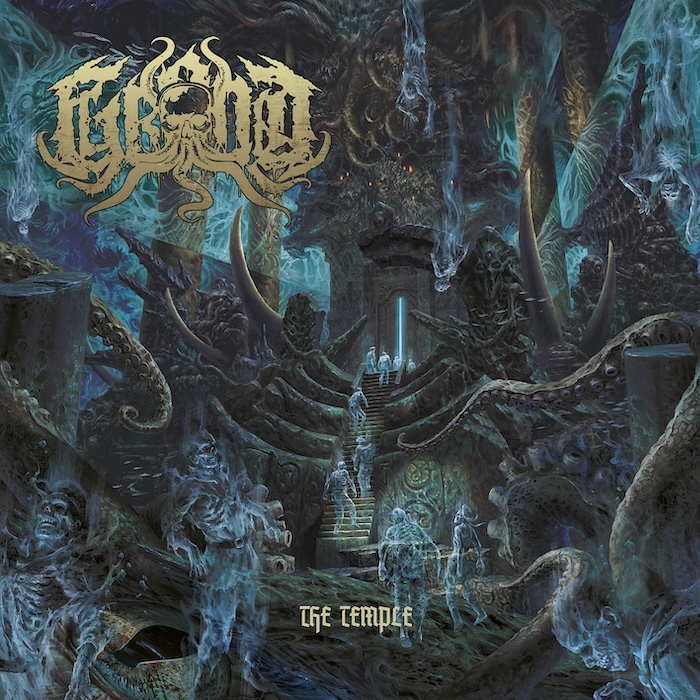
Xtreem Music gave Grond the green light, and The Temple, a concept album based on Lovecraft’s story with the same name, but the guys are true to themselves and they offer you their own interpretation of the master’s classics. We interviewed Grond’s frontman and founder Kist, and I’m excited to share this interview with you.
******
Hi, Kist! How are you? What’s going on in Grond’s lair?
Hi, Alexey! I’m doing great, thanks! Just got back from rehearsal and I’m happy to answer your questions. Right now, while we’re waiting for the album release, Grond spends a lot of time rehearsing with our new guitarist Ruin — getting ready for the upcoming shows.
First of all, there’s a huge gap between the previous Grond album, Worship the Kraken, and the new one, The Temple — almost ten years. What caused this stagnation? How did you, as a band, spend this time?
It’s worth noting that after Worship the Kraken we did release a split with the Dutch band Graceless in 2019, but still, quite a bit of time has passed. Grond has never been known for releasing albums quickly, but even for us, ten years is a long time. There were several reasons for such a delay: multiple lineup changes, various technical difficulties, the political situation in the country and the world, and, of course, my laziness, ha-ha.
Sometime after Worship the Kraken came out, I was replaced behind the drum kit by the mighty Kadath, and I was finally able to focus on vocals. Then, by mutual agreement, one of the founding members and songwriters — guitarist Dust — left the band, followed by guitarist Raze, and we became a quartet for a long time. Then, in 2022, bassist Daemorph left the group. All of this had a negative impact on Grond’s productivity.
I should also add that the creation of the new album The Temple — from the moment the drums were recorded to the completion of the artwork — took an unprecedentedly long time, over two years! Nothing like that had ever happened in our history.
But nonetheless, the album is ready, the band has overcome all the difficulties and is in very good shape!
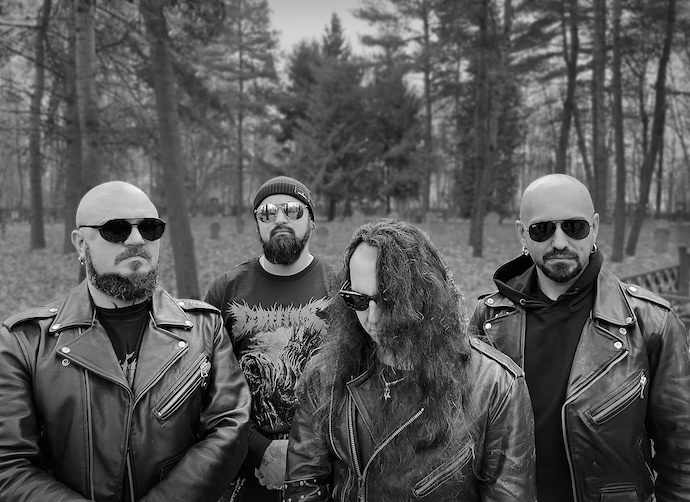
In recent years, the band’s lineup has undergone changes: your bassist Ruin returned as a guitarist in 2025 after a sixteen-year break, and since 2022 you have a new bassist, Sargash. How would you characterize these changes? Did they affect how you wrote and recorded The Temple?
As I already mentioned, Daemorph left Grond, but all the material on The Temple was written with his direct involvement, as well as with the participation of former guitarist Raze. We are very grateful to them for their invaluable contribution to Grond — without them, the album would have sounded completely different. So by the time Sarghas joined the band, almost all the material was already finished.
Ruin joined Grond after all the material had already been recorded. All the guitar parts on The Temple were recorded by Void on his own, but to perform the new material live properly, a second guitarist is absolutely necessary, and Ruin’s return to the band was a very joyful event for us. Our songs have taken on new colors at rehearsals and shows!
How much time passed from the moment you started thinking about the album’s concept until its final completion? How smooth — or rather, how intense — was the work on The Temple?
I can’t say exactly how long the whole journey took, but it seems to me that it was about five years in total, considering all the lineup changes and other difficulties. This time we chose an unusual recording method for us, which largely determined the length of the whole process. We only recorded the drums in a professional studio, while all the guitars, bass, and vocals were recorded in guitarist Void’s makeshift home studio, without a sound engineer or producer (unlike the previous album, which was recorded from start to finish at Hiboll Studio in Saint Petersburg).
This approach has its pros and cons. On the one hand, you’re practically not limited by studio time, and you can take your time realizing all your ideas. On the other hand, you kind of lose your sense of reality — days turn into weeks, weeks into months, and months into years. But Void did a great job both as a sound engineer and as a guitarist, and all of us did good work, even though we aged during the creation of The Temple, ha-ha! We learned a lot during the recording process, and that’s a good thing. But don’t try to pull off this trick yourselves! Albums definitely shouldn’t take this long to make, we understand that.
How much of the old Grond is left in the new material? For instance, how much of Steel Coffins is there in The Temple?
It’s hard for me to answer this question, since I lack the ability to look at my own creative work from the outside. But one thing is obvious: our music has undergone quite noticeable changes compared to the old material. I’d like to think that in many ways, Grond has grown musically. I’m the only one left from the original lineup, and the songwriters have changed on the new album — that couldn’t help but affect the new songs. But of course, we tried to preserve the spirit of old Grond! Time will tell how successful we were. I’d be interested to hear outside opinions after the release.
As for Steel Coffins — conceptually, it has definitely made its way into The Temple, the old and new songs sound organic together.
The Temple is a concept album based on Lovecraft’s short story of the same name. But the artwork (which is truly magnificent!) shows that you’ve interpreted the original story differently. You even added Otto Weddigen, a German Imperial U-boat commander from World War I, to your narrative. So how does your version differ from the original plot?
I’ve always been a huge fan of King Diamond — along with Mercyful Fate, they’re my favorite band! I always knew that someday we would try to write a concept album, to tell a story, but it had to be a story in Grond’s style. Lovecraft’s short story The Temple is very much in line with what Grond typically sings about: there’s a submarine, the depths of the sea, mysticism, madness — in short, true death metal. I had my eye on this remarkable story for a long time, and I felt that using it for just one song wouldn’t be enough, but at the same time, for some reason, I didn’t want to base the album’s story solely on The Temple.
In the story, the action takes place on the submarine U-29. It was on a submarine of the same type that the real-life captain Otto Weddigen made his famous military campaign. Creativity knows no bounds, and I decided it would be interesting to merge two stories into one: the real story of World War I captain Weddigen and the fictional story of the protagonist of Howard Lovecraft’s tale. The connecting link between the two narratives is the submarine U-29.
In brief: a terrible war begins. Otto Eduard Weddigen sets out with his crew on a combat mission in the North Sea aboard the U-9. During patrol, the submarine spots three four-funnelled British cruisers — the armoured cruisers HMS Hogue, HMS Aboukir, and HMS Cressy. All three ships were sunk, 1,459 people perished, and Weddigen was awarded the Iron Cross 2nd and 1st Class. On October 15, 1914, U-9 under Weddigen’s command sank the British cruiser HMS Hawke, after which Weddigen was awarded the Prussian order «Pour le Mérite» for sinking four cruisers.
On March 18, 1915, Weddigen led U-29 to attack a large group of British ships. In poor visibility, focused on selecting a target, he didn’t notice the dreadnought HMS Dreadnought approaching from starboard, which had received word of the submarine from the battleship HMS Marlborough. After being rammed, U-29 sank with all hands.
And then the mystical events from Lovecraft’s The Temple begin: whether in reality or in grotesque hallucinations, the captain sees enormous structures on the seafloor. He yearns to reach the open sea, his entire being is drawn toward the mysterious Temple. Meanwhile, on the surface, one of the most terrible and bloodiest wars in history rages on.
I want to emphasize that we don’t claim to be academic historians, and compared to Lovecraft, we’re not even in the same league. The album The Temple is simply death metal, and the lyrics are meant to create the right atmosphere. You can just listen to our songs without diving too deep into the lyrics, but for those who want to learn the story in more detail, we have a CD booklet meticulously designed by Daemorph. There you can also find a couple of interesting Easter eggs.
What exactly drew your attention to this story, which lacks action and actual visual horror? I believe you’ve already touched on this theme in the previous album Worship the Kraken, haven’t you?
I wouldn’t say this story lacks action. And there’s plenty of visual horror in it. What could be more horrifying than war and death? Death metal as a genre is meant to explore such themes. Let me emphasize that all members of Grond are normal guys — none of us glorify war. War is terrible; it’s a true curse on humanity. And Otto Weddigen was arguably the most successful submarine commander in history. He was a cold and calculating military man, and what he did in the North Atlantic was a true nightmare for the British fleet!
As for the album Worship the Kraken, it had submarines, giant octopuses, prehistoric sea creatures, Lovecraft — everything we love so much. But that album wasn’t fully conceptual, even though all the songs were united by a common maritime theme.
What characteristics of death metal help you create a connection between your music and the story itself?
For us, it’s darkness and brutality filtered through the lens of depth. Depth, in the most literal sense, is connected to the essence of the band. Grond is an old submarine lying at the bottom of the ocean. Pale, slow-moving crabs crawl around it, disgusting hagfish swim by, and from inside the rusty hull, grim stories can be heard to the sound of death metal!
By the way, this year saw the release of the first album from your project Kadavereich, Perversa Mysteria. You’re working on it with your former bandmate Daemorph and Panzer. Both Perversa Mysteria and The Temple were written and recorded around the same time. How do you see the key differences between these two works, aside from the fact that Daemorph now lives in Germany and you worked remotely?
Kadavereich is first and foremost Daemorph’s project. He had an idea to write more straightforward, primitive, warlike metal, even with a bit of a black metal edge. For Kadavereich, I came up with the lyrics, recorded vocals and drums, and had no part in the songwriting — that’s entirely Daemorph’s and guitarist Panzer’s doing. I also used a different type of vocals for the recording of Perversa Mysteria. So the similarities between Grond and Kadavereich are minimal — I’d say they’re practically nonexistent. You can hear for yourselves — the album is available for streaming.
If you want to learn more about Kadavereich, I recommend reading this in-depth interview with Daemorph for DEADLY STORM zine:
https://www.deadlystormzine.com/2026/03/interview-kadavereich-dark-mysterious.html
The first songs on The Temple strike with absolutely powerful, crushing sound, and the recording quality is exemplary. Did you mix the album at the same studio as Perversa Mysteria? How involved were you in this process?
Thank you, I’m glad you like our sound! No, Grond and Kadavereich were mixed at different studios. The mixing and sound production for Kadavereich was handled by Sasha Borovykh from TsunTsun Productions. He’s an excellent sound engineer and a true professional!
Grond, on the other hand, turned to our old friend Konstantin Dolganov — he mixed Worship the Kraken. We’ve known each other for a very long time, and we’ve shared the stage on many occasions. Finding the right sound wasn’t easy, given some changes in musical style and the presence of many guitar solos (which we hadn’t had before). But the collaboration paid off — we’re very happy with the result.
Popular metal bands like Arkona and Grima, who have signed with major labels, are still able to tour worldwide. Does Grond have such an opportunity? Have you ever performed abroad?
Yes, we were fortunate to perform once in the Netherlands, at the Schoonebeek Deathfest in 2017. The festival was organized by our label at the time, RawSkull Recordz. The lineup also included bands like Soulburn, Fleshcrawl, Revel in Flesh, and others. Those were some great days, which we look back on with great fondness.
At the moment, we don’t have any shows abroad planned, but nothing is impossible. We’ll see — maybe after we’ve road-tested The Temple on Russian stages, we’ll try to make our way to Europe. Time will tell!
What are your plans for the remainder of 2026? And do you also plan to continue with Kadavereich?
Right now, we’re actively rehearsing old and new material with our new guitarist Ruin, as we have a number of shows planned for the rest of the year. We’re also slowly starting to gather material for the next album!
As for Kadavereich, in its old format, it most likely won’t continue. As far as I know, Daemorph is thinking about putting together a new lineup in Germany for live performances, and maybe for studio work too. I’d be really happy if he pulls it off, and I wish him all the best!
https://xtreemmusic.bandcamp.com/album/the-temple
https://shop.xtreemmusic.com/
https://www.facebook.com/grondrus/
https://www.facebook.com/xtreemmusic666/
Definitely a record worth digging into after reading this interview. That album cover is amazing too.