
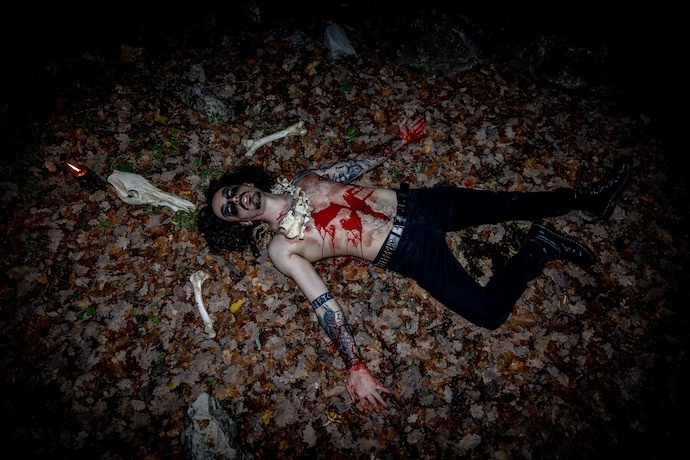
(In April of this year Antiq Records released a new album by the French black metal band Tarask. Comrade Aleks was drawn to it, and followed up his listening with this interview of the project’s creator.)
I fell for this bait again and initiated an interview with the band, whose new album description included the adjective “Lovecraftian.” But the Toulon-based black metal duo Tarask has slightly altered its concept for their second album, Sitra Ahra, and now relies on occult metaphors as a means of expression towards consumerism and modern society.
Being doom-guy for most of my time, nowadays I lean towards black metal as a more focused and straightforward way of channeling this discomfort… and I had a lot of this today after reading just the headlines of up-to-date news. So I have to admit, that classic and atmospheric black metal of Sitra Ahra is a good soundtrack to this evening when I’m ready to share with you this interview we’ve done with H. P. K. (vocals, guitars, bass).
Hi H.P.K! How do you do? What’s new at Tarask’s side?
Hi! I’m doing great! Lots of new musical projects are going on with new releases coming in 2026, A first split for my new band Soufre coming this summer, and another project supposed to come out later this year…
You formed Tarask as your solo-project, but the new album Sitra Ahra was recorded with Florian on drums. How did you collaborate together recording the material?
Florian was introduced to me by my former guitar teacher, Cyril, as they play together in the same brutal death metal band, Dying Earth. The collaboration went smoothly, Florian came up with great ideas very quickly and improved the demo midi drums I had written. He recorded his parts very fast, did the mixing, and helped me record my vocals. His input in the making of the album was greatly appreciated.
Didn’t you think to perform this material live now when you have a constant drummer in Tarask?
I am actively working on a lineup to perform live, but it won’t be with Florian on drums, as his personal life won’t allow him to assure the dates. I’m now looking for a live drummer.
Some years ago you took part in the Cercle Noir split alongside Loup Noir, In the Mist, and L’Eclat du Declin. Is it a real coalition or a temporary alliance? Do you collaborate with these projects and bands on other levels?
Cercle Noir is a real coalition with bands and people I really like, and a new Cercle Noir opus is coming out this summer, but this time not with Tarask, as the beast morphed into something way different musically than it was at the time of the first split, but with my new project Soufre, which is a ’90s-inspired raw black metal project I created with my best friend Sulan.
By the way, which bands formed Tarask’s initial aesthetic besides Dissection?
Tarask’s aesthetic was formed by many bands, not as much as a direct musical influence but more as an approach to music. Bands like Dissection, Mgła, Peste Noire, Death, Psychonaut 4 that have such unique approaches to music that make them so immediately recognizable, that’s what I wanted to do with Tarask. I’m still experimenting and improving on this aspect of course, and album after album I try to forge my own sound, and my own way of composing.
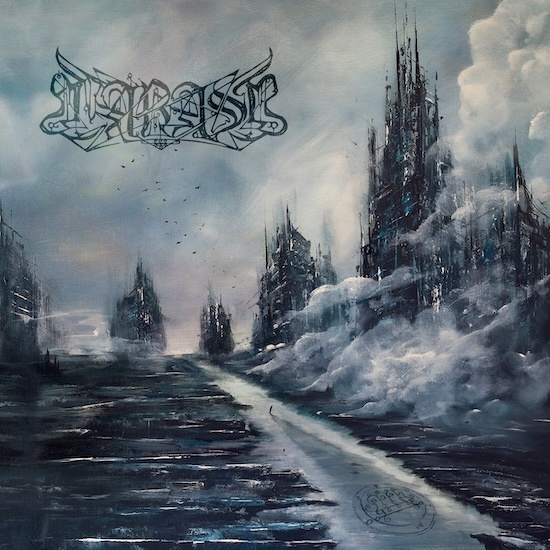
Regarding Sitra Ahra’s concept, the press-kit states that “On the cover [of first album Pharus Morti], there was a protagonist discovering a Lovecraftian, industrial port city filled with horrors”. But Lovecraftian horrors most of the time barely have connections with industrial surroundings, so how did you manage to combine these themes in the album? Let’s say, how much of Lovecraft is in Pharus Morti and why did you totally get rid of his influences in Sitra Ahra?
Pharus Morti was an album with a simple concept: using Lovecraftian myth as a metaphor for a society plagued by consumerism and alienation of individuals. So we followed a protagonist wandering through a city where everyone is alienated by an obscure Lovecraftian entity, and the protagonist tries to escape this city without getting corrupted too. At the end of the album, he escapes, but the horrors he has faced destroyed him, so he tries to find salvation through the Left Hand Path, the Goetic path. As for Sitra Ahra, it’s then the direct following of Pharus Morti in the sense that it’s a spiritual wander through the left-hand path, looking for the answers to attain freedom and the completion of self away from the modern world.
Did this concept twist influence your approach towards composing the album? Did you aim to keep the music and lyrics tightly connected?
Obviously yes, each song was supposed to fit a narrative, as each song had a place and a function in the coherence of the album. For example, “Evocation IV” has this role of being the pivotal moment in the album, with the intensity slowing down so the clean part with female vocals can breathe… and then come back at the end. And it fits with the tone of the lyrics, getting depressive then slowly rising toward acceptance and anger.
You changed the plot in Sitra Ahra, relocating the protagonist of the first album in the world of occultism and satanism. First of all, do you consider both just as a background frame or do you perceive it as a real practical doctrine?
It’s more continuity than changing the plot, as the ending of Pharus Morti was already shifting the protagonist from the Lovecraftian corrupting city to the search for salvation through the occult. I consider this doctrine as it is: a doctrine, a way of thinking, a way of perceiving the world, and a way of getting through this life and a path towards transcendence. I don’t see it as an organized religion or anything; it’s a personal study, and a cult to the empowerment of the individual. And that’s kinda how I see the world: if people were better individuals, the world wouldn’t be so shitty. Because individuals lack discipline, the ability to grow through suffering, and they lack ambition.
How do these concepts manage to reveal “a critique of conformity and consumerism”? Okay, a part about conformity is more or less clear, but what about other factors?
I get that it needs explanation. To me black metal always has been against conformity. To society, to music standards, to the metal scene. And still, I feel like it’s more about conformity than ever. Everyone is still trying to emulate the same sounds, the same riffs, the same branding. Some others are trying to distort it, to make it fit a narrative and are stripping it of its substance. Very few are trying to push the genre forward, as those who came before us did. That’s what I’m trying to do with Tarask, musically speaking, and I’m addressing it lyrically.
Consumerism is also a consequence of this. We are plagued by society forcing habits on us, and telling us how to live our life, and of course that reflects on art. Everything seems accessible, ready to consume, because that is how people consume these days. They don’t dive deep enough inside the art that they consume, so people that make art don’t bother anymore. Everything remains superficial, without substance or intricacy.
The album is built around six tracks named “Evocation”. Did you put some real evocations in your lyrics or is it a way of storytelling in Sitra Ahra?
This is kind of an hommage to Exercise in Futility by Mgła, which is an album that I love and often come back to. It’s also a way to make the listener dive into the album as a whole piece, and not only single songs. Some lyrics in the album, especially “Evocation VI”, are of an evocative and goetic nature obviously.
There’s an interesting atypical female vocal in “Evocation IV” and the overall vibe of the track is performed in some kind of noir trip-hop style. What’s the place of this song in the album’s entire plot?
As said earlier, this track is the pivotal moment of the album. It wasn’t really planned this way, in the writing process, it was just an idea of mixing a dark folk-Lana Del Rey/Chelsea Wolfe part with the ending part of the song, which is this epic and groovy riff.
Then it became a bit journey-esque with how it fleshed out to be: a kind of depressive black metal song, with this long atmospheric and folk acoustic part, with those soft female vocals, and ending with this epic riff that is one of my favourites from the album. It makes for me the perfect middle track in the album (not exactly the middle but with 6 songs you get the idea) and kind of give a bit of a rest, which is needed because the album is very dense.
Your songs are well-structured and complex to some degree, and it’s really interesting to follow their patterns revealing twist after twist. How consequently were these tracks were shaped? Do you see their structures as a part of the “evocations” as well?
The process of writing the album took a lot of time, as I made several versions of each song. For example, the version of “Evocation IV” that is on the album is the 7th version of the song. I constantly rewrote multiple parts before I was satisfied. Many songs also didn’t make it into the album. I wanted to write songs with layers, intricacy, while remaining effective and catchy. I love music that has depth, that alternates calmer parts which emphasize faster and more aggressive parts. It’s all part of my process of writing for Tarask, where I try to make me, and by extension, the listener, feel the lyrics through the intensity of the music.
How much of your own experience and views are channeled through the main character of this story?
Pretty much all of it! As Pharus Morti was a metaphor for my confrontation to big cities, consumerism, and alienation of the modern world, Sitra Ahra is a metaphor for the tale of my spiritual journey.
Did you say everything you wanted to through these six tracks? Is the story finished or will you continue it in another album?
The story is not finished yet! I thought of it as being a trilogy. So I guess I’ll bring a conclusion to the journey of the protagonist in the next album! Sitra Ahra raises a lot of questions about spirituality, transcendence, and how to become free in this world, the next album will try to give an answer to that.
What are your plans for the rest of 2026?
The release of the new Cercle Noir split, this time not with Tarask, but with my raw black metal project that I share with my friend Sulan, Soufre! It’s gonna be two songs and the intro of the split, as our first release under this new project. There is also another project I’m part of, another split, which has already been teased, but more will be revealed in due time!
https://antiqofficial.bandcamp.com/album/sitra-ahra
https://tarask666.bandcamp.com/
https://www.facebook.com/tarask.tarask.9235/