
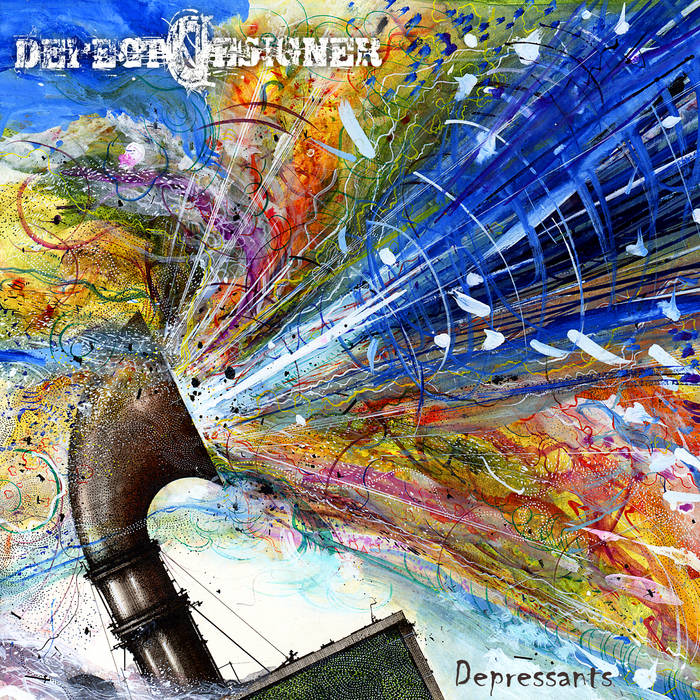
(Anyone who has listened to Defect Designer, and perhaps especially their current album Depressants [released last month by Transcending Obscurity] will expect any discussion with them to be unusually interesting, especially if it includes insights into their creative process — and expectations are fulfilled in the following interview of Dmitry Sukhinin and Martin Storm-Olsen by our Comrade Aleks.)
I bet that you already had a glimpse here on the new metal of Defect Designer, so I’d prefer to avoid revisiting the band’s background. What we have now is Defect Designer’s fourth full-length Depressants, which continues a series of experiments in prog, death metal, and avant-garde music.
Dmitry Sukhinin is responsible for guitar, bass, and main vocals, as well as some of the music and lyrics; Martin Storm-Olsen has added banjo, mandolin, and twelve-string acoustic guitar to his arsenal this time around. Besides relatively new and extraordinary drummer Eugene Ryabchenko, this album also features female vocals (“Body Count of My Cow Tail”), and one of the three guest vocalists is Björn Strid from Soilwork (“Expiration Deferral Request Denied”).
Depressants sounds like an anthem of unbridled chaos, but in reality, it’s a meticulously crafted piece that has undergone a series of modifications at various stages. In fact, the band’s previous album, Chitin, was recorded literally in the middle of working on Depressants! So the songs were written unhurriedly, with all the necessary elements given due attention. Thus, the screaming death metal cacophony of “Butterfly Juice Straw” easily transforms into epic, melodic metal, while the magical, orchestral keyboard lines of “As the Terracotta Dust Settles”, on the contrary, are instantly dispersed by a rabid death metal overtone.
Asynchrony and extreme dissonance go hand in hand with harmony and classical music. Depressants is the carnage of “Daily Dose of Gloom,” the mandolin finale of “Repeated Aversive…,” the hard rock of “Expiration Defreral…,” and the sleepy prog haze of “Body Count…” A lot of everything to listen to, a lot of everything to dig, a lot of everything to discuss with the band’s main authors.
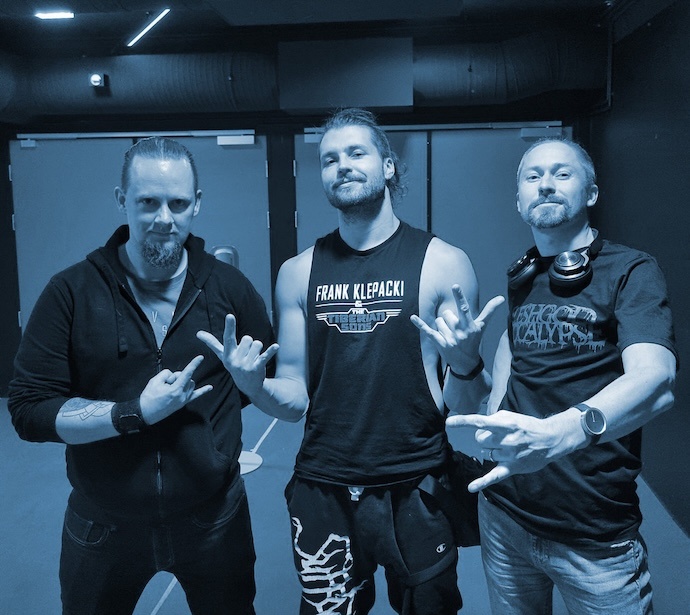
Hi Dmitry and Martin! How are you? How did you deal with Depressants’ release? Did you have any special event regarding this?
Dmitry: Hi there! Thanks for spending time on us! Uff, I am glad we have survived until this day. It’s been a lot of effort, demoing, arranging and rearranging for this to happen. Almost draining. So draining I had no power to celebrate really. I had a glass of wine, I guess. Most importantly is to have it available for people to listen to, and even more important – now I can listen to it myself.
Martin: Thanks for having us! This landed without any additional event on our end. Like Dmitry says, it was a massive piece of work bringing it all together. It even had a few speedbumps along the way with issues with Dmitry’s home recording setup that prolonged our recording process for bass and guitars a few months. Luckily with all this, and the product done, in our “camp” there was a decent amount of time between producing this album to completion and release that gave us both a bit of rest from listening to it constantly for months while we progressed. Listening to it now, I still remember the hardship that went into its creation, but I’m also able to hear that it turned out in a way we wanted it to.
First of all, you have a new drummer. Eugene Ryabchenko is a highly demanded player who’s busy with a lot of bands and international projects. And Defect Designer is a band which needs a highly skilled drummer like him. How did you manage to involve him in the band?
D: We actually have worked with Eugene on the previous record Chitin. You know, I have always envied the bands who have a stable lineup that does not change over years. But some very long time ago I simply gave up my constant searching. For the Ageing Accelerator that was out in 2015, we used Flo Mounier from Cryptopsy. And for these last two records it was also clear we needed to get a pro. So I had a list of those whom I thought to approach this time – for Chitin – and Eugene was the first one, I think. And it was really easy to get in touch and to deal in general. It worked like a charm, and we already had most of the Depressants material ready, so then I knew whom we would like to have for Depressants. When I write my material, I also write the drum parts with all the peculiarities, so I sent the parts to Eugene on Chitin, and we sent our drum parts for Depressants to him this time as well.
M: When we stood at the crossroads and knew we needed to engage someone after our local drummer, Simen Kandola, didn’t have the time available to continue with us in the aftermath of Neanderthal, the list of who to look for to record the next album wasn’t that long, and Eugene was both a top choice and available for Chitin. Based on his performance on that one, we knew we wanted him for Depressants too early on, if it was possible to align with him. How we managed from there was mostly about being prepared with material on our end in time so he could rehearse and go record in the studio during his available slot between touring and gig rehearsals.
What’s Eugene’s role in the band? Did he take part in the songs’ composing and will he join you on gigs? Let’s say, is he the band’s constant member now?
D: A lot of music activity is driven by economic relations. If a band gets a certain offer and is able to cover the costs – then there are gigs and band members. You often see an official band member being just a hired gun (e.g., Dave Lombardo) and unlisted musicians playing with the band all the band’s lifetime (e.g., Sugarfoot). So considering the live gigs – a lot depends if and what the offer is. Eugene has played on two of our records; obviously, he is there in our sound and he has made it so that there were no compromises done at all – which is not something I have seen with any other drummer so far.
M: The compositions, including drum parts in detail, were done by Dmitry and myself. Like Dmitry mentioned, we sent Eugene the drum parts as we wanted them, a process, putting a bit of extra work on our pre-productions for the two of us to be as exact and realizable for an actual drummer as possible. How close he got and how dynamic and human he has made this extreme music sound from our templates is all kudos to him and highly impressive.
On the other hand, you have both played together for more than a decade, how did you collaborate shaping the new album? Who offered crazier ideas?
D: Martin outcrazed with the amount of instruments this time. We have songs that are written 100% by myself, 100% by Martin, 50-50 or some bigger/minor share. This was a much more collaborative album and I think it is very well heard, since it is our most easy listening. It is the opposite of Chitin. Those who get a physical format will see who composed which song or major/minor part.
We have been working since the final touches of Ageing Accelerator: it was 98% done when we teamed up – Martin has contributed to some very final touches. Then we were sending ideas/demoing and doing the changes from the Ageing Accelerator times or around then.
We did a Neanderthal experiment, pivoted with some changes, made Chitin and now Depressants, which we had worked on for these years.
M: I can’t really say who was the craziest, but as Dmitry and I draw on “crazy” from quite different approaches and toolboxes, I think that the end result shows a blend of restraint and crazy that in a way got a bit broader in both aspects. Perhaps even more so for Depressants where the composing effort was more evenly split between us than before. The production phases have always been open to various ideas and sparring to get things just right, where “just the right amount of crazy” has been one of the factors we’ve looked at, though.
What was your original vision of Depressants? How would you describe a central motive of the album?
D: The central vision was to have a total blast in every riff. Wanted to have it both fun, groovy, catchy, and interesting to listen and experience. Most of the time we spent on making the bridges – so that it would sound organic. But the main thing was to realize the riffs that really needed to be heard and have no compromise. It was a lot of very serious work.
M: I had in mind that this time around we were showcasing very worked-through material that we spent a long time reviewing every aspect for, and as such perhaps more deeply rooted songs that at least I had an extra strong connection to while we worked our way through the production and mix phases. We were making sure that each part transitioned well to the next, and if not, replaced parts until it did. It also meant putting our all into the performances on instruments as well as vocals. Being “Defect Designer” it was also an equal amount about seeing it go unhinged and manage to return or go out with a bang. So if we in all seriousness made you smile from our creative outbursts at times, I think we succeeded just as much as if you’ve been headbanging along.
This time Martin played a bunch of new instruments. How did you manage to integrate all of these in the songs? How long did you try before you fit it in its structures?
D: Years literally. It took us years. We have been demoing the songs for several years – after Ageing Accelerator. We had recombined some songs tens of times. Some riffs or riff variations had travelled from one song to another. Yes, we did have other things on the plate – but during Neanderthal we already rehearsed some songs from Depressants.
M: I don’t really think about the amount of instruments in that way myself. Although producing some of these songs took us a long time, I didn’t see it as a struggle in that regard to add the more untraditional instruments. It could have happened more on earlier releases if it was suitable. From the start, Dmitry and I have both been guitarists in Defect Designer. On Chitin, Dmitry’s songs were so readily composed that I contributed more strictly on bass, and the songs didn’t really have need for or room for that sort of “extra”. On Neanderthal, however, there’s a part with 12-string acoustic guitars added for ambience in the final song.
For Depressants we split the bass between us, and divided guitars pretty much equally between us. And yes, you normally don’t need acoustic guitars or mandolin when you make death metal, but then again I added them out of a “why not” type approach when I had an idea that it would make a great part for the end of Repeated Aversive Stimuli Inducer. And banjo too, which you get a glimpse of from the start of The Inevitable Mad Composite, was part of that composition from the get-go on my end, and to me felt important enough to keep until the finished product. If you ask Dmitry, he’d probably say it got there because we didn’t have a sitar on hand.
D: Special announcement. We have read numerous reviews from true death metal scholars and would like to express our sincere apologies to those who involuntarily became victims and were injured while enduring sustained exposure to banjo on this album, which was labeled as death metal.
M: Special announcement #2: I don’t really need the scholars to like my banjo. It’s there. Take it or leave it 🙂 If you didn’t suffer from it, I even started using more banjo in the time after this record was done with another band of mine, Hermit Dreams, where I was recruited simply because I could add banjo to the songs along with my guitar capabilities. The debut album was released in December 2025 and is called Desperate Anomies. [Editor’s note: go find that here and be punished for your efforts!]
Working in such progressive and avant-garde directions, don’t you think to go away further from death metal roots? If you consider death metal as your original genre….
D: I personally do not care about the genre label. Probably one can tell by listening to the latest record. It happens to be close to death metal, but on Depressants there are songs that are almost purely black metal, prog rock, cabaret/Korn, and groove. Heavy groove is important, though – and it is our taste that makes us write in a direction that people happen to call death metal or grindcore. Speaking of which, we started getting the grindcore label after Neanderthal, and we have never thought that that is a grind record – but since the first review – voila – grind label. And we were like “hmm, yeah, that does have quite a lot of grind”.
We were thorough and the vocal part took some time – you will notice that they are quite different from the previous records – not only does it include Martin doing harsh vocals on one song alone, we also had Björn from Soilwork, Makeda Rose (Soul, Broadway, R&B, Jazz, Pop, Opera vocalist), Ottar from Shaving the Werewolf, but I also did very different vocals compared to any previous record.
M: It’s not that important what genre label gets put on us. It will always be outweighed by how important it is for us to have this outlet where we can be pretty much as creative as we want and have as much fun as we can while doing it. Is it metal of some kind? I think that it is, at least for the most part, while not being particularly restricted.
What are your non-metal influences? Usually prog-bands draw their inspiration from various sources, so what about you? How much of non-metal influences do you put in your songs? Maybe we can even speak about non-musical influences as well, can we?
D: Michael Jackson (we quoted him on the Ageing Accelerator – only on bandcamp and CD versions), the Prodigy, Nirvana, Andrew Lloyd Webber (well, this is also quite obvious, – we quoted him on Wax), a lot of classical music (Neanderthal even has a quote, but I used to listen to classical music a lot), Original Soundracks (yep. Chitin has a quote. Also you might have bumped on some very famous quote on Depressants too).
OSTs… endless inspiration. I listen to Danny Elfman, Jerry Goldsmith, John Williams (he is the most listened to composer on Earth today), Vangelis (especially the Blade Runner!!) and those influenced by him (have you heard the Stray PS5 game soundtrack? Yann Van Der Cruyssen), Ennio Morricone, Thomas Newman, John Barry (well, he is obviously mentioned above, right?), Alan Menken…
Ok, let’s have a must-mention category here too – defining my childhood: Glenn Stafford, Derek Duke, Jason Hayes, Neal Acree, Russell Brower, Matt Uelmen (THANK YOU, Blizzard Entertainment!!!). The Beatles (heard of them? Brits), Pink Floyd (especially Dark Side of the Moon and Wish You Were Here, some parts of The Wall), Abba. Limp Bizkit – one of my major inspirations (Very sad that I was not able to see Sam Rivers live), Slipknot inspired a lot. Gentle Giant (that was easy, I guess? But I got to know them when we were in Hertz studio recording Wax).
Frankly, I do not think that there is much metal inspiring me to compose.
M: I’m not really good at name-dropping influences, but I started my teens with a lot of rock music in my life and expanded into metal gradually onwards from there, so anything from jazz, jazz rock, to various types of folk music can inspire my songwriting just as easily as metal can. A few honorable mentions: Alice In Chains, Jaga Jazzist, Chicago (primarily their second album), Nine Inch Nails, Weezer, The International Tussler Society, Mastodon, Farmers Market, Incubus, Motorpshycho, and Silverchair are not nearly all, but some of the bands that shaped me.
Was the artwork of Ian Miller your choice or was it the label who offered it? I guess, the last Miller artwork I saw was a Warhammer-spawned double illustration for Ulthar albums, two years ago or so.
D: The artwork is always a very important piece for me. When we finished Neanderthal, I asked Vladimir Smerdulak (he did our Wax cover) to do the art for Neanderthal – and I still love that version – it is “ROSTA Windows” – inspired art. It kicked major ass (and still does when I open that image), but most of the planet would not get it. We had all the text in that style. Would have been awesome. But maybe even too unusual even for us.
So the label suggested we go for one guy who draws very interesting and unusual acid-looking paintings. But with busy schedules, we had waited for an eternity to get a sketch and it was not a good match.
Then the label casually suggested that it could be cool to get that other guy, but it is probably not possible… and sent me a link to Ian Miller’s works. And I had seen his works before – I instantly recalled that. Daaaamn. To not try would be just awkward. I wrote to Ian and arranged everything. And now we have used his works for three records now. I have a file with links for his works – tens of them – that we wanted to see if we could use. Ian is absolutely fabulous, absolutely jolly to work with.
Of these tens of arts that I have gathered there was one that had multiple exclamation marks as a comment. The Depressants artwork. That was my number one choice and… well, surreal to see that we have SUCH a cool art for the album.
M: Dmitry did all the legwork on this, but I find that what we landed on was an artwork that was in many ways a very good visual representation of the music, similarly wild, unhinged, playful, and colorful. Ian Miller’s work is in general pretty phenomenal and I am quite fond of the trio we got to use on our three latest releases.
We can hear a bunch of guest musicians in Depressants, but of course it was a surprise to hear Björn Strid singing one of your songs. How did it happen?
D: We started cooperation with Björn on Chitin. Shine Shine needed someone else, so there was a need for vocals from the outside. I had some options in mind and since I have been a big fan of Soilwork since 2002, Natural Born Chaos, I asked Björn to do the vocals. It was extra easy. Then I had a prog rock song that is on Depressants and it is basically the same story – the song is a bit more proggy compared to Shine Shine, but it obviously needed this type of vocals.
I am generally very fond of writing to people I like.
But it was not easy to find someone for Body Count of My Cow Tail. I had written to a (big) number of our locals, but all of them – except for one – have thought I do not deserve an answer. Quite crap to see that the message is read – when you are connected contacts – and ignored. A “No” reply is professional, but absence of any reply is just lame arrogance. Interestingly though, that one reply I got was from the one who should be the most swamped and disturbed of all of them combined – from a lady who was singing on behalf of Norway on Eurovision.
Luckily, I found Makeda who at that time was residing in New York.
Dmitry, you’re the lyrics’ author in the band. Can you reveal what kind of meanings you put into songs like “I Heard Robespierre Screamed Like A Bitch”, “Body Count Of My Cow Tail”, or “Butterfly Juice Straws”?
D: Hehe, the CD layout mentions who does the lyrics, and it is not only me, but rather 50-50 on Depressants. And Chitin also includes Martin’s text for some songs.
I both love and hate writing lyrics. But these three songs mentioned happen to come from me. The most difficult part is “what should it be about?”. I literally spend much more time on the topic.
The album is not conceptual (I had mentioned in some previous interview that we are not Dimmu Borgir), so there is no connection between the songs.
Content-wise, the CD layout is the best source, I think, the text is very straightforward.
The “Robespierre” working title song is literally about (Maximilien) Robespierre.
“Body Count of My Cow Tail” is a song about hulder or huldra – a creature from Norwegian folklore, – women with a hidden tail (typically that of a cow). The text literally has it, so the shorter version is as follows: Huldras are beautiful and what they do is they seduce men by luring them into the forest; they may beguile them into staying or even marrying them. If a man marries a huldra, she loses her tail and becomes human. When things don’t work, you are lost in the forest and die (btw, – check if your new girlfriend who suggests a hike has a cow tail. You’ll thank me later for the warning).
PS: I hope the Huldrologists will forgive any factual inaccuracies.
“Butterfly Juice Straws” is about the adult butterfly cannibalism.
M: I usually like the lyrics to speak for themselves and mean what they do to those who get into them. That doesn’t mean I don’t put effort and meaning in them, though. I typically don’t set any limits to where I gather inspiration from. My way of writing often has one very literal direct meaning and one a little less direct, but not necessarily hidden, meaning. The Inevitable Mad Composite dabbles with how something that gets voted on to bring forth a certain consensus result then is tested and competed for by smaller groups for a joint majority and how that doesn’t always end up as something you desire. As The Terracotta Dust Settles is also referencing directly to the terracotta soldiers found in China and the dynasty lore and history surrounding them.
Thanks for the great interview gents! It was a pleasure! So, to sum it up, what are your plans for the rest of 2026 regarding Defect Designer?
D: We need to see how it goes with Depressants.
M: Time will tell. Perhaps we will start being creative again and try to understand where we go next after this.
https://www.defect-designer.com/
https://www.facebook.com/defectdesigner1/
https://defect-designer.bandcamp.com/
https://defectdesignerband.bandcamp.com/album/depressants