
(written by Islander)
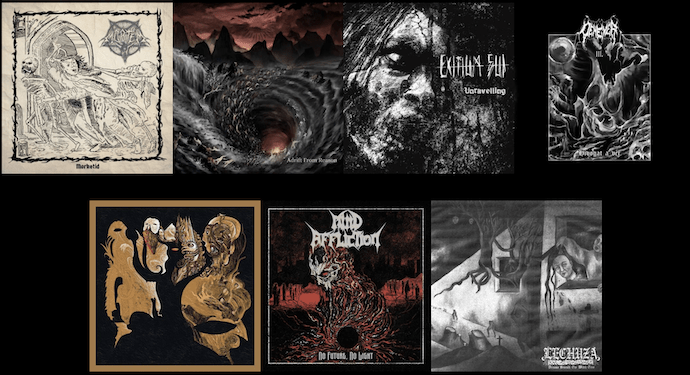
As you can see, despite yesterday being the Fourth of July, I carved out enough time to find music worth recommending today. I had made some of today’s selections before yesterday but completed the grouping while people were getting ready to make a lot of loud noises last night — or so I thought, because I made one last-minute addition this morning.
As usual, there’s considerable variance among the following songs, because I really do believe (as a long-dead poet said) that variety is the spice of life, and because black metal these days offers tremendous variety. Having said that, the first five selections and the final one all prominently feature keyboards in important roles, though they don’t sound alike either. There are some genuine head-twisters down below as well.
MORTEM (Norway)
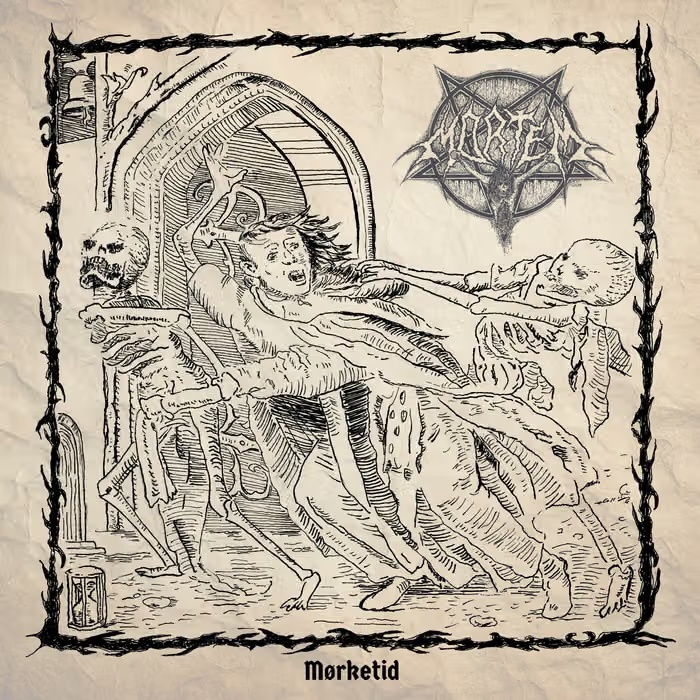
Mortem reactivated in 2018 after a long absence, released their debut album the next year, and then hibernated again. But they’re back now with another album, which draws attention because of the presence of so many black metal luminaries: vocalist Marius Vold (ex-Arcturus and Thorns), drummer Hellhammer (Arcturus, Mayhem, etc.), keyboardist Steinar “Sverd” Johnsen (Arcturus, ex-Ulver), bassist Tor Stavenes (1349, Svart Lotus), and guitarist Jamie Stinson (ex-Covenant, ex-Dimmu Borgir).
The name of their new album is Mørketid, and the title song was revealed a couple of days ago, along with a video. The song’s persistent lyrical refrain is “La alle byer brenne – det er mørketid“. Google Translate renders this in English as “Let all cities burn – it is dark time”. Further searching reveals that while “mørketid” may literally mean “dark time”, it refers to the polar night that descends in Norway’s far north during the deep winter months.
However, Mortem’s song isn’t about the season, but uses “mørketid” as a metaphor for something worse, which the video makes clear through its collage of documentary footage of people waging war against each other. After an eerily whispering start, the song itself sounds like modern mechanized warfare — drums and bass firing like massed artillery, guitars blazing and maniacally swirling, a voice screaming the combatants forward.
When the drums slow, a high-flying melody both expands the song’s scope and layers it with a blanket of sorrow. And then, as chords imperiously surge, keyboards unexpectedly grab attention with wailing flute-like radiations, brightly dancing piano notes, and mysteriously ringing tones.
As the vocals continue shrieking and snarling, the music continues evolving, rendering sensations of chaos, distress, mystery, and mourning, accented by some prominent bass-work and the reappearance of those contrasting keys.
Mørketid was released last Friday by Peaceville Records. I’d like to tell you more about the album as a whole, but I haven’t yet had time to listen to it. However, the whole thing is now streamable at Bandcamp – so avail yourselves!
https://peaceville.bandcamp.com/album/morketid
https://www.facebook.com/mortemnorway/
SOL SISTERE (Chile)
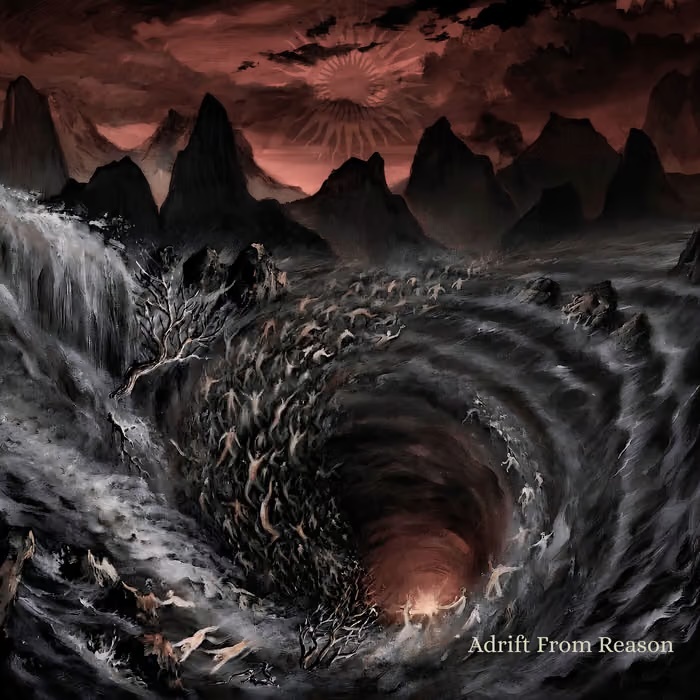
Next up is a two song EP named Adrift From Reason by the Chilean band Sol Sistere, whose music I’ve been recommending since 2016, including their self-titled third album released in 2021 (their last release before this EP).
The first of the two new songs, “Chasm’s Oddisey“, immediately sears and majestically soars, furiously batters and creates grand waves of symphonic sorrow. Grit-edged growls, deep roars, and tormented screams appear as the drums slow, and the music reaches crests of nova-like intensity above urgent bass-throbs, but also descends into troughs of emotional darkness and despair.
Constant shifts in the drumming create dynamic accents, while the music mostly remains vast as it moves like enormous emotional tides. The song does include a softer and brighter interlude, albeit with dour spoken words, before the drums resume blasting and the music becomes breathtakingly panoramic again.
The second song, “Share the Decay“, hammers and surges right away. Again, it panoramically sweeps and elaborately sparkles, but the orchestral melodies create moods of tension and turmoil, like an ocean of distress washing across ruined lands. When the sonic tide recedes, opening the way for both growled words and a grief-stricken solo, the song plumbs even deeper depths of sorrow.
Howls of pain rise up, but they’re no less pained than the tragic magnificence of the ensuing musical swell. The drums boom, batter, gallop, and again provide galvanism in varying ways. You may need to take some deep breaths to recover when this ends.
The EP’s cover design is the work of Daniel Hermosilla (Nox Fragor Art).
https://solsistere.bandcamp.com/album/adrift-from-reason-ep
https://www.facebook.com/solsistereofficial/
EXITIUM SUI (Australia)
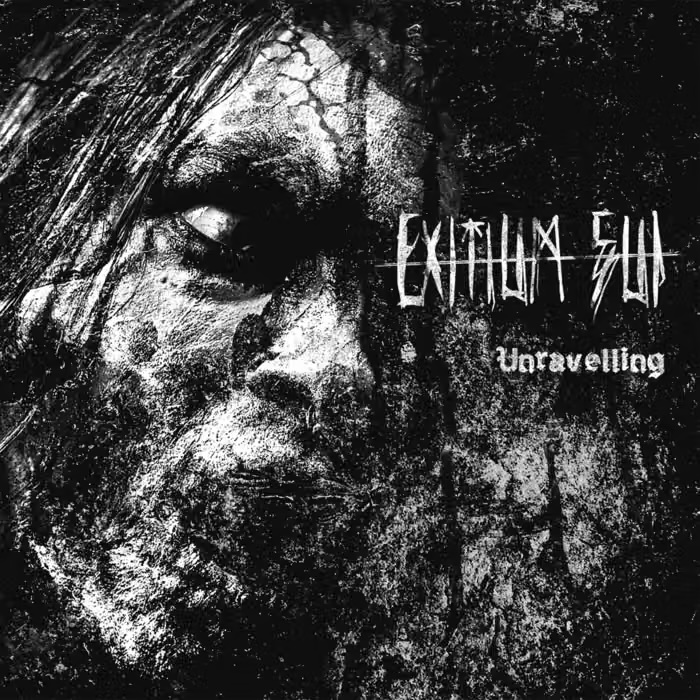
NCS favorite Exitium Sui is breaking a two-year silence with a new album named Unravelling that will be released on September 4th through Meuse Music Records. Described as a “ground shattering blackened doom record”, it features guest vocals by Drew James Griffith, a re-recorded rendition of “Until the End Hath Found Us” from the project’s debut EP, and frightening cover art by Anett Gebauer.
The new song disclosed from the album last week is a nearly 11-minute epic called “Crippled By The God-Hand“. Swelling symphonic strings and deep organ chords provide a solemn overture of sorrow, something like the music of a classical funeral mass. But no ecclesiastical choirs raise their voices to reverently bid the dead goodby — instead, as the music begins to tower, pound, and wail, we hear serrated-edge growls, tormented howls, and tortured screams. The music alone is far more than enough to sink hearts, but the vocals are utterly wrenching.
The pace moves at the slow and steady gait of funeral doom; the scale of the music is daunting; and a frantically flickering guitar flashes through the vast, heaving darkness. Eventually, the drumming does become more animated, but the enormous musical cascades begin to seem even more spiritually crushed and hopeless, and the vocals tear themselves apart in their anguish, or fury, or both.
As one might expect (and hope), the music’s terrible immensity subsides, and the orchestral instrumentation and organ chords take the lead again, but they still sound like the sonic equivalent of a death shroud. On the other hand, after that the drums begin blasting, the music sweeps and burns, like skies on fire, and the low end also pounds like big rhythmic battering rams, while the vocals pour out their final excruciating agonies.
https://exitiumsui.bandcamp.com/album/unravelling
https://www.facebook.com/exitiumsuiband/
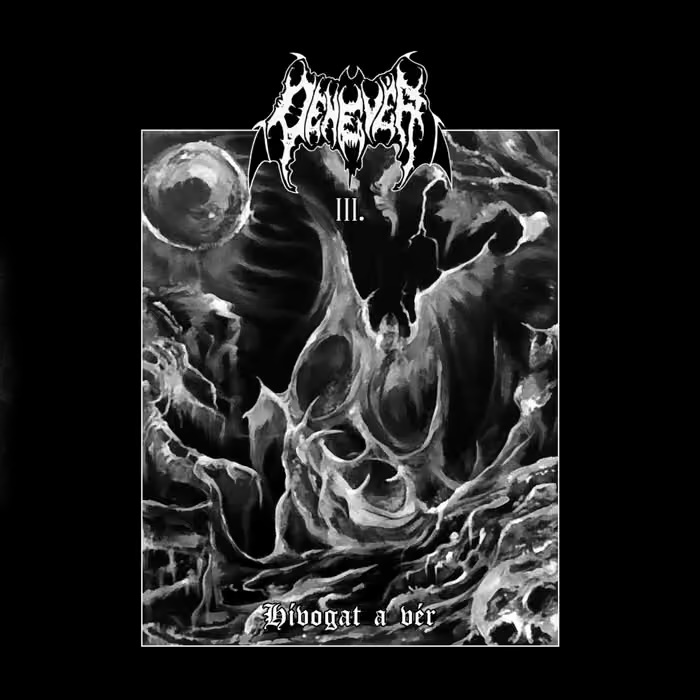
DENEVÉR (Hungary)
Now we begin a block of two songs by Hungarian bands. The first is an episode of “Hungarian Vampiric Black Metal” from the forthcoming third album by Denevér.
This song, “Az öreg temető“, has its own classically influenced orchestral overture, in which darting strings, timpanic booms, and moaning horns are prominent. Denevér then pick up that melody and carry it forward with slowly writhing and grievously moaning guitars whose tones straddle a line between abrasive and clean, coupled with rabid screams and steady beats.
All of that creates a dismal and disturbing experience, especially when the lead guitar miserably cries out like a gutted soul. Militaristic drum-beats guide the song forward into a more deranged phase created with lustfully throbbing bass notes, weirdly quivering and feverishly shivering riffage, and further doses of vocal throat-cutting.
In the next phase, all the derangement abruptly ceases, replace by a haunting gothic organ melody backed by a beefy bass-pulse, and then a surging bit of chugging riffage and witchy guitar-leads takes over, creating a sinister and occult presence at the end.
The name of Denevér’s new album is III. Hívogat a vér. It will be co-released by Pest Records (Romania) and Metal Ör Die Records (Hungary) on July 12th.
https://pestrecords.bandcamp.com/album/denev-r-iii-h-vogat-a-v-r
https://www.facebook.com/p/Denev%C3%A9r-100083364756178/
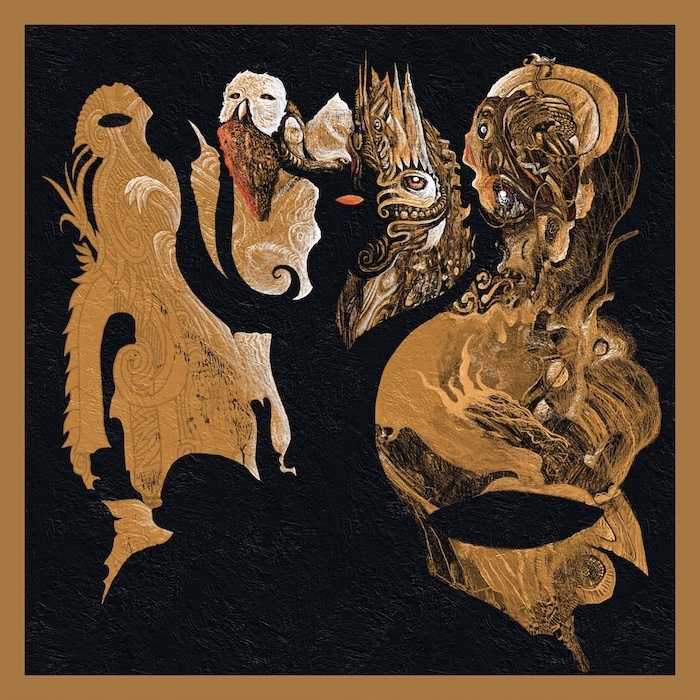
RIVERS ABLAZE (Hungary)
Now we come to the second song by a Hungarian band in today’s collection, a band named Rivers Ablaze whose fourth album Omnipresence was reviewed by our Andy Synn in one of his Things You May Have Missed columns in 2023 (he described it as “Dealing in a strain of Technical/Melodic Death Metal that’s heavy on the ‘Prog’ vibes (with a dash of subtle ‘blackening’ around the edges))”.
Rivers Ablaze released a fifth album, Internal Dread, in March of this year, and they are quickly following that with a three-song EP titled Inexternal Dread Part II: Tension. The song below is from that EP.
“Liftoach Pandemonium” gives you no room for even a quick breath at the beginning, but instead erupts in an assault of furiously blasting drums, manic bass notes, densely churning and ecstatically screeching guitars, and a mix of goblin snarls and possessed cries. Pandemonium indeed.
Crazed, dissonant tones throb; a jagged arpeggio generates menace; and as the pace slows, the cries sound haughty and the music becomes an order of magnitude more sinister, but also more despairing. Things go wild again too, sheer chaos made manifest, and the vocals are at least equally insane during that closing chaos.
Inexternal Dread Part II: Tension will be released on July 24th by Inertial Music. It forms the second installment in a planned three-part conceptual work exploring psychological collapse. The interesting cover art was made by Niklas Sundin.
https://www.inertial-music.com
https://riversablaze.bandcamp.com/
https://www.facebook.com/riversablaze/
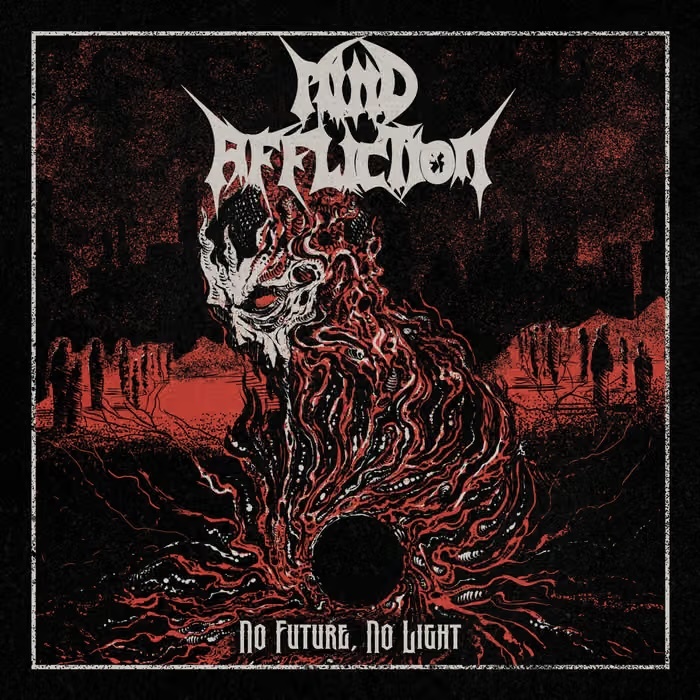
MIND AFFLICTION (Poland)
I see that Mind Affliction were formed in Kraków in 2009 and released a debut album named Pathetic Humanity in 2013, which I missed. It’s obviously been a long time since then, but Mind Affliction are set to release their second album, No Future, No Light, next month.
The new album’s first single is “Awakening“, which we might interpret as what the band are doing after such a long absence. Like the immediately preceding song by Rivers Ablaze, this one immediately storms, with drums thundering, the vocalist roaring, and the guitars generating a dense and scathing churn.
But very quickly, the lead guitar also strangely quivers and manically squirms, creating an idiosyncratic and clear-toned strangeness in the midst of the hostile vocals (which not only maliciously growl but also rabidly bark), the sandstorm abrasiveness of the riffing, the neck-cracking impact of the drums, and the gut-slugging force of the bass. The lead guitar also flies off in an ecstatic solo before continuing to strangely squirm, shiver, and squeal.
On the one hand, the song is patently vicious. On the other it’s quite peculiar, and yet it’s the music’s peculiarities that make it so memorable. All those weird guitar machinations wormed their wriggling fingers into this listener’s brain (and perhaps that will happen to you too).
No Future, No Light will be released on August 21st through Via Nocturna.
https://vianocturna.com/mind-affliction-no-future-no-light-cd-p-2410.html
https://vianocturna.bandcamp.com/album/no-future-no-light
https://www.facebook.com/Mind.Affliction/
LECHUZA (U.S.)
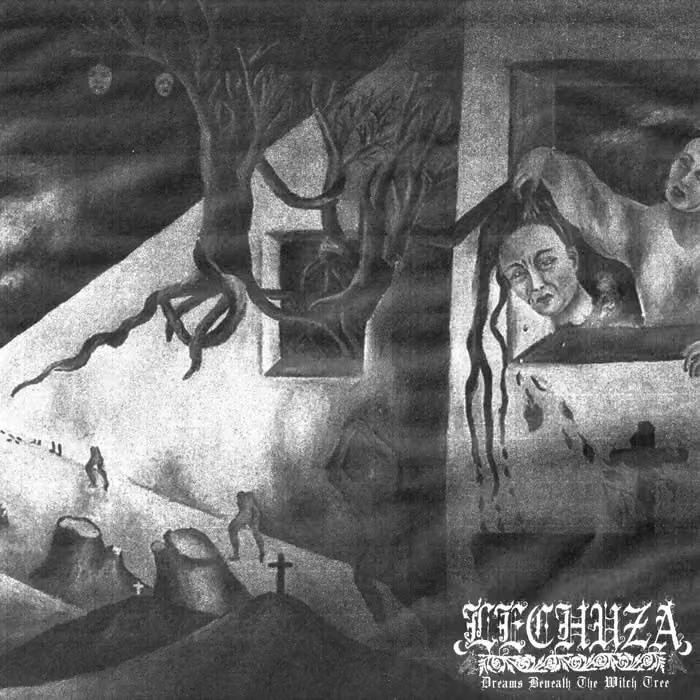
Now we come to that last-minute addition I mentioned up at the top. It’s a debut EP (though it’s roughly 35 minutes long) by a band named Lechuza from the South Texas border town of Brownsville. It’s the solo work of The Hermit Witch, and the EP’s name is Dreams Beneath The Witch Tree. Here’s how one of the band’s labels (Rabauw) describes it:
Lechuza is raw black metal born beneath a merciless sun and awakened beneath moonlit skies. It is the sound of abandoned missions, dying rivers, windswept cemeteries, and the ancient folklore that still stalks the night. Here, sorrow is a sacrament, silence is devotion, and isolation becomes communion with the unseen.
This is the sound of desolation. The sound of sorrow. The sound of folklore refusing silence.
The EP’s four long songs are simply identified as “Sueño I” through “Sueño IV“, and they’re best heard straight through.
Lechuza introduces itself in that first track with a dose of feedback that’s both ear-piercing and grim, both momentous and afflicted, and then the drums start racing, the riffing burns like wildfire, and the vocals cut loose in ruinous screams. The drums also march, and the music darkly heaves as well, creating an atmosphere of dark grandeur as well as incendiary extravagance. Those dark heaving chords, sounding almost like big brass instruments and massed bassoons, become a hook in the midst of the flagrant, firebrand nature of everything else.
But the first track also reveals Lechuza’s songwriting dynamism, as the intensity drops and shimmering keys provide the pastoral backdrop for a subdued (and sorrowful) acoustic guitar melody and brightly ringing reverberations. Of course, the music will escalate again, and when it does, it towers and strides like a giant. It also brutishly pounds, vibrantly races, and blazes like a celestial event (with those deep tonal hooks returning as well, along with avalanche-strength percussive accents).

Stylistically, and in its ingredients and variations, “Sueño II” is closely akin to “Sueño I“; it does include aspects of raw black metal (especially the vocals), but at least equally it’s symphonic, monumental, and knife-sharp in the piercing clarity of its lead guitar frenzies; it reaches dark depths of desolation but also sounds like the soundtrack to skies on fire; its final notes are sultry and beautiful.
Without dramatically altering the ingredients, “Sueño III” is initially more in line with traditions of depressive black metal, the most mid-paced and most heart-breaking of all the four tracks. Unless I’m mis-hearing, there’s also some distressed singing in the mix of this one. But the song becomes very disconcerting and unnerving before it ends, like a flaring of psychosis; and it includes moments of haunting beauty, including a strummed acoustic melody with flute-like shimmers behind it at the end. I think it might be the most impressive of the four songs.
“Sueño IV” seems to flow over from there, beginning slowly with a melancholy acoustic folk melody and ethereal ambient backing; Lechuza also dials up the intensity, like a flash flood in a desert ravine (and maybe there’s chant-like singing in this one too?); a trilling lead-guitar melody channels yearning and heart-ache; bounding beats, crackling fire-bright guitars, and savage roars stir up the blood.
All in all, this is a very impressive first effort by Lechuza, equal parts fierce and atmospheric, highly combustible and haunting, elaborately monumental and lonely in its grief.
Dreams Beneath The Witch Tree was released digitally by a new label called Infernal Sanctum and on tape by Rabauw on July 3rd. The cover art is a painting by the Mexican painter Maria Izquierdo (1902-1955). My thanks go to Rennie from starkweather for putting the EP on my radar screen.
https://lechuzadwells.bandcamp.com/album/dreams-beneath-the-witch-tree
https://rabauw.com/products/lechuza-dreams-beneath-the-witch-tree
https://www.facebook.com/rabauw1748/