
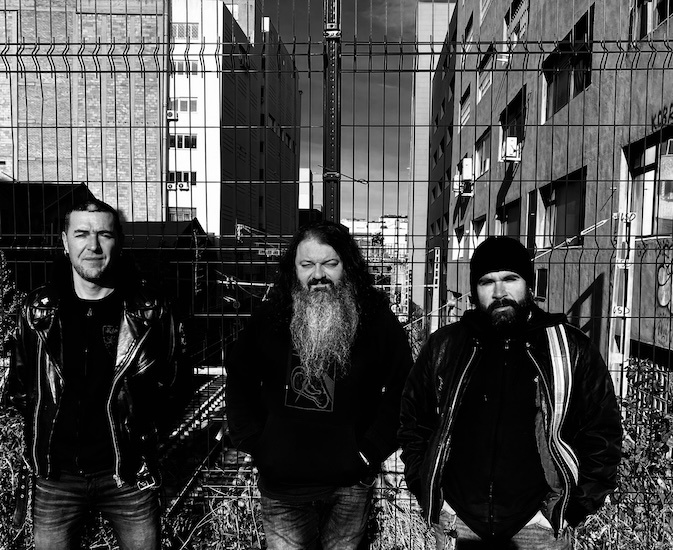
(Comrade Aleks has brought us a very good interview with guitarist/vocalist Emilio from the Catalan death/doom metal band Bocc, whose new album Demolarium will be released in just a few days by Night Terrors Records.)
While all members of the Barcelona trio Bocc had previously gravitated toward different sorts of extreme metal (some dabble in sludge, others in death metal), in 2019 they came together in a single, pernicious fervor and gave birth to a blood-soaked death-doom monstrosity.
You can tell from the cover of their second full-length album, Demolarium: the Catalans eschew the sentimentality of melodramatic doom, embracing its uncompromising, destructive, yet musically savvy expression instead. Bocc would be a good match for bands like Autopsy, Cianide, and Coffins, if you’re looking for references, but their sludge-laden, uncompromising base and vitriolic aggression adds variety to the sound.
This fact might be considered curious, given the brutal roar of Bocc’s frontman, but the lyrics are written in Catalan, and their themes are historical, mythical, and folkloric. The vocal delivery negates this merit – the lyrics are impossible to decipher. And that’s one of a few reasons why we got in touch with the band.
******
Hi Bocc! How are you? What’s new in the band’s lair?
Hi Noncleansinging! First of all, a very big thank you for the interview! This is Emilio (guitar and vocals), spending a few days on holiday in the north of our country, Catalonia.
Okay, glad to talk, Emilio! First of all, BOCC! Such a name! What does it mean? What did you put into it?
The name means “goat” in our language, Catalan. In fact, it’s “boc”, and we added a second C to the word because we thought it looked cool. It’s like the Ö in the Motörhead logo, something like that.
Why goat?! Is it about satanic or heathen stuff? Or does it keep a vibe of the countryside?
It was an idea from our first singer. You know, goats are closely associated with metal, and they rule! But no, there are no satanic intentions behind the concept.
Emilio, the band was formed in 2019. What was your original vision back then? Did you aim to play that macabre death-doom thing with lyrics written in your mother tongue from the start?
Yeah! The vision for Bocc’s sound has always been the same: to make some kind of raw death-doom metal with a strong crust-punk vibe as well. At the beginning, we wanted to make something like the “C” side of Coffins’ Buried Death record. And, of course, we wanted to talk about horror and other topics, like politics and class struggle, in our own language, dealing with things that are closer to us.
Who else besides Coffins impressed you in those early years? I see the point why you mention them, but it sounds like you have even more guttural and harsher influences.
I think the original idea was to sound like Coffins, but with other influences as well, like Autopsy, Obituary, Winter, Corrupted, Cyanide, and lots of sludge bands.
All of you play and have played in a bunch of local bands, and most of them are extreme as well. How would you sum up your experience besides Bocc? How deeply involved are you in the Spanish underground?
We have played with a lot of underground Spanish and Catalan bands. As you say, we are very deeply involved in the Spanish underground. We think there are a lot of very good extreme metal bands in our country, both in Catalonia and in Spain. You have to check out bands like Balmog, Tort, Osserp, Udol, Assot, Cruz or Avern, among many others.
Then, for a start, which of them have new recordings this year?
Balmog released an LP called Laio on War Anthem Records last year, and it’s great. Tort released their fourth LP, Domonis de la selva negra, last June on Discos Macarras. Avern will release their third full-length, Unique and Eternal, on Hell on Earth in a few days, and Osserp are putting the finishing touches on their brand-new EP, which I think will be released this autumn.
From the very beginning, Bocc has followed this underground aesthetic of putting out a lot of mini-releases: singles, splits, EPs, and so on. Do you see it as something necessary? A sort of sign of constant movement or something like that?
We love the spirit of punk rock in this sense, and also the grindcore scene. In that respect, we think we are a very punk-minded band, and we love sharing records and projects with other bands. Since 2019, we have recorded two LPs, three EPs, two splits, and three demo tapes, as well as appearing on two compilation albums. Check out the Noxious Ruin tribute to Finnish death metal — it’s great!
You know, we love doing things the old way, like they did in the early days of death metal, back in the late eighties and early nineties.
You’re all experienced musicians, yet how do you see the band’s progress on Demolarium compared with Dolça Mort en els Llims del Rec Comtal? Which edges of Bocc did you polish and sharpen?
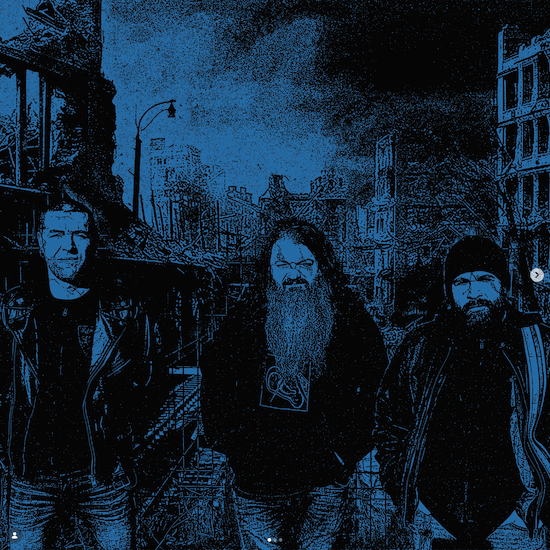
There has definitely been a change in the composition process on Demolarium compared with Dolça Mort, because the lineup is different. Back in 2022, we were a four-piece band, and now we are three. Only the drummer, Sergio Linares, and I are still members of the band. Now we have Andreu with us on bass and vocals, and we have a different approach to composition.
The spirit is the same, but we think the songs are much more elaborate now. Back then, we had only one singer, whereas now there are two of us, so that is another important difference.
How would you describe Bocc’s spirit? What kind of emotions and intentions do the band put in as an expression of your artistic will?
I think we are a death metal band with a lot of influences from the punk, hardcore, and D-beat scenes. It’s some kind of meeting point between metal culture and punk culture.
What requirements did you have for the new songs? Did you aim to get a live sound in the studio? Or did you spend as much time as needed taking care of the nuances?
In the studio, we always have the idea of recording with a very well-produced, live-sounding approach. In fact, around 70–80% of the album was recorded live in the studio, with the three of us playing together, without a metronome. After that, we added another rhythm guitar, the overdubs, solos, and vocals.
Our producer, Gerard Porqueres, has this idea that if you want to record a band, you have to let them play together and try to capture that. His approach to recording is similar to that of producers like Andy Wallace or Steve Albini, among others, and we love it.
Did you have any disputes with Gerard regarding his approach? Do you have an experience of producing music on your own?
Not at all! We trust Gerard’s work one hundred per cent. I think he is one of the best producers we have in our country. He understands what kind of band he has in front of him and knows how to capture its sound. Our previous releases were “produced” by ourselves, and in a way Demolarium was co-produced by Gerard and Bocc, but we don’t really know much about engineering and that side of things.
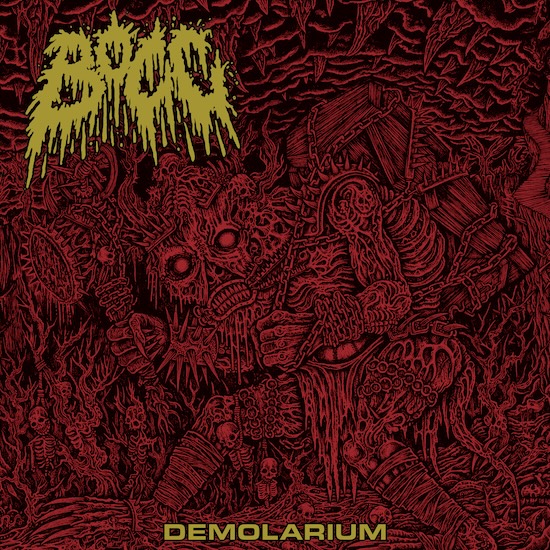
The Demolarium artwork really strikes! It’s powerful, brutal, and expressive! How did you pick this one?
Thank you! As with almost all of Bocc’s albums and EPs, it was done by Narcís Boter Jaume (@demonomania666), an amazing artist and a good friend of ours. The cover is inspired by Dante’s Divine Comedy, specifically Inferno, and the monster you see is some kind of punisher of condemned souls.
You use Catalan lyrics in your songs, and it’s… you know, it’s a double-edged sword. On the one hand, it’s usually difficult to understand extreme-metal lyrics regardless of the language they use; on the other hand, it’s always interesting, it adds an extra layer to the music, and it seems that some bands care about conveying their ideas to a certain audience or proving their identity. Why don’t you use English in Bocc?
We have used Catalan since the very beginning of Bocc as a natural thing for us. You know, Catalan is our language, and it is very important to us. It’s easier for us to express our thoughts in our own language, and it is also a political decision.
We want to sing death metal in our language rather than using other major languages like English or Spanish. We think there is a small but growing tendency to use languages other than English — think of bands like Undergang, among others. We love American and British bands, but we prefer to sing in our own language and translate the lyrics into English in the record insert so that everyone can understand them.
Your lyrics are based on “the history, folklore, myths and macabre events of Catalonia and Barcelona.” Could you tell us about the songs on Demolarium and their context?
This is definitely our most political record to date in terms of its lyrics. The songs on Demolarium deal with oppression, class struggle, suicide caused by capitalist society, prison… There is more horror based on reality this time, rather than the earlier lyrics, which were more deeply rooted in the Catalan folklore horror tradition.
Any specific historical reference regarding Demolarium songs? And why did you describe this collection of stories with a “demonic” definition?
“4227” is based on a philosophy book by Catalan philosophy professor Laura Llevadot. 4,227 was the number of registered suicides in Spain in 2021. The song tells the story of a girl who decides to take her own life because she can’t cope with the harshness of this world any longer.
“Ànima d’acer” (“Soul of Steel”) is based on a true story. It tells the story of a man who works in a foundry. He falls into the molten steel and, in a macabre sense, becomes part of a steel beam himself.
“L’escorxador” (“The Slaughterhouse”) is based on the book of the same name by Lluís Riera. It tells stories about working-class people in our country — addiction, love, pain, and death — in a very realistic way. It has a kind of Joel and Ethan Coen vibe, but set in Catalonia.
All the songs are about horror, but real pain and real horror — not Lovecraftian stories or things like that. Hell is here, on Earth, close to us.
You also highlight your anti-fascist views. What do you mean by this statement? How does fascism act nowadays in Spain? Or do you mean the EU in general? Do you see it as a real threat now?
We think we are at a point in history where it is absolutely necessary to say that you are antifascist. In Spain, as in the EU or the States, the rise of neo-fascism is a real and serious problem, and we want to fight against it.
Metal music is full of right-wing bands, labels, and festivals, as well as full of people who claim to be “non-political”, and we think it is very important to say no to these attitudes. Metal needs to go back to the attitude of bands like Bolt Thrower, Sepultura, and Napalm Death, and say clearly, with one voice, that there is no space for fascist and Nazi scum in our culture.
Isn’t fascism just a special case of capitalism? Which ideology may oppose it?
Fascism is a consequence of capitalism, without a doubt. The only way to deal with it is to smash it, and it is very important to expose people who say they are not fascists while collaborating with or protecting fascist attitudes.
How do you see the possibility of promoting the new album with a series of gigs? Do you have enough opportunities to perform live when and where it’s necessary? How do you organize this aspect of Bocc’s live activity?
Yeah, we are booking a lot of dates for this year and next year with our mates Osserp, with a co-headlined tour. We will play in Catalonia, Spain, and southern France, and we are trying to arrange some gigs in Central Europe and maybe Britain as well.
It is sometimes difficult for us to play in Europe because Catalonia and Spain are in the south, far away from Central and Northern Europe, where metal is more important than it is here. But we want to give it a try!
There are some festivals too, like Castelehell, with Dead Congregation, Galvanizer, and Benighted, among others. We can’t wait for it!
What are your plans for the rest of 2026?
Play live to present Demolarium — and survive it!
Sounds like a proper plan! Thanks for the interview Emilio! Did we skip something important?
Thanks to Noncleansinging for this in-depth interview! We’re very honoured to answer your questions. And thanks also to everyone who has supported us over the years!
I appreciate any band with anti fascist views, I’ma check them out based on that alone. They do have an awesome sound, too, perfect mix of sludgey guitars with osdm influence. Death/doom is becoming a new favorite metal type for me nowadays.