
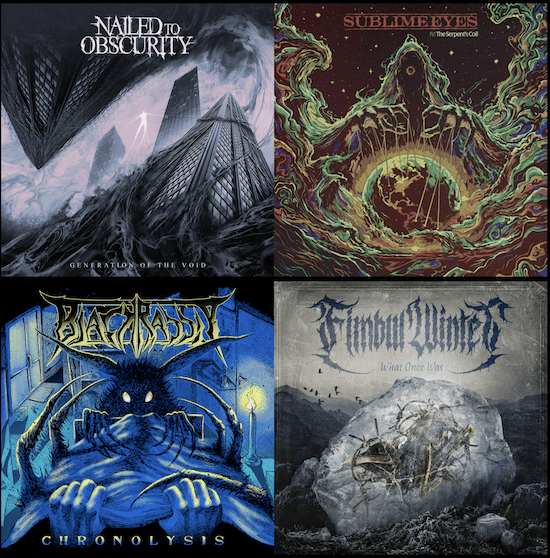
(This is the third Part of what projects to be four record-review collections by DGR — collections of multiple reviews that are shorter by his standards than what you usually see from him — all of them intended to clear his slate in preparation for his year-end lists to come.)
Just four albums after the shovelfuls of music you’ve been flinging at us already? What sort of madness is this?
At one point I swear I had a theme going for this particular grouping of albums. I cannot for the life of me remember what that theme was. I think at one point it was just me archiving September releases but that fell apart quick. The other was an attempt to cover bands that’ve been long-running but have somehow not found much footing here at the olde’ NCS cliff wall, but that too kind of hit a snag.
Finally, the ever-constant moving cogs of the metal machine assured that releases would shift back and forth and my review archive would soon resemble a crayon box after an attack by a toddler. An interesting swatch of color all splattered around places you don’t necessarily want them to be. Thus, as Part three of four, my inevitable “organization can get fucked” mindset finally kicks in. Ballast must be launched, otherwise this review boat is going down.
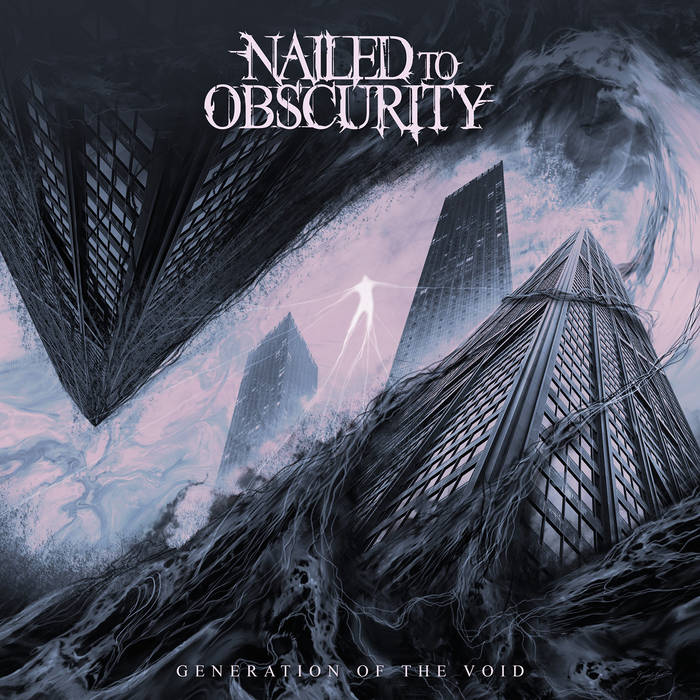
Nailed To Obscurity – Generation Of The Void
Considering that we have been in the orbit of Germany’s Nailed To Obscurity before, it is interesting that we missed out on the group’s most recent disc Generation Of The Void, which arrived in late September. I had snapped the thing up as an album to look into as a September review to help keep the site going while we were off gallavanting around but somewhat sort of expected it to have appeared by now. Perhaps we have not trained our writers enough to think exactly like me, so that I don’t have to do anything anymore just yet. It’s a project I’ll have to keep in my back pocket as we solemnly march into 2026.
Maybe it was the fact that the group’s mad-scientist combining of doom and melodeath into the joyous hybrid that groups like Insomnium have long mined is a hard sell in the beginning of September for those of us Northern-Hemisphere dwellers who are caught up in the ass end of summer. Not that it has ever stopped us before; I’ve reviewed Euro-doom albums before in the hopes that I can conjure up enough frozen lakes, bleak skylines, and snowy mountains that the 100+ Fahrenheight days will stop.
Nailed To Obscurity are a long-running band by this point, having existed since 2005 and bearing five albums to their name. There’ve been some extended gaps in the release schedule – as evidenced by their most recent album laying six years after the last one – so it isn’t uncommon to see four-to-five-year gaps for the Nailed To Obscurity crew in an overall time line. In fact, the distance between 2017’s King Delusion and 2019’s Black Frost is probably more of an outlier for the band than anything by this point.
As one might expect with our more melancholic European brethren, Nailed To Obscurity have delivered us a decently-weighty album with Generation Of The Void. It punches in at around fifty-five minutes of music and ten songs. Two earlier released singles, “Liquid Morning” and “Clouded Frame”, find their way into the lineup alongside eight other songs to round out that aforementioned ten. Mostly we hover in the deep five-minute range except for one epic that we’ll touch on that sails well over eight. The format here has a comforting sense of familiarity to it, and Generation Of The Void does a solid job demonstrating that the reputation is well-earned also, because Nailed To Obscurity, at five albums in, are criminally good at executing upon their established blueprint.
Generation of The Void opens strong with the three-pack of “Glass Bleeding”, “Liquid Morning”, and “Overcast” leading the charge. Granted, “charge” may not be the best word for it but the in-between melodic death metal “fast” and the heavy, ponderous steps of “doom” that many of these bands have found, wherein they are splitting the difference between a proper circle pit and a mid-tempo chug, has always been difficult to pin down. You hate to be one of those old men declaring “I’ll know it when I see it!” but this is one where, trust us, you’ll know it when you hear it.
“Liquid Morning” has been around for some time now, having floated around in single form – like mentioned before – but finds itself revitalized and fitting well in compact form with six-minute-plus songs surrounding it. “Glass Bleeding” does a great job laying out the foundation of the album, and “Overcast” does well with expanding the directions that Nailed To Obscurity could travel in over the course of the fifty-five minutes you’ll be spending together. It also helps that the song does some early prep work for the true behemoth in the eight-plus minute journey that is “Echo Attempt”.
If you had us picking highlights from throughout Generation Of The Void, “Echo Attempt” would be in the mix and not just for being the titanic song among the more reserved collective of four-to-five minute songs, but also because it’s a good example of the two wider moods that Nailed To Obscurity are blending together to create their sound. “Echo Attempt” would be on one end of the pole and opener “Glass Bleeding” would likely be on the other.
There’s temptation to put “Clouded Frame” in that mix as well, but it’s a song whose familiarity from having been out in the wild since 2022 might find it being shuffled to the side slightly in favor of “Allure” or “The Ides Of Life” – which is an excellent closer – if you were purely picking a song to have an even spread from the back half of the album. That’s not to discount “Generation Of The Void” in song form either; it’s one of those where upon hearing it you understand why the band chose it as the title track, but it finds itself in a weird spot with “Echo Attempt” arriving just behind it and so it becomes the vanguard of the closing half of the first part of the album. It catches fire from two different directions and may not have been the one that wanted to be in that spot.
There are many moments across Generation Of The Void wherein Nailed To Obscurity come across as truly inspired. It can be hard in a genre such as this, which has so many acts to choose from, to stick out, but it seems the long-running career – its various fits and starts included – and experience that Nailed To Obscurity have come to their aid. Generation Of The Void is filled with excellent genre-faire for the melodeath and doom metal hybrid lover, perfectly melancholic and dramatic at times and just as good at wrapping an excellent guitar riff around a powerful double-bass roll.
The amount of headbanging moments is a little heavier on the scale than the truly pensive on Generation Of The Void, but like referenced earlier, as the band oscillate between the album’s two overall polar moods and into their own middle ground, Nailed To Obscurity do well on the journey. Songs blend their various inspirations and genre tropes together so well that even a sense of familiarity takes a back seat. Generation Of The Void is a great example of the melodeath and doom combination and why it seems to persist for so long amidst the wider heavy metal world.
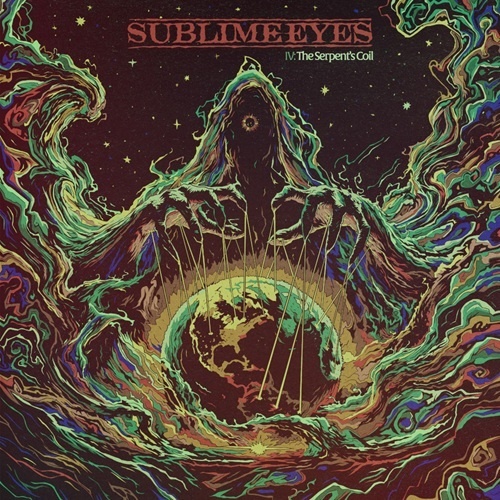
Sublime Eyes – IV: The Serpents Coil
You may note the center of this collective for a few reasons, and it is likely subconcious on my end, but at the time of this writing we are running a lot of album reviews and premieres wherein the main cover art and a lot of the press photos are entirely in black and white. Without context and stumbling upon the site for the first time you’d think the world of heavy metal and tripped and fallen face first into a nostalgic movie flashback. Hence, why some of these albums called out to me just by having their album arts being these gigantic blasts of color.
The universe’s equilibrium pendulum must swing from one end to the other and so too will it be done when it comes to some of the artwork scrolling past our patrons here. Well, that and the long-running theme of these releases coming out in May and September of this year, as there is ever more evidence across these features of just how many albums I was looking into writing about for people to help keep the site going while we were traversing the planet.
Sublime Eyes have scrawled out a weird space all their own along the course of their career. The keyboard-heavy sway and melodic death metal mix has been a strange one over the years and they are one of many bands who have sought to make it all their own. It’s not too difficult to imagine many of these groups winding up with too much of one, not enough of another, and the result usually has people looking to those projects as being great entry points to the genre as a whole.
Sublime Eyes ostensibly occupy the area of melodeath mutation that aims for the epic grandeur but the result is more diluted on IV: The Serpents Coil in favor of a lot of grooving metal in the mix. If you’re digging for the classic Gothenburg two-step or the high speed wind of razors guitar dive bombing and battle for glory leads that might come from the genre, you’re likely to struggle. Sublime Eyes mix their elemental bits with abandon and the final result is an organic genre-mix that sounds like them. The heaviness is less one dimensional and overt and flavored more subtly.†
†In the case of IV: The Serpents Coil, Sublime Eyes are often using it to create sinister atmospherics, such as in “Venomous Curse” wherein the band are awash in effects that make it seem as if they are emerging from a wormhole in space.
It isn’t the introductory “Venomous Curse” that seems to have this album in its thrall though; if you were asked to pick the song which the album seems to coil itself around, it would seem to be “Inferno Begins”. The song’s five and a half minutes hammer out the foundations of the album’s near forty minutes far more than “Venomous Curse” does at its opening. “Venomous Curse” gets the honor of being the introductory adrenaline rush and atmospheric showpiece and then “Inferno Begins” takes that initial impression and begins to forge it into the form which most of the album takes.
You’ll hear traces of the latter song over and over again throughout the album, even as it carries into the shorter “Wrath From The Sky” and “Pray For Death”. Some of that could be credited to the amount of work both of Sublime Eye’s guitarists are putting in as they let their lead guitar and solo work soar across multiple songs, but also vocalist Arvid Tjelta has a very distinct yell and sticks close to it for the entirety of this album. You’d be hard pressed to feel like you’re listening to anyone else with the sort of throat-rending yelling that some of the songs have on top of them. At least there’s a quick breather for him in “Echoes”, which is two minutes of haunting instrumentation before we kick back into gear on “Emperor’s Mountain”.
It is fitting at least that the titular “Serpents Coil” song has a lot of fire beneath it. Up to the halfway point of Sublime Eye’s newest issuance it would seem that the group had found a home in massive groove and epic swings between atmospherics, suitably heavy and with scaffolding constructed around each song consisting of some hefty double-bass work. That heavier-than-hell groove does come at the cost of the four-to-five minute songs feeling a little lengthier than need be at times, with the rotating mid-tempo making each high-speed moment feel like a blessing from above.
“Serpents Coil” starts off at a spring and stays there for most of its run time and it shows that Sublime Eyes can kick a lot of ass when they pick their feet up – it’s no shock then that they do so again in follower “Cast Into Hell”. It might not be a case of less is more but Sublime Eyes do have the guitar-driven melodeath part of their formula down to a science.
An array of backing keys for ominous atmosphere in tow, IV: The Serpent’s Coil is a suitably dense album. Sublime Eyes manage to make four- and five-minute songs sound much, much bigger than you would expect, and do so by using every melodeath – and the occasional black metal – trick of the trade available to them. While the wider work sounds like a descent from space and into the depths of hell, each particular song across the album is suitable for a melodeath ass-beating. There isn’t quite as much much “forward into battle!” gallop as you might expect from some of these riffs; Sublime Eyes instead use a lot of heavy chug and groove to propel this album onward, but the moments in which the old and classic circle-pit segments fire up still hit just as hard as if Sublime Eyes had decided instead to make an album full of those.
IV: The Serpent’s Coil is an interesting journey beyond basic genre hybridization for Sublime Eyes. Part of the joy of listening to it can come from hearing how the band are attempting to break from the pack and then just as quickly showing that they’re just as good as “the rest” are at the very throughline of the genre. IV: The Serpent’s Coil is a solid forty-minute spin worth undertaking if you’re looking to adventure further into something more grandiose than the entry gates of extreme metal.
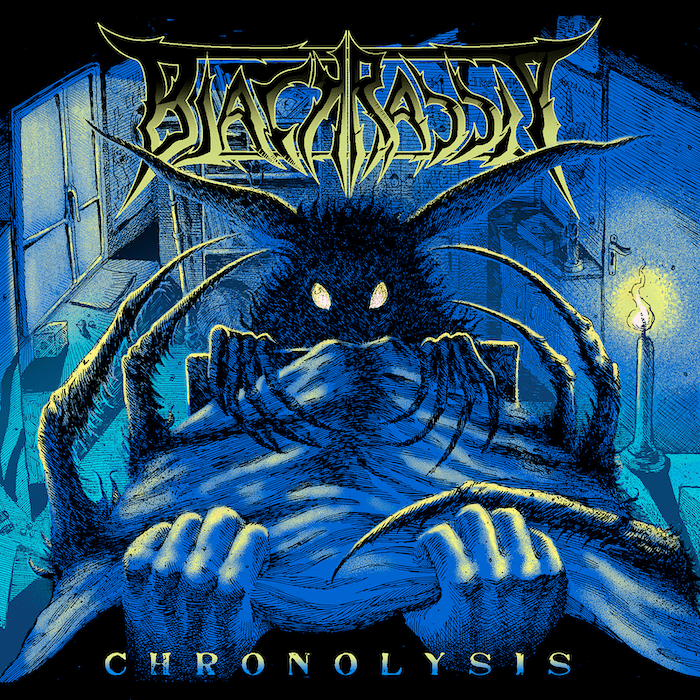
Black Rabbit – Chronolysis
Why not let the ghost of April pop up in this feature at least once. We’ve let May and September hog the spotlight a few times by now, why not continually remind ourselves just how surprisingly heavy the glut of releases that hit during the early part of the year actually was, just one or two more times, for funsies you know? While the overall narrative of 2025 seemed to be one of fits and starts, with many groups playing their latest offerings very close to the chest, if you knew where to look or were brave enough to just launch yourself head-first into a few musical rabbit holes there was still plenty to find.
Death metal with a taste for thrash – by way of that sort of early death metal combination wherein it seemed like many bands wanted to be thrash bands but couldn’t help be way, way heavier – the group Black Rabbit are a known entity around the No Clean Singing halls, so once again – much like we did with their Hypnosomnia release – it is surprising that we have taken so long to get around to their new record. At least this time I can chart it up as a personal failing because the early April release of the group’s EP Chronolysis was one that I had snapped up for the big May backfilling of the site and then kept getting distracted from it, like a cat in a room full of laser pointers.
I do this full well knowing that the group even have a newer EP entitled Warren Of Necrosis – sharing the same name as their first demo – that was just unleashed on December 10th of this year. I intend to tackle that one as well, possibly alongside Blood Red Throne’s new one, because alliteration is fun. We just need to get through all of this first.
Black Rabbit’s conceptual adventures continue on Chronolysis, a five-song and twenty-four minute EP that continues their trend of stomping death metal and thrash riff work that is so consistently good that you can’t help but wonder why more people haven’t picked up on them. With so many bands embracing glorious knuckle-dragging idiocy and circle-pit swarming songwriting style, Black Rabbit should be riding right alongside some of the acts that have exploded in upward trajectory as of recent. That they remain something of a hidden gem is mind-boggling and Chronolysis won’t do much to assauge that feeling. You start to feel strange after a while when it seems like this has become the overriding theme whenever you’re reviewing a band. If nothing else, before we even start tumbling downhill with Black Rabbit’s Chronolysis, it should be stated that it’s worth diving into this bands discography as it is.
Black Rabbit are terrifyingly good at a few things, and one of those in particular is the sort of hammer-drop riff wherein it feels like part of the song is written for the sole purpose of making your neck snap. It’s that sudden upturn in accelleration and aggression at about the same time, as if the song didn’t want to wait for a pivotal moment to organically build to something heavy and instead just launches into pit-broiler after pit-broiler.
Four of the five songs on Chronolysis seem like they’re constructed entirely out of that exact feeling and chief among them is opener “Malevolent Glare” – which opens with a sinister near-Possessed by way of drunken Slayer shenanigans guitar lead – before dropping into a constant percussive assault that drives the song forward as if it had a battalion behind it. “Paracusia” follows in those footsteps with a far more tech-death bent to it in some of its bent riffwork, but this is a song that quickly descends back into enough guitar chugging to make anyone satisified. “Paracusia’s” main chorus guitar parts and ascending melody make it an easy earworm too, and at four-minutes and ten seconds it’s probably the best candidate for constant repeats.
The middle two with the much more wordy song titles are fun experiments on the overall Black Rabbit sound. “Pity The Mind Of The Fail And Feeble” has an unsettling “assault from all angles” approach and at first seems more like mathematical equation than song with the way those opening segments seem to pile on top of each other. It’s impressive just how quickly Black Rabbit grab that song by the throat and bend it back to the zero-point of blank-minded dumb that death and thrash consider a hallmark. There’s not much translation work involved; at a certain point you will get the aforementioned hammer drop and its time to start spinning the whole room up again.
“To Be Alive, To Walk This Earth, That Is My Curse” is a little more ambitious – and one of two songs to clear five minutes. It is slower moving and atmospheric in comparison to the early assaults that make up Chronolysis. Quite a few bands seem to be planting the mid-tempo and atmospheric number at song four on their EP these days. That and the song having some guest-vocal clean singing make for a dynamic turn closer to the end of the EP, especially when it arrives right before the true sludge monster of “Rancid Taste Of Horror”.
By the time this review runs, Black Rabbit will have released another EP in the form of Warren Of Necrosis, and if that EP is as good as this one then Black Rabbit will have released a killer album’s worth of material in 2025. Chronolysis is Black Rabbit doing what they do best for three songs – straddling a line between death and thrash metal so fine that it just sounds like really fucking fast death metal minus the wall of blastbeats – and then taking the whole formula and bolting it together at such weird trajectories that the resulting monstrosity is both horrifying and beautiful to witness; the ratio on which one wins out is really the only huge debate.
Chronolysis is a killer EP worthy of many a circle-pit and once again it hammers the point home that although their name continues to be among the unexpected for jaw-droppingly heavy bands like this, Black Rabbit are worth the time to listen to and add to your collection.
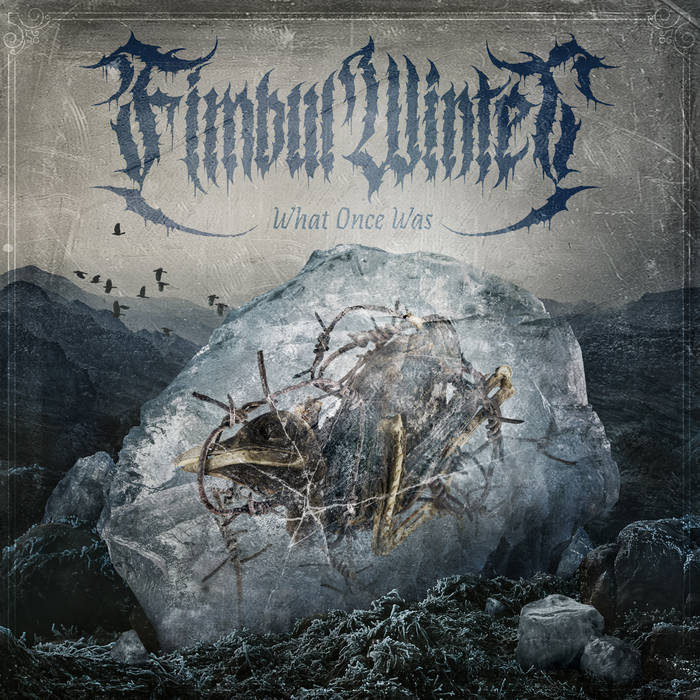
Fimbul Winter – What Once Was
Like many people I was drawn into the orbit of Sweden’s Fimbul Winter – one of a legion of acts baring permutations of the fimbulwinter name – by the previous resumes of its current members. Its hard to launch a band in general, so any sort of leg up to grab the attention of slack-jawed yokels in the valley like myself can’t be faulted too much. Plus, I’m a sucker for the melodeath genre as a whole, so the sales pitch isn’t one too crazy hard to make. Really, it would be like leaving a cardboard box at my front door with just the tiniest bow on the corner and I’d be sure to be all over it.
In the case of Fimbul Winter, its band members have been spread decently far across the melodeath world as a whole – and the wider death metal genre in general – with shared time spent in bands like Just Before Dawn, Netherbird, and for three of the four of them Amon Amarth at differing points in time in that band’s career. Fredrik Andersson in particular, spent a good chunk of his career sitting behind the kit for the former band and has kept active in other projects since, changing position to guitar alongside Anders Biazzi for Fimbul Winter.
So like we said, the past resumes alone for three of the four gentlemen here are enough to draw people in. Adding vocalist Clint Williams to the mix completes the Fimbul Winter lineup and 2025 has now seen the release of their first EP, What Once Was.
With its cover art What Once Was conjures imagery of snow and battlefields long lain dormant but musically the riffwork generates so much fire that it is like standing front-of-stage for a band that has spent their entire budget on pyrotechnics. The riffing on What Once Was is sharp and aggressive in comparison to many of its classmates these days, summoning up old ghosts from back when melodeath had some rawness to it as bands sought all sorts of inspiration from myth and legend so as to seem more than the introspective group that eventually won out the day.
This is not the pretty-boy guitar leads style of melodeath that the genre has codified into but one that snaps up quite a bit of violence from the death part of its genre-name provider. It is a throwback in that sense; when many bands are reuniting or tying themselves around to resurrecting old school death metal, and melodeath crews seem equally fit to pick a specific decade to channel in their sound, Fimbul Winter’s ear for melody arrives via the main guitar parts each time and less one “lead” player sailing above the rest. Shades of Necrophobic’s recent works haunt the rafters consistently throughout. Fimbul Winter are more battle-horde than most on their debut EP.
What Once Was opens on “Storms Rage” and you’ll near immediately recognize why it seems like we’re zeroing in on how Fimbul Winter spend their whole time spewing flames. The combination of galloping guitar riff and vocalist Clint Williams’ black metal befitting snarl makes for a fun maelstrom of sound, as Fredrik Andersson and Anders Biazzi seem to plow their way through melodic death metal staples in guitar riff form in three minutes. It is a whirlwind of a song that spills over into a more ponderous four songs that follow. Not that they’re slow, but they’re definitely beefier on the weight front as they hover between four and a half and five and a half minutes easily.
The titular “What Once Was” leans heavily into the raging “battle in the sky” guitar-style riff that “Storms Rage” used to propel itself forward. It is a driving force for much of this EP in general, but as mentioned above, this is also the main source of guitar lead work on much of the EP. You get the spotlight shined on them occasionally – a given, since it’s a guitar-heavy genre – but otherwise it’s a tag team approach to rhythmic guitar riffs with a vocalist soaring over the top of it. You could not ask for an easier “headbang you moron!” neon sign than some of the main rhythm riffs that appear in the built-for-fists-in-the-air anthem that is “What Once Was”.
“A Soul That Soared” is where Fimbul Winter slow things down. This is where the band break down into their concentric parts so that each gets its moment to shine, but it is the slower battle anthem that provides the most earworm lead melodies to hum along to. The three songs prior to it – including lead off single “Mounds Of Stones” – were all much quicker on their feet despite being on the longer side, but “A Soul That Soared” is Fimbul Winter’s swing at dynamic moments to keep the whole EP from descending into one-note territory. The galloping-horde guitar riff works just as well at high speed as it does at a more mid-paced tempo, especially when you have the drums hammering away at any opportunity anyway. Subtlty can take a brick to the skull on that front — you will be getting punched in the chest repeatedly by a double-bass pedal.
Closer “In Solitudes Embrace” brings the rumble back for a strong highlight on this EP. What Once Was iterates on one particular formula, moving in degrees to the left and right direction-wise but never fully shifting off of its Swedish death and melodeath font of inspiration. You’ll recognize Fimbul Winter’s writing approach quickly, and so trips through What Once Was are explorations of how they bend it to their will each time. “In Solitudes Embrace” uses a martial stomp for each of its choruses, splitting the difference between the slower march of its immediate predecessor and the white-knuckled falling from the sky into the storm style songs that the first three were.
What Once Was sounds like songs written to be the backing tracks to legendary tales. Many a melodeath band have made good headway into battles of mythology and tales of a frost-strewn north for subject matter, and Fimbul Winter – more obvious given the name – are well practiced in that regard. Musically they’re pulling from a massive well of fiery and head-on aggressive guitar riffs that propel this EP forward much quicker than the twenty-three minutes or so it asks of you. Many of these songs are built to lodge their way into your skull with rhythm sections and guitar leads so tightly intertwined that you’ll be humming along to one or the other before you notice it.
What Once Was is a strong first example of what this band can do with a blueprint that was forged exceedingly well and long-written, injecting life into the sometimes staid waters of melodeath. It brings so much along with it from the “classic eras” of the genre and modernizes it enough that you almost don’t notice it, save for the time where the band members’ pedigrees are clearly being put to work. The future for Fimbul Winter looks good, especially if they continue down this path, as you can never have too many “to war!” style anthems in your collection.