
(With apologies for our own delay, today we present Comrade Aleks’ very lively interview from late last year of Léon Guiselin, the proprietor of the always-interesting Antiq Records and a figure in many bands of his own. The broad focus is on his philosophy as a label curator and artist, but with a particular emphasis on the fascinating new album of his project Hyver.)
Over the past couple of years, I’ve been paying more and more attention to releases from the French label Antiq Records, run by Léon Guiselin. Antiq tends to release albums with a story behind it, and whenever I’ve interviewed these bands, the lyrics have been wonderful!
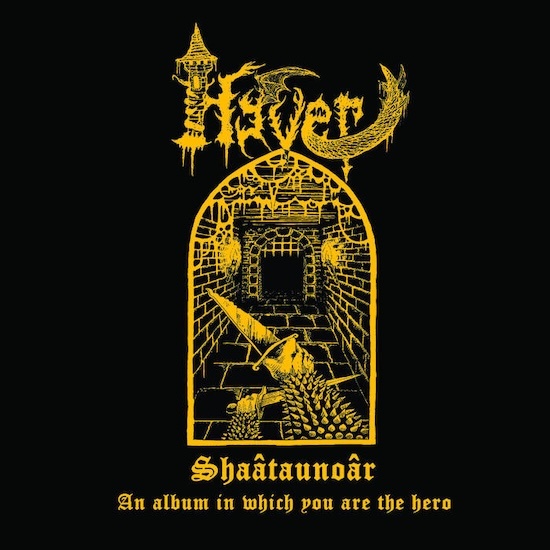
Stylistically, the label focuses on old-fashioned black metal with elements of folk and dungeon synth, which is unsurprising, as Léon himself plays in a number of projects and bands of this kind. One of his solo projects, Hyver, released a new full-length album Shaâtaunoâr in November 2025, the structure of which resembles an old computer adventure game set in a medieval setting. You even have a choice of actions! But first of all, it’s a proper black metal album with good dungeon synth layers!
We did a pretty in-depth interview with Léon in the end of 2025 covering the themes of Shaâtaunoâr, black metal in general, and Antiq itself. And I’m pleased to share it with you.
Hi Léon! How are you? What’s new on Antiq Records’ side? Is the end of the year a busy time for you?
Hi NCS! New on Antiq Records website are a lot of LP distro, and soon CDs as well. Antiq-wise, the release of Morte France, and the planning of new releases for next year. Yeah, end of the year is always a busy wrap to get the time to have everything done, and orders as well are quite numerous.
You’ve run Antiq Records since 2008, and somehow you find such original bands – it’s like if the French (and not only) underground never runs out of ideas! Is this a reason why you tend to record albums with such a unique approach yourself? In order to keep a high level of variety?
Actually at the end of 2009 the story began, to be precise! As much as the level of variety is concerned, I can’t help myself! Cannot write the same album two times. I have to find original ideas and new concepts! It’s just like this, a need for new things and new ideas! Of course, the variety of French and abroad underground surely influences me, in a way.
But at the same time Antiq Records tends to release a specific kind of music. How would you sum up it? And what kind of music or bands do you refuse to sign?
Music that tells a story and that tells it right, I would say. I profoundly refuse to release music of which the story is not complete, half-imagined, or unoriginal.
You aren’t afraid to expand black metal themes covering RPG-games, folk tales about animals, or some historical topics. Do you feel that you established black metal’s right to go beyond its satanic and Nordic borders?
I’ll answer by broaching each topic separately. Satanism: we are in a country where the Christian roots are extremely important, it’s the basic ground for all art in Europe between the years of 500 and 1950. So how can I love the tree when I would despise the roots? Christianism is more than a religion, it’s a culture, and it forged the works of art that inspire us: castles, churches, cathedrals, manuscripts, and folktales.
For many people who have only a basic education, Christianity ended Paganism and its cultural facts. If you study deep the Christian Art and Culture, and bring it into comparison with Pagan Art and Culture, you can then notice subtle references belonging to Paganism in Christian Art. Wow, there is a rooster sculpted in the entrance of a Church? Paganism. These Celtic knots sculpted in a castle of south France? Paganism sedimented in Merovingian churches and then reused as a construction stone in the castle.
I think I have made my point: I am deeply influenced by the pagan reminiscences in the Christian culture. That said, I don’t forget the presence of deviltry and the Devil in folktales. Very important clue to my understanding of black metal.
I think, to answer, that I have participated in establishing the right for Black Metal to expand its borders to themes that truly speak to the namely medieval subjects and a few other topics as you quoted.
Do black metal musical frames satisfy your needs and grant everything you need to express your ideas? Or to be more precise, it’s rather about traditional black, so to say, folk elements, and dungeon synth. Do you aim to participate in expanding not only the lyrical but also the musical borders of black metal?
No, black metal is not enough for me to express what I need to say with the label or my bands. I need a black metal ground or basis, but I need various and more influences to say widely what needs to be told. So yes, the borders of traditional black metal need to be expanded in the most interesting and expressive way, with influences that vary, and that apply to their fields. For instance I’m writing a Hyver in which bass is absolutely prog-rock in the ’70s style.
Hyver’s third album Shaâtaunoâr has a very atypical concept. We know that even Burzum was influenced by board games, but I don’t remember if someone adapted an entire album the way you did. How was born the idea of Shaâtaunoâr?
Shaâtaunoâr was originally a normal album, when it did not yet have a name. Then arrived the cover artwork that I noticed on Instagram and thought it would fit perfectly! Then I imagined the idea of a living castle, that would defend itself or try to attack the explorers. From this, I imagined the dungeon crawler would be spoken to by the castle. So, I imagined dungeon interludes. Then I thought, why would the castle speak if not for choosing the tracks where to go?
The process had begun and I was launched. So, I started making plans, I mean literal plans of the castle to see if the following of the rooms was logical. I also adapted the metal tracks according to the spirit of the depicted rooms.
After this I wrote the texts and the schemas of the arborescence of choices, and I started asking David Thiérrée and Virginie Ropars to help me with the vocal takes.
Did you already have another concept before this original one? What was it about?
No, it’s funny but the Shaâtaunoâr tracks were vacant concept-wise. Totally untold and free of lyrics. So when the concept emerged, I was delighted. And the lyrics appeared easily about each castle room with a nice unfolding of inspiration, as it should be. I was very happy with the arrival of all these inspirations. Perfectly when I was finishing the music.
How did you come out with the idea of listeners taking a choice of action during this quest? Do you still see it as a good thing after all?
Hehe, as said, it came gradually as an idea to allow the choice of actions during the exploration of Shaâtaunoâr. First to have each song for a room, and then the dungeon interludes, and then to use the interludes for instructions.
Yes, I still absolutely love the album! And I think it’s a good thing because it brought a nice originality to the album.
Indeed, it does! Don’t you think to create Shaâtaunoâr pt. II or to find someone who would create some simple PC-game based on this plot?
I was asked and suggested. I even have the inspiration in a way and there are some free Spaces to explore and find new ideas without just rewriting it all. So I guess in a time it will appear. For a PC game I would love that but I don’t know anyone skilled enough, so this is an announcement: if someone can help with it, write me!
You recorded and released both English and French versions of Shaâtaunoâr. What drove you to perform the album in both languages?
I thought it was a shame to have only a French version, so I needed an international version. In the CD, the French metal songs are explained so you get to choose wisely the path you take.
I was on the verge of making a German and Italian version too but I don’t think there would be enough customers to make it worthwhile.
Narration in the dungeon synth introductions between songs was voiced by David Thiérrée, a famous French artist who made a lot of artworks for (mostly) black metal bands, as well as for some books. Why did you choose him to perform the role of narrator?
Oh it all began when driving to the Dark Dungeon Synth Festival. We stopped at a village named La Comté, “the shire”. We had a good laugh, and I thought, “Why would not David do the French interludes’ vocals instructions?” Also I needed the vocal intervention of someone of a certain age, because the narrator should not be too young on Shaâtaunoâr. So everything looked great for him to help me with this.
You take the Shaâtaunoâr character through such locations as “Attic”, “Kitchen”, and finally, “Gardens”. Quiet ordinary places, I would say. So can you tell more about the album’s plot? Is it totally “medieval” / “fantasy” focused, or did you connect it with some modern surroundings?
The Character in fact is exploring the whole castle, choosing the path he wants for making his own progression. The interludes are a helpful and handy way to indicate the dangers and the visions in the castle. For most of the album, the Character thinks the voice indications are helping him or her. But in fact, something way more wicked is brewing in Shaâtaunoâr! I connected it with the classics of horror movies, for instance the monsters in the castle: the mummy, werewolf, mad scientist, goblin, vampire, demon, etc… So yeah, Shaâtaunoâr is fully medieval / fantasy inspired. In this album, there is no connection to modernity, whereas the next Hyver albums might see a change.
Did you come out with some special inlay designs to support the album’s vibe?
Absolutely, David Thierrée helped me with a nice illustration of most of the monsters / protagonists in the story! I absolutely love most of all the armour, because it’s on a pedestal but supposed to attack you. So how does it move? Maybe it jumps in a clumsy way, or maybe it moves scraping the ground like in a chessmate comp game. I love the way so many goofy ways of imagining it come to the mind!!
I did all the translation myself to help understand with the English version; there might be some mistakes but I prefer it than a soulless translation with AI.
Léon, you perform traditional instruments in your albums and in collaboration projects. What is your musical background? Do you have experience in folk bands like your colleague Geoffroy “le Veuzou” of Paydretz?
I have no musical background; I just started playing my music instruments with all the energy and motivation I could. Started with the guitar in 2003 and continued with flutes in 2005-6 as there was no flute player in my town. I have made some appearances in various projects; some will see the light in the coming months. Besides Grylle, I have no experience in pure folk bands. But I can quote that I played traditional instruments in various Hanternoz albums.
To answer you, I have far less experience than Geoffroy, he is way better than me, also he does not play guitar so he can focus on folk instruments.
You took part in the recording of the Cercle du Chêne album Récits d’automne et de chasse. It seems that Joanna “owns” it, but you and Stefan Traunmüller performed all instruments there. Was it important to keep it as a separate project?
Oh, we are all three part of the project. But for some reason, the Metal Archives did not take it into account and we have never tried to correct it. It was important to create a different project, because it is synth-led and does not have the same spirit as many of my other projects. Also the thematic of animals speaking the secrets of humans is very broad so it was worth starting a new project.
A year ago you also released an interesting album of your solo-project Grylle, Égrotants, souffreteux, cacochymes, covidards (“Ailing, sickly, decrepit, covidards”). Can you tell more about this work?
It’s the second full-length of Grylle and as such it is themed around one of the main events of the past years: the fear of disease. So I studied the thematics of disease in medieval literature and art to get the most precise and accurate terms as a medieval chronicles writer to depict the disease and the fear it inspired. And now, I used the lyrics to describe the disease in the most medieval way possible. I got to speak of all aspects of it, making the Grylle album a very thorough work of art: physical sickness, society’s vision of it, mental problems, the devil’s share of the soul of the dying. It’s such a broad work it could be worth an interview on its own.
It’s an interesting topic, and I know two or three doom bands that wrote albums describing their personal experience of death and disease in families, and for example there is a new album of Vigljos talking about the ergotism pandemic in Medieval Europe. So what’s it all about? Can we say that it’s a kind of adult person’s music today?
We could say it this way. Kids will just need to try with the traditional thematics when they’re starting a band. But when you grow up and your audience grows up with you, then you need to tell better stories and tell them better.
Léon, what are your plans for 2026 as a publisher and as an artist?
Now, I am wrapping up things for the coming release of Vide, an atmospherical project of ethereal black metal by H. of Le Prochain Hiver. Next is Malenuit’s second opus, a very nice piece of neofolk/ metal with extraordinary instrumentation and great vocals. Then a few other projects are coming, including mine. As an artist I must say that I’ve been active: I have now two Hanternoz albums almost ready, two Hyver albums (in the “kellersynth” genre), and four splits, and many, many more projects are ready too. One of the Hanternoz albums will release soon; it’s a great piece of dark Breton art, with an extraordinary artistic direction and much to write upon as it is a story that will speak to many. Last but not least, a new Véhémence album has been worked and it’s now ready for release. It sounds exceptional, and the lyrics are excellent!
Being a head of Antiq Records with such activity, what are your visions for the label’s prospects? Is there a fundamentally new plan that goes beyond release quantity or print runs? How far do your ambitions (and opportunities) spread?
I’m not sure I understand the question but I’ll answer the way I understand it. Yes, there are constantly new plans of releases that go behind one another. Also my expansion plans are there but quite modest, I just wish to serve the best for my dear listeners and hope that the audience spreads but not too fast.
Okay, I think that’s enough! Thanks for the interview, Léon! It was good to talk about all of these things, and I hope that we’ll have another conversation sooner or later. Would you like to add a few more things in the end?
I’m here whenever you need because all my releases always have so much to say. So don’t hesitate, of course. Thanks a lot for the interview it has been a pleasure and the questions were great; you do have a spoiled audience with such quality.
I have to add that more of Hyver is coming with deep lyrics as usual, which will make both emotions and thoughts boil in your minds and hearts! Have a nice beginning of the year, cheers!