
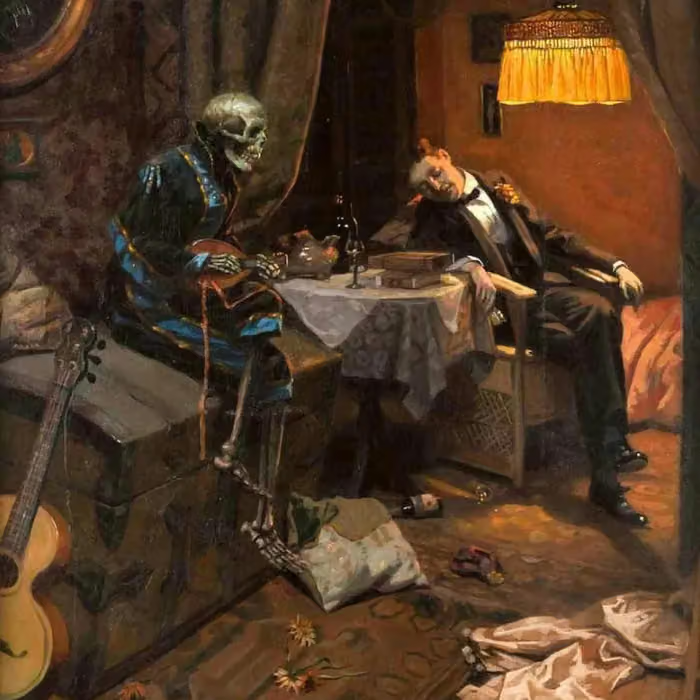
(This is DGR’s review of the swan-song release by Die Like Gentlemen from Portland, Oregon. The eye-catching cover artwork is a painting circa 1910 called “The Drinker” by German artist Erich Plontke.)
Many, many moons ago, in an era before space and time, when the world was just an idea in the eyes of the gods, we published an interview with Portland, Oregon’s Die Like Gentlemen.
That’s it, just wanted to check in and point people to an interesting interview we did about five years ago as we have some new readers on the site and sometimes it is nice to highlight the fact that we’ve been publishing stuff for a while at this point and there are plenty of rabbit holes to fall down. You can go about your day from here.
Actually, here’s the thing. While diving around the underground world and exploring music I saw the name and cover art for Die LIke Gentlemen’s recent self-titled – and apparently final – album go floating by and it must’ve re-lit some incredibly old neurons in my brain because it is one of the few times where I found myself doing the CSI detective thing of tapping the desk and going “why do I know this, why do I recognize this, why is this familiar?” over and over until I would soon discover that the primary suspect was well… us.
For some reason, be it the name, excellent choice of outfits, or the fact that I do make a valiant attempt to scroll through everything here, that previously mentioned interview for Die Like Gentlemen stuck with me enough that years later I would find myself very interested and intrigued by the group’s newest release, the self-titled Die Like Gentlemen, at four songs and nearly forty-minutes of prog-metal weird and avante-garde doom exploration at its most adventurous.

Some albums have an aura to them, that draws you in time and time again even though you’re not sure why after the first few visits. There’s an intangible and mysterious “something” that lies just out of your grasp that the brain continually wants to seek, as if you’ll finally wrap your head around it and the universe’s mysteries will be solved with just one more listen. Just as often it is, as if you’re the aforementioned CSI detective portrayed in the opening and the album’s mysteries must be laid bare before you in order to close out this specific narrative arc. Eventually after a room full of masonry line and photos pinned to walls do you feel as if you have some idea of what you’ve been experiencing.
Die Like Gentlemen’s self-titled is a combination of the two, itself a four-song tour through murder, mystery, and tragedy in about that order that is hypnotic at times, embracing sludge atmospherics and doom theatrics with enough “auteur” airs to them that Die Like Gentlemen seems like an album wherein the band were free to make whatever choices they liked and the gods be damned whether any of it made sense.
Those choices become the second factor, because not everything on this album works from a polished and practiced sense, but Die Like Gentlemen’s willingness to just “go for it” stiches everything together by the force of complete enthusiasm. Die Like Gentlemen is not a frenetic and hyperactive album in that way, but it is more the bravery to make their ideas at any particular moment that holds a song in place and keeps it from falling apart.
The album being mostly clean-sung means there is a variety of off-kilter and unexpected vocal lines and pathways to wander down, and the story portrayed on the group’s newest album is one that calls for all sorts of lyrical oddities. Yet it is that “devil may care, we are making art” attitude that can keep a listener firmly rooted in place while the band explore their three longer compositions and one midly indulgent interstitial.
We zero in on the avant-garde and prog-metal nature of Die Like Gentlemen’s latest issuance because for all the talk of them counting doom among one of their myriad genre descriptors, it is more that many of the group’s elements would fall into it as an umnbrella genre. The taste for longer songs and slower grooves as well as the fuzz-worship laying on the edges could have the band placed well within its bounds, but on their latest album they are stretching further than that.
That aforementioned clean-sung nature across the three longer songs causes the mind to race, even as things calm down for a brief moment during the band’s take on the old folk idea of “the work must be done” during “The Lawn Must Get Mowed”. Die Like Gentlemen paint in allegory and analogue for this album, and while many of the situations are remarkably straightforward – it doesn’t take long to put two and two together during “Because I Said So”, even before the band spells it out for you eight minutes in – they dress another in shadow during the near-twelve minute journey of “The Cauldron”.
In that sense, “The Cauldron” is the final unifying act of the album as a whole, as that near-twelve gives them plenty of room to breathe in their tale, allowing them to also combine everything into one massive track. You can understand why the band placed the aforementioned three-minute “almost” murder-ballad right before it, especially as it follows the boistrous and shockingly infectious “A History Of Silence”. It’s a shame the band are hanging it up at the moment because the whole vocal line and melodic hook that wraps itself around the song like a constrictor that is “is it quieter now?!” will be stuck in people’s heads for days, and witnessing it would probably be a blast.
The continued explorations outside of one’s wheelhouse have yielded a strangely magnetic gem with Die Like Gentlemen’s self-titled. While we have had a brief familiarity with them – mentioned above – it is impressive that this feels like a creation from dedicated musicians and not just a band doing a good version of what they traditionally do already. Die Like Gentlemen allow themselves a lot of freedom on their self-titled release and use it to create something unforgettable. The sonic realm they have crafted feels like it truly belongs to them, even as you could begin to break out the components and guts of what makes the machine move.
The mysterious draw of the tale being told is ear-catching enough, but the songs themselves converge into something greater, creating that much-sought-after longer journey that can tie four singles together. Die Like Gentlemen is one larger artwork rather than four separate tracks, even as they do well broken out into distinct solo tracks. The combination of so many approaches, genres, and influences into their own delightfully angular formula is enough to make their newest and apparently final album well worth the listen.
https://linktr.ee/dielikegentlemen
https://www.facebook.com/DieLikeGentlemen
https://www.instagram.com/dielikegentlemen/