
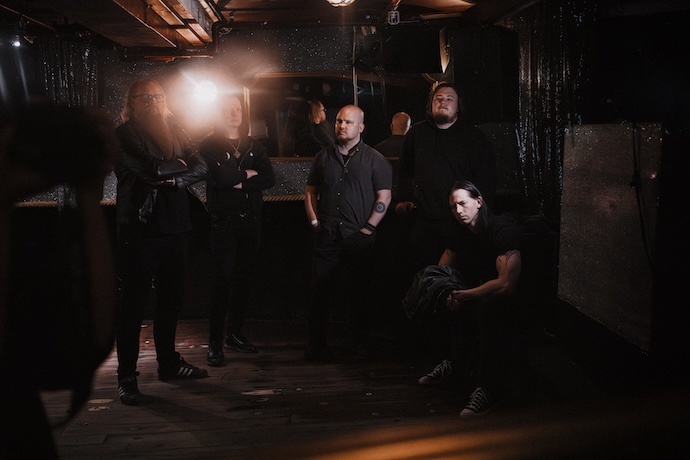
photos by Ekaterina Yakyamseva
(Comrade Aleks has brought us many good interviews for many years, all of them worth some attention, but some stand well forward of others, and this discussion with Johan from Rikets is one of them. Read it and you’ll see why.)
The debut album by Swedish death metallers Riket was released to mark the band’s tenth anniversary. And it’s not just another melodic death metal band, as, foremost, all lyrics are written in the native language and it’s inspired by historical events in Sweden. And as you may imagine, the album’s title 2026 isn’t just a number. At the same time, there’s no room for the usual metal cliches like Vikings’ conquests or war in Riket’s lyrics, and every song is named after the year when this event took place. The band focuses on more specific authentic topics, which you will learn from the interview below.
Meanwhile Riket has created an organic, well-produced, and honest album in the key of sophisticated yet straightforward melodic death metal. And 2026 has every chance of being remembered by listeners for more than just the lyrics.
Hi Riket! How are you? Who’s online today?
Hello! This is Johan, vocalist and lyricist speaking!
It’s hard to skip over your release 2026 for many reasons. The album’s title, the artwork, the songs’ names, they evoke a lot of questions. Yet you started with the EP Avarter in 2016 (four tracks, eleven minutes). What was Riket back then? What was your vision?
Back then, Riket was more of an instinct than a defined band. We started it as a way to explore something more direct and less restricted than our other projects. There was no clear long-term vision, just a desire to play death metal in a way that felt honest to us.
Over time, that instinct slowly shaped itself into Riket. When Netherbird was put to rest, I felt it was time to put more focus into this band and channel my ideas here. From late 2023 onward, Riket became my main priority. For a while, four out of five members were shared between the two bands, so the transition felt very natural.
Which bands did shape Riket’s sound? Were there bands which influenced not only the way you wanted Riket to sound, but your very attitude towards death metal as well?
It is difficult to point to specific bands. After many years in the scene, influences become more like a foundation than something you actively reference.
That said, the early Swedish death metal scene shaped both our sound and our attitude. There was a rawness and a lack of rules that we still carry with us. Bands like Nihilist and Grotesque had a huge impact on me, along with many others that shook my world back then.
Personally, I have always preferred emotion over technical perfection. Grit, imperfection, and honesty are what inspire me. The other members bring their own influences, and it is that combination that becomes RIKET.
How did you spend those first years as the band with only one EP at hand?
We did not rush anything. Riket was never built around momentum or visibility. It developed slowly, through writing, rehearsing, and playing shows when it made sense.
It was a passion project alongside our other bands, almost like a creative space where we could experiment without expectations. Looking back, it was a much-needed return to a more old-school way of making music, where passion matters more than perfection.
We want people to feel something when we perform. It is not about impressing, it is about connecting.
What was the idea behind the live album Motvalser (2018) released right after this EP digitally with only five songs? Did you search to prove your intention to keep the band alive this way?
In the early days, Riket was almost exclusively a live band, so we wanted to capture that energy. It was not about proving anything, just documenting what we were at that moment.
We have always felt that we are at our strongest on stage, where the energy flows naturally. I have even considered the idea of releasing a full album recorded live with new material. It would go against how music is usually released today, but that is also what makes it interesting.
Albums like early Carcass or Napalm Death are not about perfection, they are about feeling. That is something I miss in a lot of modern, over-produced music.
There was the EP Ofarder in 2020 and then such a long gap, filled with just singles (and three of them appeared in 2026). What kind of obstacles did you meet on your way to 2026?
Life, time, and priorities with our other bands. We chose not to force anything, but to let things develop naturally.
In hindsight, the slower pace was a good thing. It gave us time to understand what we actually wanted to create. By the time we started working seriously on the album, we had a much clearer direction.
Finally, we have the full-length, where “every song is performed in Swedish and rooted in the darker corners of our shared past: small historic tales of catastrophe, blunder, and human downfall”. What pushed you to choose this concept?
It came gradually. I have always been interested in history, but more in the human side of it than the official narrative.
The real turning point came in 2020 when we released Ofärder. Swedish journalist Fredrik Strage mentioned us on national television because of the songs dealing with real events. The reaction we got showed that this approach connected with people in a way we had not expected.
At the same time, with so much music being released today, having a strong storytelling focus helps us define what we do. It connects everything, lyrics, visuals, and live performances.
We are not trying to teach history. We are telling stories in our own way, sometimes with a dark sense of humor or an unexpected angle. The goal is to evoke emotion and reflection, not to give a lecture.
Writing in Swedish became a natural part of this. It adds authenticity and allows for greater precision. Yes, it creates a barrier for some listeners, but the emotional language of metal is quite universal, and those who want to dig deeper can always translate the lyrics.
As I understand from the lyrics’ titles, “1868” tells a story of famine in Sweden that took place in this period, and “1897” is about an expedition to the North Pole. Why did you choose these two themes? And why didn’t you go deeper in history searching for plots?
Because they show different sides of the same thing: human ambition, risk, and survival.
We are constantly pushing forward, even when the odds are against us. From a distance, it can seem almost absurd, but at the same time, it is also something very human and even beautiful.
Riket is no exception. We create something that might reach very few people, yet we still do it with full commitment. That same drive is present in the stories we tell.
We focus on events where things went wrong because they are often more revealing than success. For every hero, there are many forgotten failures. Those are the stories we want to bring forward.
What’s happening in “1885”? This reference isn’t so obvious, so which event drew your attention?
It is one of those lesser-known events, which is exactly why it interested us.
Swedish opera singer Kristina Nilsson was performing in Stockholm and would give small spontaneous concerts from her hotel balcony so that ordinary people could hear her. It became incredibly popular, drawing thousands of people.
On one of those evenings, the crowd began to move, panic spread, and chaos followed. With no barriers or control, people were trampled. Around 18–20 people died, many of them women and children.
The event was later called “The dance of death in the moonlit night.”
If I allow myself a darker sense of humor, you could say it was the first recorded mosh pit in Swedish history, at an opera performance.
A lot of everything happened in “1937”. The year was harsh for a lot of countries, and as I see, Sweden wasn’t an exception. So “Welcome to the Gates”, right? What’s it about?
This is one of our earlier songs and is more of an observation on the nature of warfare. It is set during the conflict on the Iberian Peninsula before World War II, when air warfare was evolving and night raids became possible.
It reflects on how technological progress changes the nature of destruction.
I didn’t spend much time on it (but I tried), yet I have no tiny clue about the tracks “1948” (“to Kill a Child”), “1965” (Hog House and Culture?) and “2009” (“everyone is going to the ground”). I humbly ask you to tell the stories behind the lyrics of these tracks and why you found them attractive enough to write songs about them?
Each of these songs explores a different aspect of human experience.
“1948” is based on Stig Dagerman’s story and deals with irreversible consequence, how a single moment can change a life forever. It also shows the power of art, as the story had a real impact on how people behaved when it was broadcast.
“1965” is about the Swedish “Million Program,” a large-scale housing project meant to create modern homes. The vision was ambitious, but many of these areas later became segregated and problematic. It is a story about how good intentions can lead to unintended consequences.
“2009” is a cover of a Swedish songwriter and reflects on mortality. No matter who we are, we all end up in the same place. It felt like a fitting way to close the album.
All of these stories are different and yet you found a common point to unite all of them under the death metal banner. Why did you think that this genre is suitable enough to transfer this feel?
Because it allows both intensity and nuance. It can be aggressive, but also atmospheric and emotional. For us, it is the most natural way to express these stories. Another genre would tell them differently, not necessarily worse, but differently.
Usually, metal bands follow their extreme nature and write songs about violent legacies of the past – wars, riots, atrocities of a barbarian age in general. You mainly avoid touching such an obvious topic as war. Is it because Sweden didn’t take part in military actions directly since 1814?
War is often the obvious choice, and it has been explored extensively already.
We are more interested in the quieter disasters, the ones that happen without armies but still affect people deeply. Those stories are often overlooked.
Did you search for a different approach to different stories? Or did the music just come first as it almost always does?
Yes. Each story requires its own perspective. Sometimes I write as an observer, sometimes from a more personal angle, sometimes as someone retelling an event.
The approach always follows what best serves the story.
What kind of sound did you search to achieve in recording these songs? Did you look for a cleaner and more precise approach or did you want some ruder production?
We wanted something organic and alive, not overly polished.
We avoid excessive layering and aim to create something we can reproduce live without backing tracks or artificial additions. It is a more old-school approach, but it feels more honest to us.
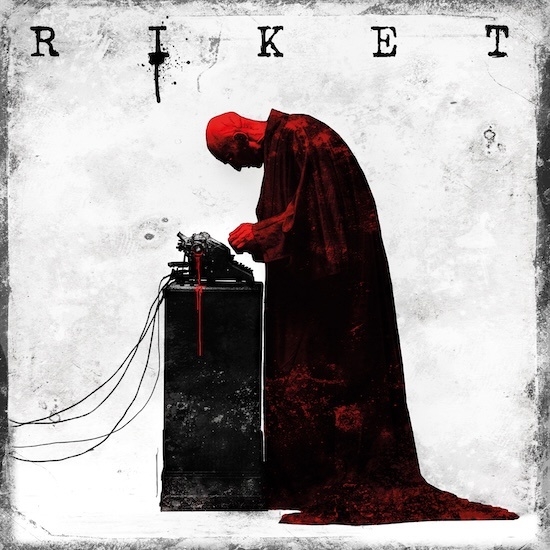
Who’s that grim chronicler figure in the artwork? It looks like a really memorable and strong image, so the choice was perfect.
It represents a kind of observer or chronicler, someone who has been documenting events for a very long time. It could be seen as a symbol of collective memory, or perhaps something more sinister. Maybe it is even the one shaping the events. We have our own idea of who it is, but we prefer to leave that open.
It’s difficult for metal bands to stand out nowadays because of the overcrowded scene, and Sweden is the one of most prolific countries in this sense. How do you think people will recall 2026 besides its concept?
We hope they will remember the songs themselves. That they have identity, variation, and do not feel overly polished. Our goal is to create music that stays interesting over time, not something locked into one formula.
What are your plans for the rest of 2026 (the year)?
To bring the album to the stage and let it evolve there. Live shows give the music a different life.
We start with Inferno Festival in Oslo, followed by a more intimate show in Stockholm at Fredagsmangel, honoring LG Petrov alongside Centinex.
Beyond that, we hope to play more shows both in Sweden and internationally. At the same time, we are already starting to write material for the next album.
So it is a busy, but exciting time ahead.
https://www.riket.org
https://riketblacklion.bandcamp.com/album/2026
https://riket.bandcamp.com/merch
https://www.facebook.com/riket.official
https://www.instagram.com/riket.official/
Really interesting. interview. So these guys were in Netherbird before? (never knew they broke up)