
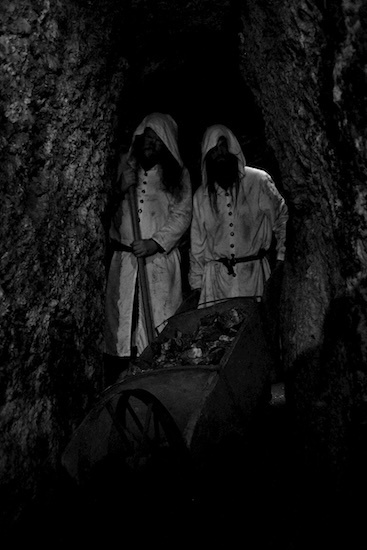
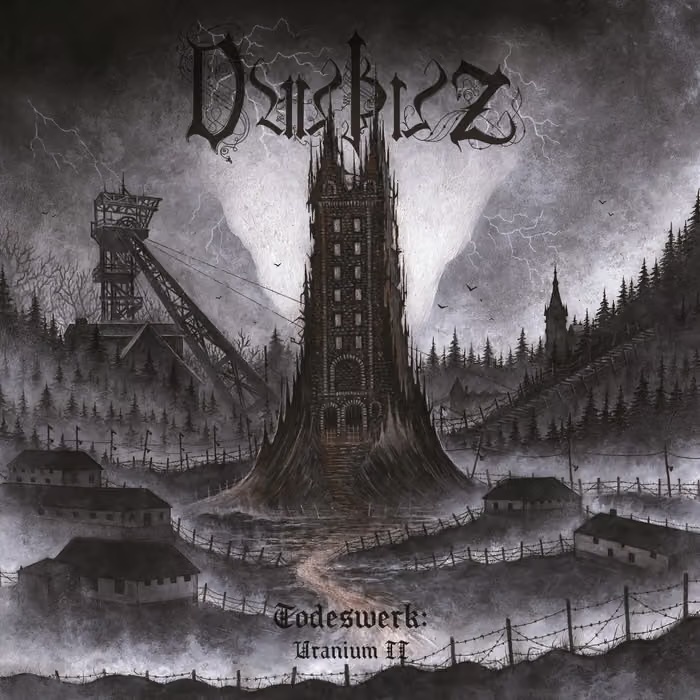
(In this new interview our Comrade Aleks conversed with the two members of the Mining Black Metal band Dauþuz, whose new album Todeswerk: Uranium II was released in late May by Amor Fati Productions.)
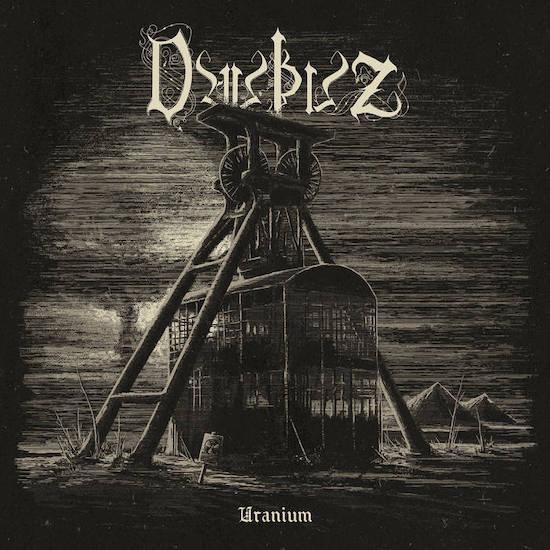
Having some knowledge of radionuclide technologies and the history of their application, I could not ignore the new album of the German black metal band Dauþuz entitled Todeswerk: Uranium II. The official press-release stated that the album’s concept was built around uranium mining in the Bohemian Joachimsthal after World War II and the inhuman conditions of workers who were forced to labour in the name of the Soviet Nuclear Program.
But the story is more complicated as always, and it’s easy to find that for long years the town was almost the only source of uranium since WW I. Uranium mining was temporarily suspended due to increasing cancer deaths in 1929, yet despite attempts to improve workers’ conditions, the mortality rate continued to rise. It’s not a secret that things went really bad when Jáchymov was occupied by German troops during WW II, and fascists utilized Soviet prisoners in the name of the German Nuclear Program there. Needless to say, the situation changed vice-versa when the War was over, and everything was in ruins.
As I reflected on this topic, I found some glimpses of the story of uranium mining in Africa… Did you know where the uranium used to make the bombs that destroyed Hiroshima and Nagasaki came from? Go and check, there was no fun there either. So, okay, uranium mining in Africa, Canada, and the USA – back then no one gave a damn about the environment or miners’ lives either of course. There was no any trace of humanism in this field for decades, and I bet there is nothing like this in some Third World countries nowadays as well.
Todeswerk: Uranium II tells the story of suffering, forced labour, and death in the name of progress and power in a most artistic way – both straightforward and epic. The interview with Dauþuz’ members Aragonyth and Syderyth was tough sometimes due to the difficult topics we discussed, but we managed to keep it diplomatic to some degree.
Hi Dauþuz! How are you? What’s going on in your camp?
Aragonyth: Glück auf! We’re still a bit overwhelmed by the response Todeswerk: Uranium II has received. All in all, things are going very well!
Accept my congratulations with the release of Todeswerk: Uranium II. How smooth was your road to this release?
Aragonyth: Thanks! There’s no stress we don’t put ourselves under, if anything. Uranium II was actually meant to be a short EP released fairly soon after the 2024 Uranium album, but somehow it ended up taking on a life of its own. But I don’t think that was necessarily a bad thing, haha!
Can you tell the story of growing the EP Uranium II into the full-length album? How did you develop its potential?
Aragonyth: I think it all happened quite seamlessly, actually. On the one hand, we found it a bit difficult at the start to carry on working on the material straight away, but on the other hand, there was still so much more to say on the subject. Suddenly we had five lyrics for four songs, and yeah… so we just turned it into a whole album. If we were going to do it, we might as well do it properly!
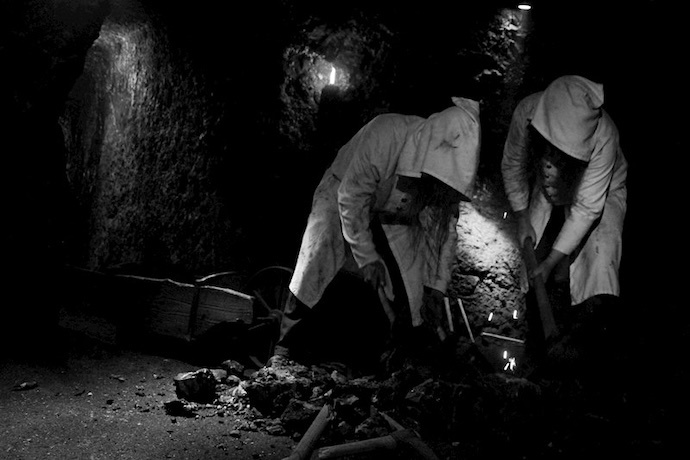
What do listeners typically notice about the new material? What aspects do they emphasize?
Aragonyth: I think our fans are always keen to see what kind of journey we’ll take them on this time, or what story will be told. Fiction or reality? More of a legend or the harsh realities of everyday life? There’s simply so much to tell, and yet it feels as though we’ve only just scratched the surface so far. Musically, too, we’ve got our more straightforward albums and our more epic ones. We do have our definitive trademarks, but I think we can still pull off a surprise here and there, haha!
The band is well known with its image and an authentic concept, and it’s really nice to see such an individual approach. How much are you focused on music and the band’s development in this department? Don’t you fear that your own growth as composers may yield before demanding lyrical and visual concepts?
Aragonyth: So far, we don’t feel that our compositional skills are lagging behind or even suffering because of the theme. If we ever do start to think that, it’ll probably be time for us to leave the whole thing behind, haha. But we’re working diligently and hard, both on the music and on the theme, so in that respect we certainly still have a bit more to offer.
Subjectively, the mining theme could be served in an industrial key as well. Didn’t you think to switch your focus from acoustic parts to more mechanical and harsh industrial riffs?
Aragonyth: I see your point, but first and foremost, we’re still a fairly traditional black metal band, musically speaking. Of course, there’s some great industrial black metal out there, but we see our roots more in the traditional realm. I think the slightly more straightforward, less epic songs have also helped us outline the more industrial backdrop of the last two albums. So – quite surprisingly – you shouldn’t expect any electronic beats from us.
Good to hear it as well! Which bands formed your perception of black metal? Or was it rather a work of intuition and other external impacts like your surroundings or a love to history for example?
Aragonyth: The first few songs – and the band name, too – were written before it was clear that we’d be focusing on mining as a theme. Nevertheless, these decisions had a decisive influence on our sound, and the theme was simply a perfect fit after all. But we definitely don’t go around saying we want to sound like Band X or Y, or write a song in a particular ‘style’. Of course, all sorts of influences play a part, but more on a subconscious level. I think we’ve now found a way where people can definitely ‘recognise’ us when they hear a song.
How challenging was the process of Uranium II recording for you?
Aragonyth: We both have our studio equipment at home, and our session drummer can record without any problems either, so in that respect it went as smoothly as ever. Working with Patrick W. Engel is always incredibly straightforward and satisfying too. The hardest bit is definitely finding the right timing for the ending as we wrap up the recordings. When is the album really finished? When is there still a detail missing? I think we’re getting more and more stubborn about that, haha, but I reckon we managed to call it a day at the right time, without overloading it or forgetting anything.
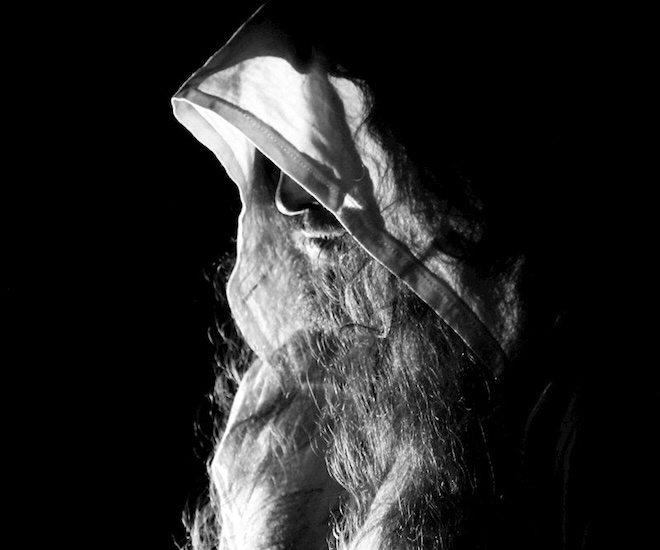
Aragonyth
Are you already used to recording everything at home? Is it too late to romanticize recording sessions in real studios as it was the only choice years ago?
Aragonyth: I must admit that I’ve never actually had the chance to record professionally in a studio before, but that’s why I don’t miss it either. Of course, it would be quite cool at some point, even if, after so many years of home recording, we’d probably turn up feeling very intimidated and anxious, haha! I tend to romanticize the good old days in the rehearsal room with 4-track and 8-track tape recorders. It sounded beautifully authentic, but the recording process was really stressful at times. Still, I wouldn’t want to have missed it!
Todeswerk: Uranium II is your sixth album, how far did you go from In finstrer Teufe? How much of that original Dauþuz spirit is left in the band now?
Aragonyth: I don’t think it’s that insignificant. To me, In finstrer Teufe always feels a bit like a compilation, rather than a cohesive album. Musically, we didn’t quite know which direction we were heading in back then, even though all the ingredients were obviously already there. But there are also a few elements that aren’t as prominent today. Nevertheless, you can certainly still hear that we’re still the same two people making Mining Black Metal.
Okay, you nailed it. Mining Black Metal. Does this definition deal only with the concept or do you take it into consideration as well when you work over your songs? Like folk-oriented melodies and acoustics we may hear in some songs?
Aragonyth: Indirectly, certainly by now. I’ve got several projects on the go, and sometimes it’s not entirely clear at the start which one a song might be for. Sometimes I change my mind as well, so I do pay a bit of attention to making sure it fits the respective concepts. The acoustic tracks are usually added at the end of the recording process by Syderyth and really underpin the moods of the release once again. But I don’t necessarily find our melodies particularly folk-oriented, haha! Though perhaps everyone experiences that a bit differently.
What was the concept of your previous album Uranium I? Are its lyrics connected with Uranium II?
Aragonyth: Uranium takes a somewhat more general approach to the subject, whilst Todeswerk: Uranium II focuses on post-war mining in Joachimsthal. Apart from the general focus on uranium as such, there isn’t really any connection between the albums. What does link the albums, however – and this certainly applies to all our albums – is the focus on struggle, pain and misery.
You touched a difficult topic in the new album; how did you learn about the Jachymov mines?
Syderyth: The subject of uranium is simply too diverse and extensive to be confined to just one album. Also in Germany some workers were forced to work in the uranium mines, but nowhere near to the extent seen in the Czech Republic. It is also a rather overlooked aspect of uranium mining.
Indeed, so do you mean that Uranium deals with issue of uranium mining in general? Not only with Joachimsthal? Because your album pushed me to search for more information and I found that the town was the only source of uranium since WW I in the region. Uranium mining was temporarily suspended due to increasing cancer deaths in 1929, yet despite attempts to improve workers’ conditions, the mortality rate continued to rise. Also, Jáchymov was occupied by German troops during WW II, and uranium mining continued in the town and its surrounding area, where Soviet prisoners of war first worked.
Aragonyth: At least our first Uranium album was a bit more general in that respect, that’s right. And yes, even though attempts were made to improve conditions, you can see that people would literally walk over dead bodies for resources, and that’s precisely why we think it’s important to talk about it and tell these stories. This history shows that uranium mining was not only economically and politically significant, but is also, in particular, a symbol of exploitation and the disregard for human rights.
Back then, very little was known about the dangers of radon radiation, which is why protective measures were initially hardly effective. During the Second World War, it wasn’t mainly Soviet prisoners of war who were working in Jachymov. Under German occupation, forced labourers and prisoners of war of various nationalities were employed. The major phase of using political prisoners in the uranium mines only began after 1948 under the communist regime in Czechoslovakia, when thousands of political prisoners were forced to mine uranium for the Soviet nuclear programme.
It’s important to remember the past atrocities and crimes, so how much of documentary work or fiction is in your lyrics? What kind of sources do you recommend to investigate regarding the Jachymov mines’ history?
Syderyth: When it comes to such serious topics, I like to explore perspectives that people are still reluctant to discuss even today. There’s quite a bit of literature that I’ve worked my way through. From general historical aspects of mining in the area, to the period of uranium mining by forced labourers, and of course eyewitness accounts. I also did a bit of research online. Last but not least, Joachimsthal isn’t too far away from where I live. I visited and photographed the historic sites on a day trip. Some of these are also reproduced in the booklet.
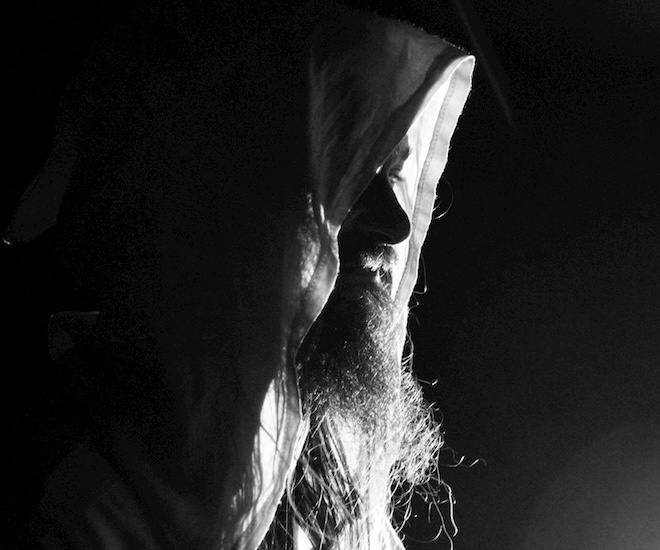
Syderyth
It’s interesting that you highlighted the issue with topics that people are still reluctant to discuss, because it’s known about the Soviet system of Gulag camps, as well as about the Fascist system of concentration camps – both systems relied on forced labour in inhuman conditions. At the same time, a very few people are interested, for example, in the origins of the uranium that became the filling for the bombs dropped on Hiroshima and Nagasaki in August 1945. It was mined in Congolese Shinkolobwe mines owned coherently by Belgium, the Wermacht, and some civilized countries after WW II.
Well, I doubt that African miners had better work conditions there. Even Canada had its Elliot Lake miners’ strike in 1974. Looks like any regime, despite its nature, tends to abuse human rights and its very own environment when it’s possible. How would you rate Uranium and Uranium II from this point of view? Do you see your art as a way to depict suffering and doom in such a manner? Or is it a kind of a call for humanism? If humanism and black metal can be combined at all.
Aragonyth: That’s a very interesting question – one we haven’t been asked quite like that before. I don’t think it’s up to us to call for humanism. At the same time, it’s also not on us to point the finger and say people should have done things one way or another. We see ourselves more as ruthless narrators of these stories – indeed, of these injustices. As soon as money or resources can be turned into more power anywhere – even if it’s through weapons of mass destruction – the human factor, or humanity, is obviously completely irrelevant. Just look at the ridiculous wars currently raging around the world. The world is going to ruin because a few corrupt, narcissistic assholes have to act like tough guys, because they’re afraid that one day nobody will remember them ever again. So they’ll be remembered as the biggest cowards of all time, but I don’t think they’ve had that perspective in mind for a long time now. And we haven’t even mentioned the countless civilian and military casualties yet… it’s just awful.
Almost one year ago I interviewed German death-metal band Gorleben whose album 235U deals with issues like radioactive waste and pollution, as the Gorleben municipality is known as the site of a controversial radioactive waste disposal facility. But we can’t imagine our life without radioisotope technologies. So is it something that really disturbs people in your region? Did you think to play a mini tour with Gorleben?
Aragonyth: In Germany, I don’t think nuclear policy has ever really been uncontroversial, at least in my lifetime. I think that Chernobyl in 1986, in particular, played a part in this, as it sadly made it all too clear what happens when nuclear radiation is released, and this certainly led to the controversial handling of places like Gorleben and nuclear power in general.
What are your further plans for the rest of 2026?
Aragonyth: We’re celebrating our 10th anniversary in October – can you believe it? – and we’ve got a few things planned to mark the occasion. No rest for the wicked!
Is it too early to announce anything regarding the anniversary?
Aragonyth: It is, yes, haha! Let’s put it this way: it’s a kind of release we haven’t done before. There’ll also be a really nice special edition. I don’t want to give anything else away just yet!
Thanks for the interview gents. Did we skip something important regarding Uranium II? What would you like to add at the end?
Aragonyth: I think we’ve covered quite a lot on this topic, haha! Thank you very much for your interest in Mining Black Metal and for those really interesting questions! Glück auf!
Nice interview. Have enjoyed a lot of what these guys have released. Uranium II is a great record. Good to see the guys getting some recognition
Very cool stuff. Great band with a highly original and interesting theme.