
(written by Islander)
On Juneteenth (June 19) Texas-based Haintgrove released “Starless Passage“, the project’s debut single and first track from a forthcoming album. I paid attention in part because I’m originally from Texas and spent nearly half my life there before moving to the Pacific Northwest, but mainly because of the song’s inspiration and lyrical themes, which Haintgrove described as follows:
“Starless Passage” serves as the opening chapter of a larger concept centered on the experiences of enslaved Africans in the colonial South. Rather than presenting history as a straightforward narrative, the project approaches it through atmosphere, landscape, memory, and emotional perspective. Coastal shorelines, flooded forests, forgotten crossings, and the natural world itself play a central role in the music’s identity.
The song proved to be quite impressive — and I’ll re-share my thoughts about it before we reach the end of this article, but the main subject is a second single from Haintgrove that we’re premiering today (along with a captivating video), a song called “I Dream in a Tongue I Cannot Speak“.
Here is how Haintgrove has introduced the song to listeners:
“I Dream in a Tongue I Cannot Speak” continues Haintgrove’s exploration of the history, landscapes, and lingering memory of the American South, but approaches those themes from a more intimate perspective.
The song is centered on ancestral memory, cultural displacement, and the feeling of reaching toward a past that can be felt but no longer fully recovered. The ocean is central to that idea, both as the distance created by the Atlantic slave trade and as a physical connection to the world that was left behind.
Musically, this track leans further into the atmospheric and melodic side of Haintgrove. It’s melancholic and windswept, with layered melodies and an expansive coastal atmosphere while retaining the blackened aggression of “Starless Passage.”
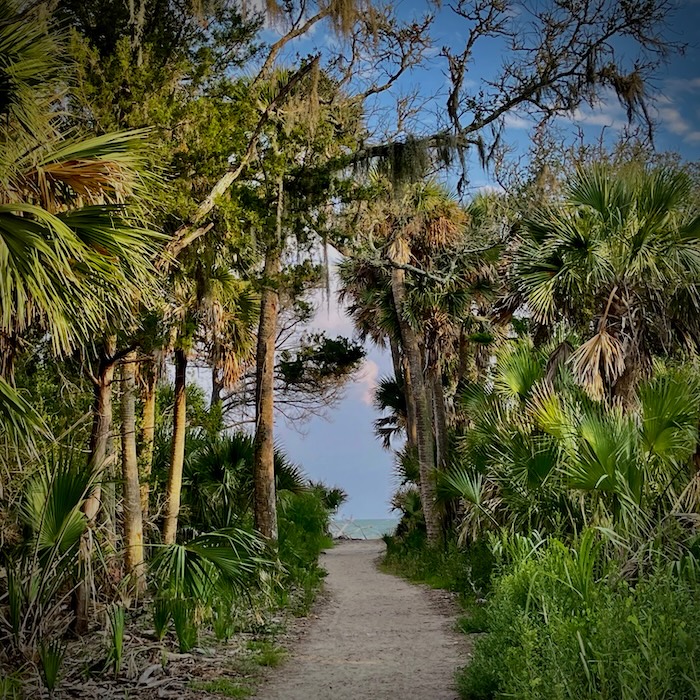
Haintgrove has also explained that the video was filmed along the South Carolina Lowcountry coast, including Sullivan’s Island and Edisto Island, within the Gullah Geechee Cultural Heritage Corridor. The choice of Sullivan’s Island wasn’t happenstance — as Haintgrove discloses, it “once served as a quarantine site for captive Africans arriving through Charleston, one of the major points of entry in the North American slave trade”:
These coastlines, marshes, maritime forests, and eroding shores are not simply a backdrop. They are landscapes where history, memory, and the lives of generations before us remain present.
Haintgrove exists to honor the history and experiences of enslaved Africans and their descendants in the American South – to remember what was carried, what was taken, what survived, and what continues forward.
That first single, “Starless Passage“, proved that Haintgrove is a powerful lyricist. The words to “I Dream in a Tongue I Cannot Speak” prove it again:
I stand where land meets endless blue
These sands lie strange beneath my feet
Memory creeps where my shadow does not fall
The sun does not reach me
Familiar voices speak in tongues I should know
I search for what I cannot recall
My steps return me to this place
How did I come to stand upon this shore
Torn from my arms
Ripped from my hands
Swallowed below
I reach for something unremembered
It calls to me from beyond
The weight I once carried
No longer do I hear its cry
I call to souls that I once knew
The wind rejects my voice
I dream in a tongue I cannot speak
Long forgotten words die behind my teeth
The horizon bars my return
No wind will carry me
The music is also powerful, as is the video, which presents vistas that are both beautiful and desolate. The song’s lyrical themes make those vistas even more meaningful.
The riffing is urgent and surging, both feverish and blaring, and it’s backed by an equally urgent rhythmic drive. When the vocals break open in scarring screams, the rapidly vibrating riffing begins to sear and roil, desperate in the mood it creates, and fleet-fingered bass maneuvers seize attention while the drums blast away.
The instrumental performances are elaborate, and noticeable at every stage, thanks to a production that allows all the ingredients to stand out, albeit without shining up the sound too much. The whirling, multi-layered guitars in particular have a rough biting edge, but they also glitter.
Given the song’s themes, the music also takes a more sorrowful turn as the urgency briefly subsides. The guitars plaintively ring as the drums boom and the bass grieves. But Haintgrove also accelerate again, providing one more adrenaline-fueled race that seems to channel despair, pain, and rage.
And now, as promised, here’s what I wrote about the first single after listening to it:
The eloquent lyrics of “Starless Passage” are wrenching. They express the agony and fear of an enslaved African chained below-deck on a ship bound for the New World — and they tell of a rebellion.
Haintgrove tells the tale through surging melodic black metal, oceanic in its tidal rise and fall but also punchy and swirling, and accented by some very nimble bass-work and rapidly skittering arpeggios that seem to channel desperation.
The near-strangled screeching vocals may take some getting used to, but they briefly trade off with guttural roars. The song also includes a soft interlude, a duet of rippling guitar and deftly picked bass — perhaps functioning as a vision of beauty in the midst of horror — as well as a finale that’s gloriously fierce and heart-pounding.
We’ll continue following Haintgrove’s music leading up to the release of the project’s debut album, and you should follow them too — at the locations linked below.
https://linktr.ee/haintgrove
https://haintgrove.bandcamp.com/
https://www.instagram.com/haintgrove