
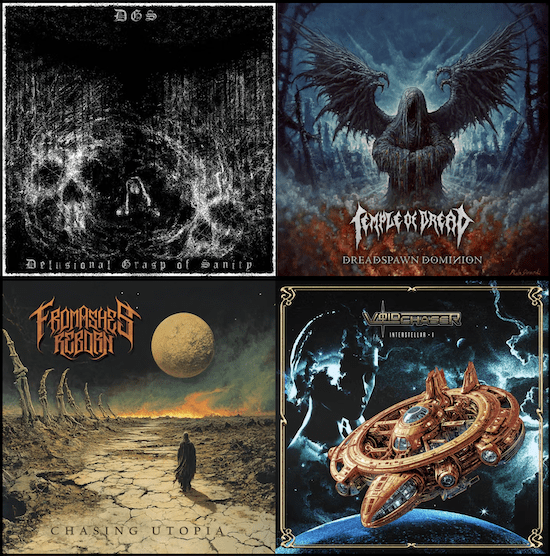
(Our writer DGR has been playing catch-up on records released earlier this year when other distractions interfered with writing about them. In mid-July he delivered Issue One (which you can find here), earlier this month he presented Issue Two (here), and now we have Issue Three encompassing reviews of four records released in March, April, May, and August.)
Over the years I’ve noticed a sort of lethargy develops when I reach the end of some sort of media consumption or project completion. The ‘Done-ness’ of it all seems to take it out of me and I wind up strangely tired for the rest of the day. I notice this more often with my videogame hobby than most, as I’ll often reach the end of some game I’ve been playing my way through – often side by side with the many albums I take a swing at writing about – and wind up tired by the end of it.
I once saw someone positing that it’s a sort of decompression, because your brain has been interacting so long with that specific ‘world’ that it is a sort of loss now that it’s over. I’ve found I do the same thing with albums and books too; albums in an equally odd circumstance because I often wind up writing about them afterward, like putting a neat little bow on a story arc and tying it off. I then walk away from the writing part of it just as tired, such that every review after a while feels like an exorcism.
The difficult part, then, is that what I should be doing is getting started on the next thing, because your writing skill is an engine that if you let rust from disuse becomes harder and harder to start up each time. Yet, keeping the machine rolling runs against my long-simmering philosophy of not just completely severing ties with any particular piece of art, because the practice of continual writing and reviewing so easily becomes more of a high score board of ‘look how much I listened to!’ It all feels surface-level at that point. Did you really listen to it if you’ve got 150 other releases on your docket for this month? Or does it count at about the same level as the music playing in your local supermarket for all of the effect it had on you?
I say that fully aware that a lot of music doesn’t need to be this deeper reach for the core of a person. Much of it is meant to be a digestible and pleasant good time. There’s room in my heart for all of it, because my biggest fear in the midst of it all is losing perspective on everything. Without that, it’s like you just devolve into seeking base-level satisfaction every time. Another creature of the eat, sleep, and breed variety. A tombstone with a life summarized of ‘They existed’ underneath the name and years.
But it does kind of run counter to the idea that things should be allowed to end, right? Nothing needs to continue forever – although once you have other people’s livelihoods involved it does feel like a different story. Once you start to matter to other people beyond just base ‘Oh, I’m a fan of this thing’ then I do wonder where the creator responsibility itself ‘ends’, as creativity can take just as much out of a person as the interaction with it on the receiving end,but the sacrifice feels a little more nobler. You give up a piece of yourself so that someone else can keep going.
I know of people who have it way harder than I do when it comes to this sort of thing, such that they often leave books, games, movies, albums, any sort of media consumption and interaction, half to three-quarters finished. That way the story never really ‘ended’ for them. It exists in a state of perpetuity. So long as the final pictures, sounds, and words have never been uttered, then whatever artist/consumer exchange is happening continues forever.
That seems to strike at the core of it, and I would wonder – in a shitty armchair psychology sort of way – how personal loss tends to go for those folks. Considering I turn into a complete fucking wreck, maybe the universal pendulum swings the other way and it goes really well for those people. Perhaps it is just as much a facing of mortality when our chosen fantasy world ends as it is when we’re actually faced with the ‘real’ thing.
I did promise you a bunch of pretentious sounding bullshit at the start of each one of these, yes?
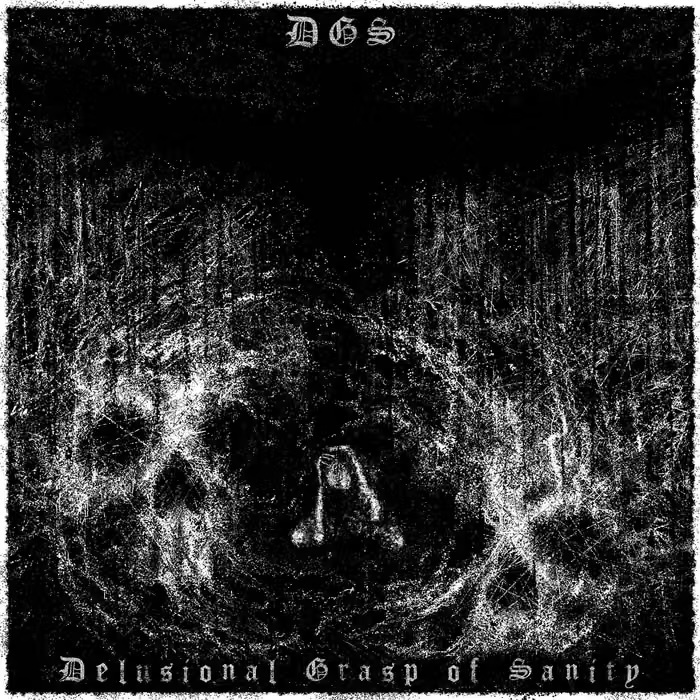
DGS – Delusional Grasp Of Sanity
Finland’s DGS slid across my desk much in the same way another Finnish grind band, Feastem, crossed my path a few years back. I’m not sure what it was with the melancholic goth rock of late-era Rapture, but it seems as if members of the group’s lineup over the years all seemed to find their way into one grind band or another, even the ones who would join the lineup past the group’s era of recorded activity. Such is the case here with the shared member of bassist Iain Hill, who is part of the three-pronged grind assault known as DGS.
Their first full-length album Delusional Grasp Of Sanity – for those who might’ve been curious about what the band’s name meant – saw release earlier this year and was one of the many that I had snapped up in my explorations with a special asterisk of ‘get to sooner rather than later’. If August represents my idea of sooner at this point, may the cosmos and whatever deities find time to deign us with their presence never let us see what might actually be considered ‘later’.
Delusional Grasp Of Sanity is twelve tracks of hefty death metal and grind that punches in at around a bit under twenty-seven minutes of music. It’s an even spread of two-to-three-minute songs, so you can expect that DGS are a little more composed than the myriad powerviolence and Scum-era Napalm Death overdose victims that are out there. This is still music that is ferociously kinetic on a momentum front and just as equally awash in noise as most grind bands out there, but if the cover art doesn’t tip you off, DGS’s approach to grind comes from a bleaker source of atmospherics and inspiration.
Some of that arrives by way of some classic death metal stomp amidst the wall of sound, stealthily disguised among the overall cacophony. Delusional Grasp Of Sanity is of the crowd where grind is meant to be mean. They’re not bolstering a scene or unleashing their own take to advance the genre, it is music that is weaponized instead. In the many iterations that grindcore has gone through and the thousands of evolutionary branches and trees that’ve sprouted off of, for the simple idea of ‘loud, fast, composition last’ the meaner acts have seemed as if they have more to prove. For them grindcore lives up to its reputation as musical exorcism, but still, by the time all wraps up, no one feels any better by the end of it. It’s a therapy session in a wreck-room resulting in zero progress. We walk away in poorer mood but richer in circle-pit currency.
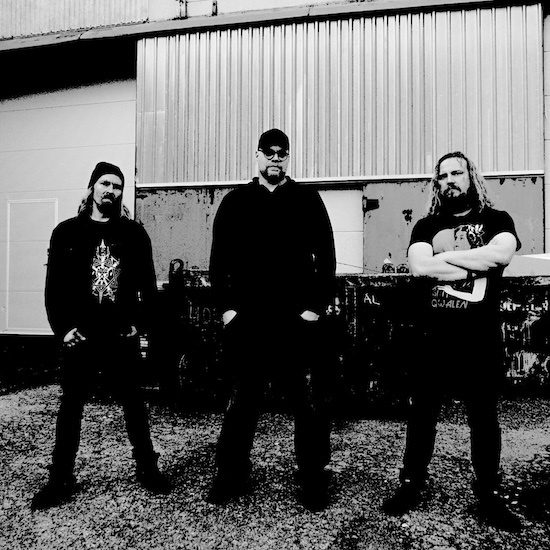
DGS are like many of the multi-pronged assaults that have emerged from the grind scene as of recent. Songs continually whip by faster than you could imagine and with less subtlety than a brick thrown through your front window. DGS write as if their instruments and voices have both caught fire and you’ll likely recognize a lot of shared DNA via cultural osmosis with groups like Distaste while listening to Delusional Grasp Of Sanity. Their shared taste for apocalyptic-sounding guitar runs that veer dangerously close to a razor’s-edge date with black metal is the group’s definition of a guitar ‘lead’, and there are no chances for anyone to even attempt a solo – which in a grindcore song would be hilarious in its own right but you quickly surmise via DGS’ aesthetic that hilarity is not even in the same orbit as the menu they’re serving from today.
This is purpose-built destruction, carefully curated and selected to end in a frenzy, such that it almost seems like a surprise when the math works out that this is a release that jumped past the twenty-five minute mark in total run time. Introductory track “Swarm” might be responsible for some of that false sense of security; the initial fifty-five-second introductory beating does not hint that later on in the album DGS will have figured out how to slam three minutes’ worth of chaos together on three separate occasions.
Given that Delusional Grasp of Sanity is an album written as one large multi-faceted carpet bombing of an album, it is not the easiest act to recommend particular songs. This is a release that gives airs of being one large explosion and to pick apart specific particulate, debris, and smoke residue makes the whole adventure all the less threatening. Delusional Grasp Of Sanity contains a lot of recognizable grindcore hallmarks, but does so less from the point of it being fun for drunken fools to run in circles to, or make the show just as much their own as it is the band’s, but more so to weaponize each and every moment.
DGS have crafted something that is believably angry – an immensely difficult act to do in the modern metal-sphere – and continues to ratchet up intensity throughout its twenty-six minutes, letting up rarely on the blastbeat or letting the rhythm section as a whole get a breather. There are no artistic boundaries being sought after to be broken with a release like Delusional Grasp Of Sanity, only bones and will in equal measure. If you need an album of near-incandescent fury to wake you up at any point in the day, this album is a good 2026 release to add to the collection.
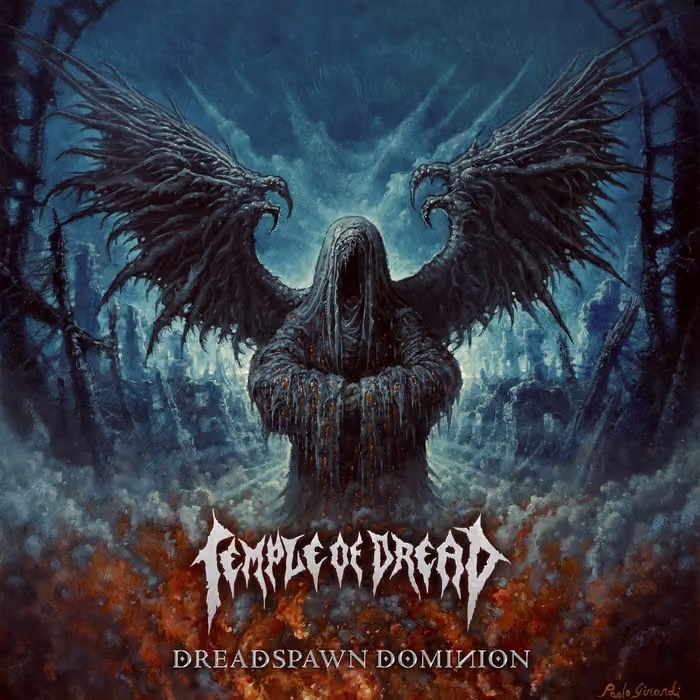
Temple Of Dread – Dreadspawn Dominion
The next few segments of this issue were completely unintentional on my part, but one of the rabbit holes that I found myself falling down this year consisted of ever-widening circles of musicians and bands based out of Germany. I suspect that some of it may be the ease with which I fell into exploring Testimony Records’ collective works.
We try our best to keep our ears open for any country wherein we may find delicious and well-seasoned heavy metal, so there are times when it seems like music moves in waves from one country to another. Every band in France one year may decide that it’s their turn to release an album, at other times you’ll find yourself in colder Nordic countries, and occasionally somewhere like Germany decides that it’s their turn to just have endless release upon endless release. The old reliable crews are always there but the deeper geographical explorations wind up with discoveries being bunched up, or in the case of the two here a combination of catch-up and newer release in an attempt to stay semi-relevant while I carve a reckless path through the forest of backlog.
It does not take a lot to keep me happy with death metal. I’ve surmised that death metal as an overall umbrella genre is one that speaks on a subconscious level, massaging specific parts of the brain that favor less challenge and lean toward primal instinct. Death metal has, of course, fractalized into a thousand-something subgenres, and just as many groups out there have turned death metal into a fascinating intellectual exercise, metamorphosizing a deep rumble into all forms of dissonant or progressive music or any number of bestial deviations in between. Sometimes it can feel as if the breakdown of extreme metal is whether or not you prefer the lead section over the rhythm crew. Yet death metal’s many permutations have found themselves equally amiable to being utilized in a variety of ways and easily transposes itself into many forms as well, which is why we have that aforementioned fractalization.
But just as easily as it applies itself as a layer over many others, like a comforting blanket of guaranteed quality, so too does it have a solid and well-laid-out blueprint that can, when followed well, transform into an enjoyable time with relative ease. The bands that are expert at it deserve just as much aplomb as those who seem to elevate and mutate the genre every few records. They probably have fewer ’employee of the month’ pictures up in the break room, but still, these bands are the backbone upon which the machine as a whole runs and they work just as hard – which is where I find myself with prolific German group Temple Of Dread and their recently released album Dreadspawn Dominion.
It’s always interesting to see how the demarcation lines between death metal that is melodic, melodic death metal, and the ossified bones that are melodeath shifts around depending on the band. It would be like trying to follow a country’s border if it were drawn by a child attempting to draw the ocean. The sine-wave nature of said line often makes you both hypocrite and prophet in equal measure, such that you fall quickly into ‘I know it when I hear it’ habits to help your brain figure out what you’re listening to.
A band like Temple of Dread trample over all three like a drunk rhinoceros but they do manage to keep one hallmark around, which is that this band likes itself a nice melodic hook. That is the reliable bedrock of Dreadspawn Dominion, Temple of Dread’s sixth album in nine years of existence. It is an album assembled out of death metal staples and tropes, constructed into an enjoyable meal and tied together neatly in nearly every song by criminally catchy guitar riffs or an equally strong melodic hook – without seeming to stumble into ‘arms outspread, spinning in a circle under stage lights’ territory.
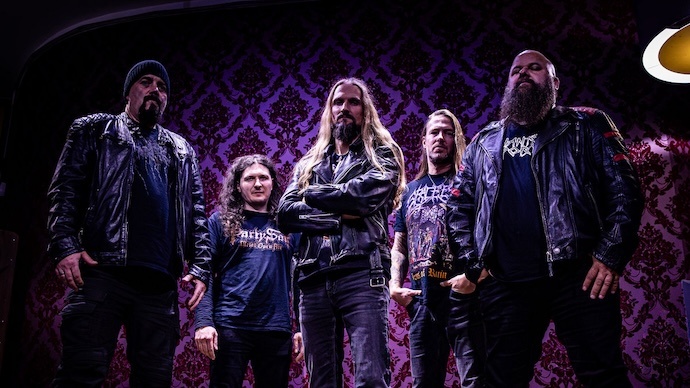
Of course, when you maintain momentum in such a way that you have a few year-over-year releases in your catalogue, there is both a tendency and a temptation to build using the tried and true, which Temple of Dread do quite a bit of as well, but where the band excel just as well may lie more in both combination and competency. You may recognize a lot of the moves being used, like a practiced eye watching a sport, but it never sounds like a band just cranking out releases for the purpose of doing so.
The mark of practiced confidence emerges early with the title-track rager that is “Dreadspawn Dominion” before spilling its offal into the much more traditional thump and rotting lead of “Born To Rot”. “Hybrid Horde Eternal” continues the breakneck momentum, so that it seems the first few songs of Dreadspawn Dominion are built entirely for welcoming people into the fold. Kept fairly straightforward, the album’s first few songs are built out of marathon guitar runs and the constant near-panic attack of a heartbeat snare.
The gargantuan slowdown of “Hybrid Horde Eternal” halfway through seems to emerge from a different album entirely, but it isn’t a mode that Temple Of Dread stay in for much of the album. They like their music on the faster side, and the ‘slowed down’ version of them that exists is more often akin to the winding-guitar riffs that Hate favors. This is something that entwines itself through three of the longer songs on Dreadspawn Dominion: “Death March”, “Scorched By Cosmic Fire”, and “Artisan Of Oblivion”. All are around four-minutes-and-fifty-seconds and all sound like massive issuances from a different corner of the death metal world whose veins instead bleed out martial percussion and massive guitar. Thankfully there is a blissfully stupid bludgeoner in “Rites Of Blasphemy” to break up the ‘behemoth bestriding the Earth’ take on death metal that Dreadspawn Dominion mutates into during its back half.
Temple Of Dread are of a class of band that have – through sheer force it seems – wrapped their hands around a core of death metal craft and they will not let it go until it has been squeezed into dust. They are of a class of bands whose stubborn consistency is just as hard-fought as it is hard-won, and sometimes being able to land precisely at the level Temple Of Dread are at over and over is just as impressive an act as it is blowing down the doors of a genre with each release.
Temple Of Dread are spreading the gospel of death with each album and luring people in with a knife fight’s worth of adrenaline and equally mean guitar-hooks to match. Dreadspawn Dominion doesn’t blow the whole death metal genre open wide, but it does fire an equally killer shot right into the heart of the music, and by planting itself there, becomes just as enjoyable a blood-red death metal album as anyone could ever want.
From Ashes Reborn – Chasing Utopia
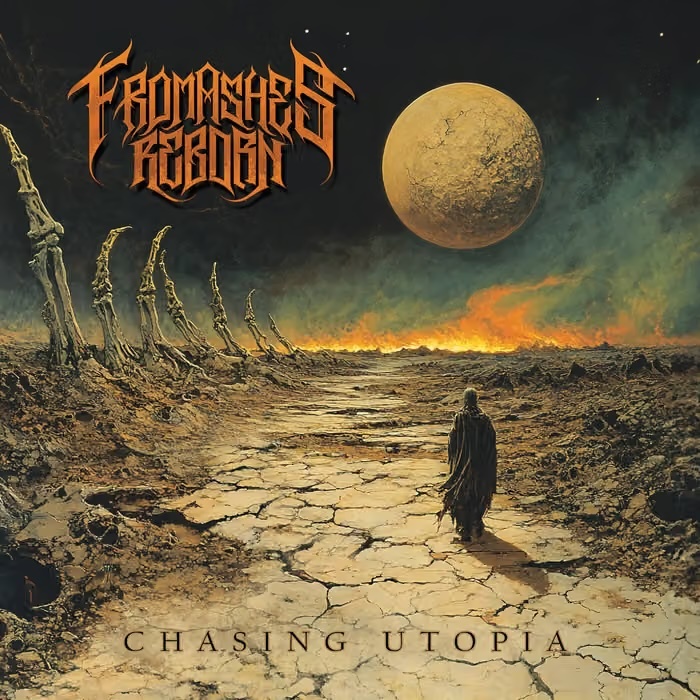
If you’ll recall all the way back to a few months ago you might remember me making a few backhanded references to the idea that just about every Germany band with an inkling of melodeath inspiration in their chosen musical style had decided to release an album this year. The purpose of doing so was to explain why I had suddenly reviewed three of them in a row, and at the time of joking about that, From Ashes Reborn’s album Chasing Utopia was meant to be the third.
You might also recall that right around that time my actual day job decided to kick me in the back of the head for daring to even think of taking a vacation and piled it on so much that I’ve effectively existed in a zombie-like state of work-sleep-work-sleep for the better part of two months. I am not, however, in full ‘author procrastinating on his newest book in a series after a decade of silence’ mode yet, and goddamnit, if I create an imagined story arc in my head of everyone breathlessly waiting to know what I was joking about all the way back in June then I’m going to finish it one way or another.
That and Chasing Utopia is an enjoyable piece of melodic death metal music to begin with, so we were going to get there at some point.
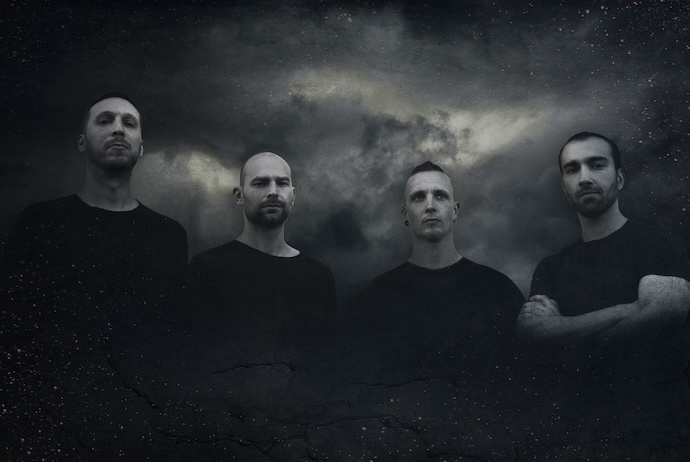
Chasing Utopia is From Ashes Reborn’s second album, arriving nearly eight years – a miss by mere weeks! – after their first release Existence Exiled back in yonder days of 2018. Surprisingly, the band’s lineup appears to have remained relatively stable in the time in between albums, when extended gaps like that usually trend toward the opposite: full relaunches, band members shifting constantly, whole group relocations, any number of multiple situations that could prevent groups from continuing, but in the case of From Ashes Reborn it just seems the primary suspect was the passage of time.
In some ways though, that passage of time could also be why Chasing Utopia is such a big album. It’s a regular occurrence that a melodeath release will ask of you over an hour of your time across thirteen songs, but it seems as if the musicians behind From Ashes Reborn were pent up and who knows when they would’ve ever gotten another chance to unleash an album. So, there’s a sense that every idea is both used and expanded upon in the melodeath world-traveling that is Chasing Utopia. If there was ever a release you could pick apart and use as a diagram to the many subgenres that’ve split off of the classic one-two thump of a melodeath song, Chasing Utopia could be just as good as any. This runs in concert with a desire to traverse more progressive death metal grounds as well, meaning not only is Chasing Utopia a large album to begin with… it’s also a dense one.
A few listens to Chasing Utopia reveals that the album expands outward in a few different directions. It is, at its core, a decently mid-to-up tempo paced melodeath album. From Ashes Reborn are another band – of many this year it seems – who are frighteningly good at delivering a strong melodic lead guitar, sometimes dominating the whole song but otherwise tastefully wrapped into the chorus parts. It is not only a tasteful hallmark but basically a requirement by this point. If one wishes to prove their mettle in the hallowed halls of melodeath then one needs to be able to make the melodic part stand out, and From Ashes Reborn are jumping over that hurdle with ease.
Elsewhere though, the shockwaves of previous bands are felt throughout Chasing Utopia. One can’t help but think of the sort of quiet rumblings that groups like Insomnium started in the early-aughts now reaching fruition generations later, such that a group like From Ashes Reborn can use some of their galloping songwriting tactics to lengthen their own songs. Back of the hand and fading ink, the average song time for Chasing Utopia means that From Ashes Reborn are often asking that you spend around five minutes with them. Small wonder that thirteen songs later and we’re looking at an album whose sheer explorative pride slides them past an hour without blinking.
However, a pairing like the titular “Chasing Utopia” and “Through Darkest Fires” is also immensely hard to deny. From Ashes Reborn flex their muscles and put forth some brawny music in the opening few songs; blurring past the introductory march of “Colossal March” sees the group playing with a few different trappings around their core sound. “In Truth Divided” is the one that lays the groundwork for most of the latter part of From Ashes Reborn’s adventures though, with a solid gallop that continues its way through multiple songs, and again, by being the first to clear the four-minute mark, bull rushes the barrier for the band to continue on to writing songs that lay well in the five- and six-minute range.
Were I prone to giving awards based on sheer heft for dollar value, From Ashes Reborn would’ve made my ’90s kid videogame shopping instincts proud. Nowadays, if you’re that pent up that no idea gets left to wash ashore years later on a plank of wood in EP form, you’re going to have to earn it – which, as mentioned above, From Ashes Reborn mostly do.
Horizons, ravines, and one brilliantly named “Interlude” later, and From Ashes Reborn crank out another triplet of killer songs in its closing numbers. They solidly attempt some cinematic and dramatic takes on their overall formula throughout Chasing Utopia but the final three – maybe with a sense of impending finality almost – are where much of it coalesces. They are some of the dense songs on Chasing Utopia, with the bookends of “Too Blind to Speak” and “Echo Chambers” laughing at the mere thought of ending around six minutes in length.
“Too Blind To Speak” is From Ashes Reborn’s best-use case for making a slower song, with a fully-charged epic sway that rocks the song back and forth for the most of its run time. While it dances close to the pirate-visage nature of latter-era Amon Amarth a little bit, From Ashes Reborn are focused more on pulling out every trick in the book to make an ‘epic’ song. “Too Blind To Speak” is meant to sound gigantic, and while its placement at the end of the album can feel like one final wall to push through, broken out on its own it yields much appreciation for the lumbering nature of the song overall.
“Beyond Infinity” is an equally melancholic and slower-moving number that excels largely on the strength of one massive guitar solo, but at the very least, From Ashes Reborn pick it up for the climactic act of “Echo Chambers”. This is the song wherein everything that is Chasing Utopia gets smashed into one near-seven-minute cube. Melodeath riff staples galore, ride-into-the-heavens blastbeats, martial chug and deft guitar work, it all means that six-and-a-half-minutes flies faster than you might expect for the closer of Chasing Utopia.
From Ashes Reborn’s second album is a little overindulgent at times but it’s hard to fault the band for this. Breaking the album into sections reveals why the group felt everything had to be included at one point or another, as you constantly find reasons for each individual song to stick around. In one full adventure, Chasing Utopia is a bit overwhelming but an eight-year gap must’ve had the From Ashes Reborn crew feeling as if they had plenty to offer. We are beneficiaries, of course, should we prove to not be overly gluttonous and absorb the whole thing in one go.
An hour of melodeath that favors the mid-tempo epics is a hard trial to keep from becoming mundane, and at times Chasing Utopia does falter, but it just as quickly picks it back up again with another one or two songs that make the trip well worth your time. In From Ashes Reborn’s case, who could fault them for recording an album as if they’d never get another chance to do so again? Eight years is a just starting to reach that nebulously defined edge of a long time. There’s plenty of music here and an equal amount to find and discover as well. Chasing Utopia may be one of the most densely packed melodeath releases out this year and it is a legitimate journey that is worth attempting.
Voidchaser – Interstellar I
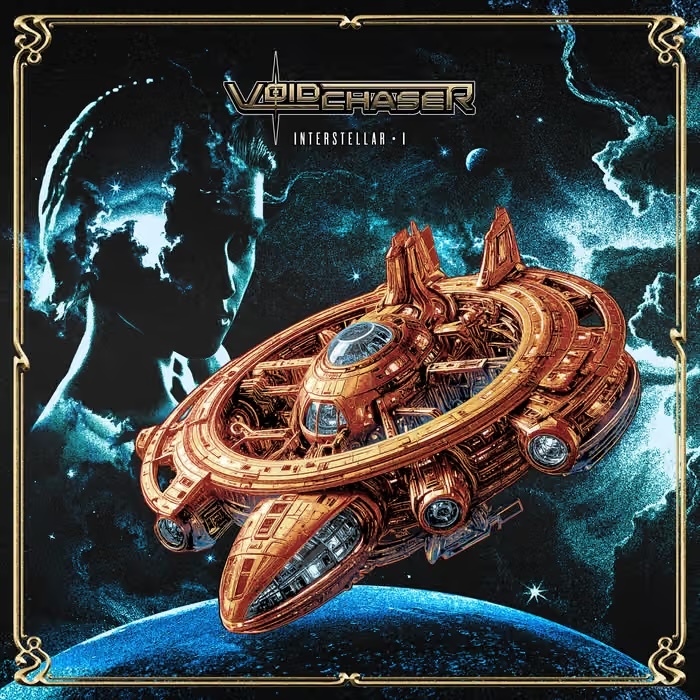
This edition’s curveball comes courtesy of the grand adventures of one Voidchaser and their album Interstellar I. We’ve covered many science-fiction-inspired bands at the site, and outside of being voracious readers of the genre itself, we’ve been more than willing to encourage people to engage with their nerdiest aspirations. That’s why – even though it is a little outside of the wheelhouse of the average NCS Cro-Magnon man beatdown – it was fated that Voidchaser’s latest would go screeching across my desk. Their hybrid of prog-metal wanderings, heavier tech-death expulsions on rare occasion, wall-breaking keyboard solos, and cinematic bombast is an unholy combination that was going to pique our interest one way or another.
Interstellar I is a concept album with all of the finest trappings one could expect from a concept disc: multiple characters and viewpoints, grand song lengths, and plenty of lyrical narration befitting the universe that Voidchaser are painting minute-by-minute on their newest album. As expected, it is also a big adventure to undertake.
Interstellar I is Voidchaser’s first full-length, though the actual definition of this could be debated. The group had existed prior to this on a string of EPs and singles, all of which are nearly the length of most albums anyway, but who could knock a prog band for being more indulgent than the rest? Obsessed with a retro-futuristic take on science-fiction, the band have made serious headway into their genre such that Interstellar I already feels like a massively accomplished album by the time it segues into song three. It’s been something that the band have been both building and evolving toward, so the natural progression – and another twenty minutes of music – into Interstellar I feels the same way it did when the album crossed paths with me the first time — ‘fated’.
Voidchaser are primarily clean-sung, much of it in the higher ranges of something closer to Dream Theater, though you’ll note a lot of Symphony X in the keyboard that shimmers so brightly in the background of a few songs that it is almost blinding. On heavier moments the band could stand shoulder-to-shoulder with modern prog-metal acts like Haken, and the gargantuan times wherein the band are actually heavy – and beneficiaries of a two-pole vocal magnetism – hit like a ton of bricks.
In an odd twist of fate, Voidchaser share a drummer with Ashbreather, whom some of you may remember receiving high praise around here – and an equally upturned eyebrow at their recent La Grande Bouffe release – so again, it was almost inevitable that Voidchaser were going to cross paths with us here, whether it be the Lascaille’s Shroud-esque exploration of science-fiction prog-nerdery or just the usual rabbit-hole tumble of fantasy metal band that we will play with musicians via Wikipedia and metal-archives.
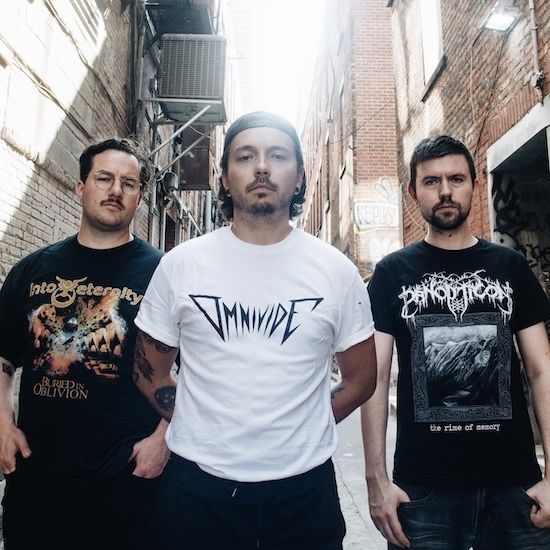
One really need go no further for an example of the sort of ambition we’re dealing with on Interstellar I than the opening few songs of the release, beginning with “The Grand Design” and its opening monologue laying the down the foundation for the adventure ahead. Voice actor Roger Craig Smith – which given the nature of voice acting means you have someone who has stood in the role for multiple Transformers and Marvel characters in animation, as well as videogame credits for Sonic the Hedgehog, Ezio of Assassin’s Creed, and Chris Redfield from Resident Evil – doing his best Zapp Brannigan before launching the album into its own interstellar explorations.
“Welcome To Terra Corp” provides us with a sweeping introduction to multiple antagonists, mostly through the veil of the faceless titular Terra Corporation, because one would expect any good spacefaring story to have bastard corporations as one of the primary needles being stabbed through the fabric of the overall tale being told, while also giving us the multiple facets of Voidchaser’s sound and demonstrating that they are, yes, a prog-metal band first with heavier moments interspersed throughout. Everything will be in larger service of the tale being told as opposed to weaponizing brutality for the sheer sake of a mosh pit.
Guest appearances abound as well, with guitar work being provided by Charles Griffiths – hence some of the aforementioned Haken influence – on the heavier expanses of “Hyperconverter”, which jumps between hefty groove and familiar hook-leaden singing multiple times over the course of its seven-plus minutes. Its an intricate song amidst an album of intricate songs and one whose twists and turns maintain a sense of vibrancy on Interstellar I even as you begin to travel into the deeper reaches of the release. The much brighter and victorious sounding (by comparison) album closer “Renew” features Circus Maximus’ Michael Eriksen contributing to a song that gets progressively heavier and heavier until the ending strings and triumphant final minute close the song out.
But aside from calling in reinforcements to keep things exciting, Voidchaser more than earn their keep with huge songs like “Rain/Solar Winds” and “Initiation Day”. Both have so much music interwoven around their core storytelling attempts that it’s tempting to just get lost within each song and come out of the other side as bewildered as you went in – likely from the song before it. Yes, Interstellar I can get a little ridiculous with just how much sheen – and multiple layers of vocals – are applied to each song, but it’s that sense of grandiosity that adds to the excitement each time you make a run through the album. Moments will happen based off of the rule of cool at times, but mostly, Voidchaser take a release that tells a tale taking place in the cold vastness of space and deliver it warm and vibrant in response.
Even though Voidchaser’s first full-length arrived way early on in the year, it is one I’ve refused to let go of simply because I know that people around here will appreciate the band’s catapulting the listener into the deeper reaches of the galaxy for a big, near-fifty minute musical adventure. Voidchaser wear their influences on their sleeves proudly but manage to meld them altogether into something that still belongs to them. Interstellar I is an album that grows and expands quickly yet organically, enough that each indulgence and grandiose reach for the stars in any particular song feels natural. It is an album that bookends itself well and shows that all the time Voidchaser spent honing their craft has paid off, since they tell a fascinating story that leaves plenty of hidden flourishes and different things to discover on each listen. Interstellar I is an accomplishment worth applauding and definitely one to dive head first into.
I massively enjoyed the DGS album! and From Ashes Reborn was also a great listen. thanks!
glad youre excited about them. its taking me forever to write these due to work but if theyre helping folks find stuff to listen to then the effort will always be worth it.