
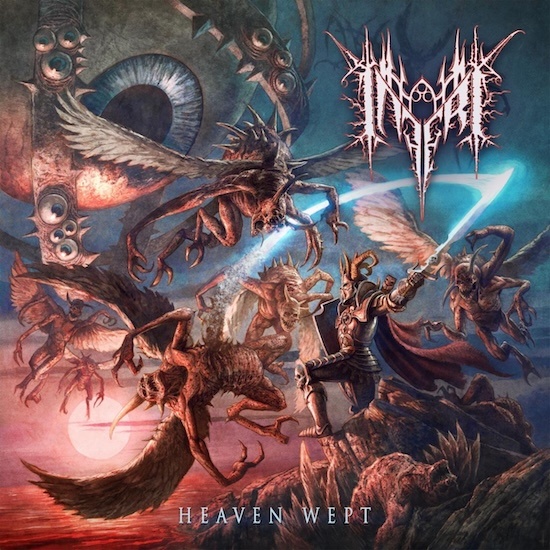
(The Artisan Era will release a new album by Nashville-based Inferi on April 10th, and DGR has managed to beat that deadline with an extensive review of it today.)
I ain’t no fancy law-talkin’ indivigible but I would argue that the case for what sort of band Inferi are is made within twenty or so seconds of their opening song “The Rapture Of Dead Light” from their new album Heaven Wept.
Inferi are a tech-death band of what could now be considered a classic style. Born of an early and mid-2000s collision of hyperspeed melodeath, proper death metal, and the more technically inclined stylings of groups like Necrophagist and Spawn Of Possession that overtook an entire subgenre in one fell swoop. They are part of a collective that helped crystalize what we now recognize as tech-death proper, enough so that you can mention specific record labels and have a good idea of the waterfall of guitar and drumming that will be headed your way.
Inferi were the band that took every element and just cranked the volume up to ten on everything. They would regularly release such densely packed albums that even years after a release you could go back to one and you’d be stunned by just how much general stuff you missed within each song. The prospect of an Inferi album was in some ways terrifying because you knew it meant you’d be getting hit with these gigantic, multi-suite songs that resulted in near-hour-long releases that would leave the brain scrambled by the time you were done.
Inferi are the sort of band that puts out an album and it doesn’t even occur to you that it had been five years since their previous release, mostly because you’re still not sure you’ve digested that previous one. They are a band where you’ve likely never been more thankful for an album to consist of just eight songs. which is what their newest album Heaven Wept is. Eight songs of hyper-fast, densely packed tech-death built out of the sort of overstimulation that can send lightning crackling across the grey matter in your skull.

The distance between albums has done Inferi some good, as Heaven Wept’s eight songs put in tremendous effort to largely remain distinct from one another. While the tech-death genre as a whole continues to change and evolve in order to avoid complete crystalization, it has developed its share of tropes over the years. When the blueprints start to look too similar, many bands start falling victim to the forty-second challenge of being able to take any forty seconds of any song and attach it to a completely different song at any point either within their album or somebody else’s and see just how much it actually sticks out.
Tech-death can – if you’ll forgive the pun – fall victim to being a little faceless from time to time. The relentless noodling and endless array of guitar terminology yours truly feels too dumb to spit out remains interesting in the moment to moment, but trying to recall any particular standout segment six minutes later can feel as if you’re trying to peer into a different dimension via obfuscated mirror. The shapes are there, but the memory is mud.
Heaven Wept doesn’t completely dodge this – as bands must allow themselves room to indulge and show off for each other even as the average listener is left in the dust – but just the fact that five of the eight songs can be recalled by title from memory for specific segments is an exciting development. Inferi have shorn off a little of the sense of repeated adventure for something ever so slightly straightforward and punchy, and it may be one of the few times where we’ve found ourselves looking forward to catching a simple left-hook from a band as opposed to a master’s ballet of martial arts in musical form.
Heaven Wept does still sound as if recorded during a battle of the heavens production-wise. The band exist somewhere at twenty-five out of ten on the adrenaline and RPM meter. The drums continue to vacillate between tempos befitting machine-gun fire and unrelenting battering ram, while guitarist Malcolm Pugh finds a new shred-buddy in Wormhole’s Sanjay Kumar. The pair see fit that moments wherein the guitar strangles the spotlight – which is about eighty percent of the time – are as spectacular and pyrotechnic as ever, but a somewhat slimmed-down Inferi seems to favor a little more groove than you’d expect given the rapid pace that the group had favored previously.
Vocalist Stevie Boiser is noticable immediately and flexes even harder than Vile Genesis five years back – which was a performance in and of itself a perfectly fitting entry into the vocal olympics category. Of course you can’t help but hear that when the first thing you notice during the aforementioned song “The Rapture Of Dead Light” lies somewhere between low death-growl bulldozer and lawn mower. Either way, the path in front of it will be laid flat and destroyed.

The previously mentioned focus on songs standing on their own from one another has the effect of Heaven Wept sounding like a collection of bursts of inspiration on Inferi’s part. The lone throughline being that a lot of the instrumental gymnastics from Vile Genesis before it carry over, much as the impressive acts of the album before that were carried onto Vile Genesis. Inferi are hard to pin down when seeking a constant evolution, as they’ve existed at a peak effieciency for multiple albums now. Instead, each release is a strange sort of thematic reset and has to be approached holistically. Each lineup of Inferi produces something different enough that the current release is the Inferi of now and the influences of earlier works aren’t as apparent.
Heaven Wept and its eight songs have very distinct starts and stops as a result – such that a few times during the album the first words of the song become the title of the song, leading to bemused moments wherein you have the realization of “ah yes, it seems as if I have arrived at ‘Master Of Nothing’ now”, given that the opening yell is literally “”master of nothing on a multi-pronged vocal trident. Radio rock listeners of previous decades would’ve killed to have such nice treatment instead of having to guess whatever the alt-rock flavor of the week band’s new single was called given that it was never the chorus.
Speaking of “Master Of Nothing” though, the guitar work of both this one and the song before it are equally impressive and are early standouts among an album in which every song is going to have its legions of followers. Inferi’s core of constant guitar leads holds on strong in both “Master Of Nothing” and the more frenetic “Feed Me Your Fear” before it. “Feed Me Your Fear” seems to dart from guitar riff to guitar riff alongside some dementedly bent rhythm work right at the end of the song, and “Master Of Nothing” is the more up-front assault in response.
“Master Of Nothing” is also one of our first opportunities to treat a song as if it sounds like the band have been lit on fire and sent running down the road. It’s less progressive-leaning than its immediate lead-in song, trading in much of the showmanship for head-first brutality. Not to say there isn’t still plenty of lead guitar work to offset it and even a quiet breather mid-way through the song – which is one of the few tactics outside of a very minor symphonic backing that does pop up a few times on Heaven Wept. It’s more classically tech-death-flavored but is far more composed than the trap of blueprint shuffling so many bands fall into.
Rock-crushing brutality continues in the album’s title song as well. If you were to compare both “Heaven Wept” and the album’s opening track you’d be hard pressed to see how one part led to the other. This being Inferi though, no song is truly one-dimensional and thus after its concrete-cracking opening segment you are just as quickly slammed back into the “car accelerating toward cliff!” music style that they’ve long honed. “Heaven Wept” is the song wherein Inferi aim for the more “epic” sounding side of things as well, with the previously discussed symphonic backing being an element of the song.
It isn’t huge, as the band aren’t in full Fleshgod Apocalypse playground, but you will notice a consistent choir sting serving to amplify the lead guitar throughout the song and the backing symphonics that traverse the musical soundscape of the whole track. They’re minor in comparison and aren’t being used as replacement for main melodic heavy-lifting as many bands are prone to doing, but if you find yourself questioning why, five songs in, all of a sudden Heaven Wept sounds massive as an album, there’s your answer. “Heaven Wept” as a song is a big battleground of music in comparison to the musicians’ en flamme assault on the earlier half of the album.
Inferi ressurect these ideas again with “Godless Sky” and “Of Rotted Wombs” at the end of the album. “Godless Sky” was a lead-off single so there’s a chance you’re familiar with the mid-tempo battering that opens the song and how the song continually cycles back to it a few times, which is a smart maneuver given that it is propelled forward by a lead-riff that is infectious as can be and you don’t want to let that sort of thing fall through your fingers like sand. Any excuse to cycle back to it one more time is a good one in that case, and so “Godless Sky” does, and who can truly blame them?
“Godless Sky” being the closer is smart in both battle-concept and a great way to close out dynamically. Inferi have room a’plenty for blastbeats in “Godless Sky” but it is mostly death metal chugging as its propulsion, steady as a running engine and standing in contrast to much of the album’s rapid-fire fireworks and occasional bombast. “Of Rotted Wombs” prior to it hints at a little bit of that but is far, far, far more manic in comparison. The strings and choir that entwined their way throughout “Heaven Wept” return in full force during “Of Rotted Wombs” to remind you that the music in this album will befit the end-of-the-world battle taking place on its artwork.
Sometimes it can seem like the Inferi crew have discovered some sort of new effect or synth instrument they can play with over the course of a song and decide “we’re gonna jam this bastard into a track somehow”, and it won’t shock that much of “Of Rotted Wombs” classical’sounding strings carry into “Godless Sky” and its wall-punching nature, even as the two stand opposed to one another in terms of pacing. One is terrifyingly fast, the other could be used as a broadside of cannon fire.
Inferi have long been a flagship and standard-bearer of the tech-death genre as we have known it since the mid-2000s. Multiple talented musicians have cycled into and out of its lineups over the years, yet somehow the core of the band, whoever may comprise it at the time, seems to release album after album of incredibly packed and impressively technically inclined death metal. They’ve absorbed and shed just as many -core and scene tropes as you can imagine but they’ve always been reliable as one of those bands whose chosen tempo lies somewhere between sci-fi railgun and rocket sled. They change tempo and riff at the drop of a hat and there are supercar manufacturers out there that would love to sit the band down to even get a hint of how to be as agile as they can be sometimes when they change from part to part to part.
Heaven Wept’s eight song issuance fighting like a cornered animal to be as distinct as it is feels like an accomplishment. The aspect of repeatedly diving into an Inferi album with full spelunking gear still remains, but it is also nice just to have songs that are cohesive enough to break out on their own and still have enough on offer not to leave one feeling robbed. Picking through the parts of a song on its own is just as exciting with Heaven Wept as it is to just let the whole thing sand your face down to a nice bowling-ball-like finish. Heaven Wept will likely surprise people in that regard, and the final “best songs” reappraisal will be fun to watch because it will likely be as wide-reaching as the songs on offer here.
https://ffm.to/inferi
https://inferi.bandcamp.com/album/heaven-wept
https://www.facebook.com/Inferimetal/