
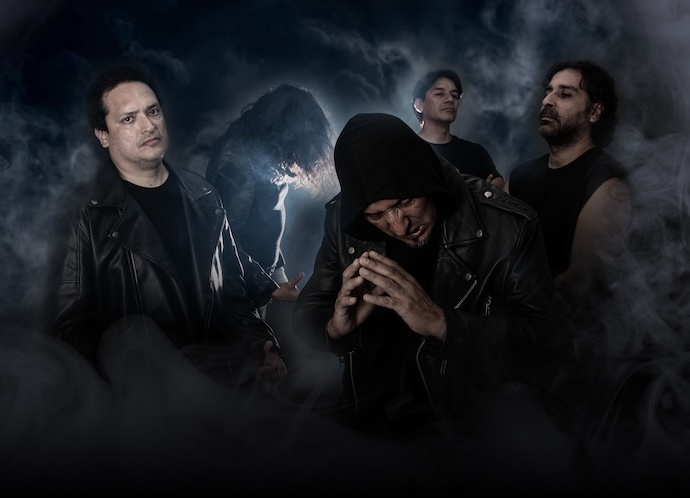
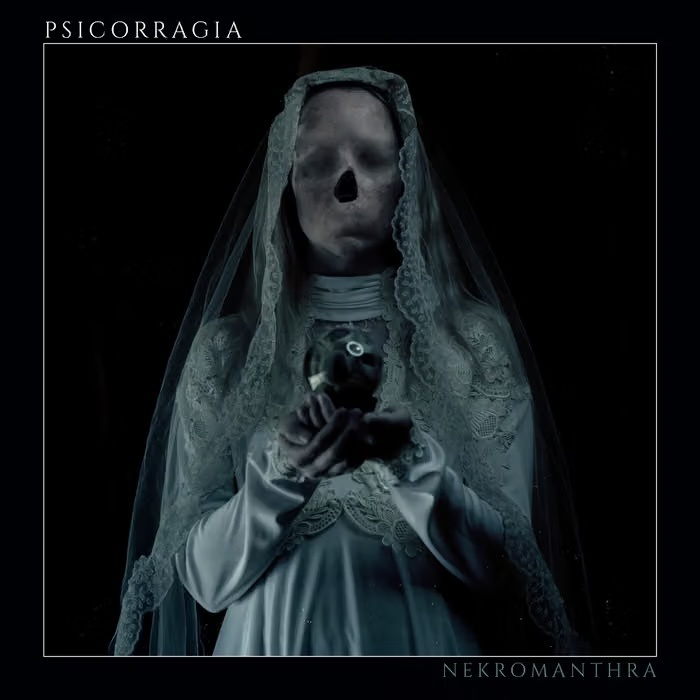
(In June of this year the Peruvian band Psicorragia released their third album. We had the pleasure of premiering a video for one of its great songs, and today we take pleasure in presenting Comrade Aleks’ excellent discussion with Psicorragia’s Mario Romanet.)
Peruvian death-doom band Psicorragia, led by bassist and vocalist Mario Romanet, has been together since 1994. Their first full-length album, La pasion de lo mortal, was released in 2001, and this year saw the release of their third major effort, Nekromanthra. Although nine years ago, the band had eight tracks in the works for their third full-length, the final release included only six songs, totaling 45 minutes. Yet there’s no need to worry; it’s absolutely a full-length recording and Psicorragia delivered professional and powerful material, effectively serving as the best work of their career.
The very first track, “Y sus plagas invocaron,” showcases their wide range of influences, from death metal to eldritch death-doom. The composition repeatedly shifts its mood from hostilely aggressive to detached melancholy and back again, the ascetic guitar sound offset by keyboard arrangements that take on the form of sublime orchestrations and mournful violin dirges.
Psicorragia tend to blend these two styles and, relying on their instincts, combine both approaches, but, for example, “Lo inexorable” embodies that very classic “death-doom with violin” from the ’90s that has become a brand in itself. The final track, “Nekromanthra,” concludes the album with grueling, drawn-out funereal doom, presented in an ominous, tormented, and almost ceremonial manner.
Mario Romanet answered a few questions recently, so I invite you to read this interview and join the macabre world of Psicorragia.
Hi Mario! How are you? What’s new on Psicorragia’s side?
Hi Aleks. First of all, thank you for this opportunity. We’ve been busy promoting the band’s new album, reconnecting with zines, distros, and friends… you know, all the things that come with releasing a new album and are simply part of the underground.
Are you satisfied with the way things go regarding Psicorragia’s promotion? Do you feel that the new release draws enough people’s attention?
We are still in the early stages, and as a band, we are doing everything we can to promote the record. We’ve always been very active in this regard; since our early days, we used to move a lot of physical mail after every release. Nowadays, I get the impression that things are somewhat more complex. To me, it feels like the scene has become commercialized, losing some of the mystique and the true meaning of extreme metal. But anyway, despite that, there are always underground diehards doing things out of pure passion.
The band’s previous album Madremuerte was released ten years ago, but I see that another band you’re involved in released a new album and an EP during this break. What’s about Evil Damn? How much did it actually distract you from Psicorragia?
Yes, this year is a double celebration, as Evil Damn has also released a new record after five years. The EP, Eons of Horror, was released at the beginning of the year through Hells Headbangers Records, and now with Psicorragia we are presenting our new album, Nekromanthra.
I think each release demanded its own time and had its own moments. We can see that the gap between releases, both in the case of Psicorragia and Evil Damn, has not been short. Throughout that time, we have been able to work calmly, without the commitments of one band interfering with the other. There has been time for everything. I have also been active since 2021 with a new, more personal musical project called Cotard.
How does your participation in Psicorragia differ from your involvement in Evil Damn? Did you influence on Eons of Horror’s Lovecraftian horror vibe?
In Psicorragia, I have always handled both vocals and bass, whereas in Evil Damn I am strictly the bassist. My growth with Psicorragia has been quite different. We started out very young, when we were still students; back then, we didn’t own our instruments or have much technical knowledge on how to play, but we had an overflowing passion for metal and a fierce desire to unleash the monsters we carried inside. We were death metal maniacs who suddenly stumbled upon doom metal, and it crossed our minds to merge both realms. We grew up together, discovering, learning, and shaping our identity.
Evil Damn is a different story: we came from three veteran bands in Peru (Psicorragia, Disinter, and Goat Semen). We already had more experience and a clear vision to create something brutal and dark that hadn’t been done in the country. The band was born with that specific purpose. From the very beginning, the concept was Lovecraftian because we share a deep conceptual affinity for that style. Personally, I have always been a devotee of weird fiction and horror in general, with Lovecraft, Poe, and Matheson as constant influences. So, as maniacs of Nyarlathotep, Yog-Sothoth, and Cthulhu, Evil Damn gave us the perfect space to channel it.
How would you measure Evil Damn’s success regarding new releases? Did the band find new listeners and new ways of distribution?
The work done by Hells Headbangers is not only very professional, but also has a tremendous reach. Their international presence ensures that your work is heard and reaches different parts of the world. We now have three releases with the label, and the trust they have placed in the band is something truly valuable to us.
I read our previous interview, which we did it back in 2017 or so, and already back then you said that there were eight songs composed “for the new album”. There are six songs in Nekromanthra, and you recorded them during 2024! What is that? What was that?
It seems that time flies when you’re working on an album haha. Actually, we had several compositions waiting, and from those we selected eight songs for the new album. When we spoke back then, those songs were already there, but there were still several things that had to happen before recording… the arrangements, for example, some changes, the development of the solos… Then there is the practical side of making a record: deciding where to record each part, how to approach each stage, and finding the right moment to do it. And time can be an unforgiving thing. We are constantly dealing with work commitments; sometimes one of us has to travel because of work, and sometimes getting everyone together is not easy. But we keep moving forward. That’s how it has always been.
And yes, the album ended up having six songs instead of eight. Two of those songs have been saved for a future release. We thought that was the right decision, especially because these six songs that make up Nekromanthra already have a length that works well for a vinyl format, if the opportunity comes up at some point.
So it was part of a strategy — for what kind of release have you kept those two tracks?
Those two tracks share the exact same spirit: they lean a bit more towards death metal, of course, always with that inevitable passion we have for bleak passages, only in this case they are oriented towards a more sinister atmosphere. Furthermore, lyrically they walk the line between horror and the blasphemous, so they combine perfectly for something special. Given their running time, we have considered releasing them as a 7″. Hopefully, it will happen, because it’s also the only format we have yet to release.
Nekromanthra is an attractive and glorious piece of death-doom metal with some other external influences. It’s balanced, it’s well-built so to say, and it’s interesting to follow – there are a bunch of unexpected atmospheric twists here and there. How would you compare this work with Madremuerte?
There is a certain connection between both releases. I think this darker approach, with certain characteristics in the compositions and that black aura, started to take shape from the Sátira Macabre EP. There is a clear line that can be traced from that release towards Nekromanthra.
However, you are always learning, and with time you are able to achieve your purpose with a clearer focus. Time, precisely what we were talking about before, is also a factor. I think we took the entire arrangement process calmly, until we felt truly satisfied with the result. The stench of death is even more present in this release.
There are quite interesting and intricate instrumentals in these new tracks; are they one of the main cornerstones of the band’s new sound?
Part of the band’s vision is to experiment musically, drawing from different dark genres in order to create a funereal atmosphere. That also means absorbing the essence and techniques of each of those genres, letting everything develop naturally, without forcing anything.
One of the defining characteristics of old-school death-doom was those emotional shifts, the sudden turns that dragged you into desolation or madness. That’s the kind of dynamic we’re after, but taken to a more extreme level, also drawing from classic death metal, which is one of our main pillars, and black metal.
I think the band’s direction keeps growing darker with every release, completely opposite to those bands that gradually soften their sound or move towards something more accessible.
Can you list some experiments you tried in Nekromanthra?
I think we played with harmonies that break conventional patterns, avoiding a linear structure. We also utilized some dissonances and unexpected shifts. The keyboards focused on providing specific accents to deepen the gloomy or tragic atmosphere. Regarding vocals, we stepped away from the growls at times to introduce clean yet lugubrious choirs, like rituals floating over a chaotic background. The track “Nekromanthra, el meditar de los fúnebres” is possibly the strangest moment on the album—a trance-like state with ritualistic percussion and minimalism in the strings, only to end in a dark proclamation.
The previous album was well-produced, but Nekromanthra overcomes it in production too. What can you tell about the final stages of polishing these tracks?
Thank you for those kind words. Besides working on the arrangements, we went over the ideas again and again until we felt they truly served their purpose, until the compositions reflected the dark and twisted feeling we were looking for.
The production itself, the recording process, was also carried out with patience. Every recording session took place without pressure. The same applies to the post-production, which has been handled by the band’s keyboard player, Antonio Duncan, for many years. We worked on that stage until we were satisfied with every detail.
By the way, how much has the situation changed regarding gigs for Psicorragia? Do you have more opportunities nowadays to play in and outside of Peru?
Well, we’re not a band that plays live all the time, but whenever we do, we try to make it something special. We recently celebrated the band’s 30th anniversary, and it wasn’t just about putting together a good setlist. We wanted every aspect of the show to be carefully planned, with guest musicians, additional instruments, sinister choirs, and visual support.
Of course, the anniversary gave us the opportunity to create something special. Regardless of the circumstances, we always give everything we have and try to convey that black mystique.
At the moment we’re not playing live because one of us is dealing with a health issue, so we’ve had to put rehearsals on hold. But as it should be with a new album, we definitely want to bring it to the stage. We’ve already received invitations both in Peru and abroad, but first we want to resolve these issues before making any concrete announcements.
The central idea of Psicorragia’s lyrics was death from allegorical, emotional, and philosophical perspectives. How did you work through this image in the Nekromanthra texts?
Death is the lyrical backbone of the band. We can approach more existential themes, others from a more abstract perspective, or tell a story where horror becomes a metaphor for what we are, but in the end, death is always the thread that runs through everything. As you rightly pointed out, we have explored it from allegorical, emotional, and philosophical perspectives.
When we talk about death, we are actually talking about ourselves. It is something humanity tries to deny, something it prefers not to look at, but it is present at all times: our inevitable destiny, that final destination we all reach, our ultimate liberation. At the same time, there is also that visceral and morbid side, that fascination with darkness, decay, and those things that disturb us and attract us. That duality is precisely what allows us to pay homage to death in every release.
Some bands get a little carried away when they sing about aspects of death like decay and rot. How important is it for you to maintain these attributes in your lyrics?
That visceral and morbid side of death is not foreign to us, but we don’t approach it from a gore or purely ‘anatomical’ perspective, as that is not part of our concept. Yes, you can find phrases like ‘filthy excrement, despicable waste, a leprous kingdom they shall inherit’ or images like ‘black flesh gnawed by rats’, but they are metaphors used to represent, with that very same physical crudeness, something that at its core carries an equally crude and decaying meaning.
What drew you so tightly to this topic?
I don’t know. It seems I have a serious obsession with death.
What are you further plans for the rest of 2026?
First of all, we’ll be getting back to rehearsals very soon and continue preparing the live set for Nekromanthra. The plan is to perform the album at a few shows and, perhaps, organize an official album presentation here before taking it to other cities outside Lima. We’re also working on a vinyl compilation featuring Peruvian doom metal bands. The songs have already been selected, and every contribution is previously unreleased. The project is currently underway.
Good luck to you with this project! I believe that I can imagine the kind of bands that will appear there along Psicorragia! However, thanks for the interview, it was nice to talk again!
Thanks to you, Aleks! It’s always a pleasure to talk with you and catch up after all this time. Thank you for your support!
https://psicorragia.bandcamp.com/music
https://satanath.bandcamp.com/album/sat422-psicorragia-nekromanthra-2026
http://www.facebook.com/psicorragia
http://www.youtube.com/user/psicorragiaofficial