
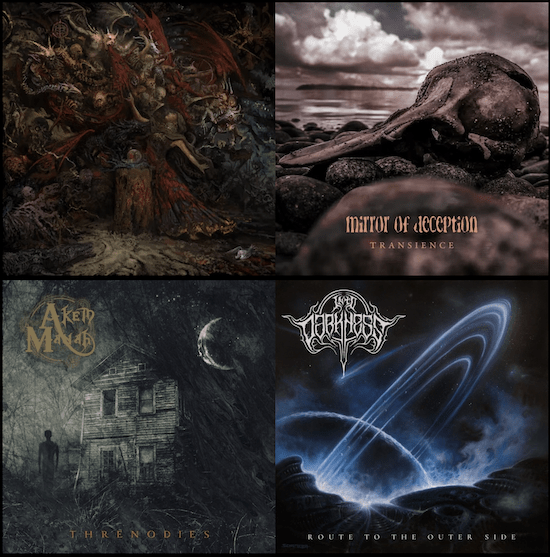
(Our writer DGR has been playing catch-up on records released earlier this year when other distractions interfered with writing about them. Beginning in mid-July he has delivered three Issues (which you can find here, here, and here), and now we have Issue Four bringing together extensive reviews of four more records released in preceding months.)
I don’t mind the heat too much, I’ve found that I’m still fairly operable as an individual until we reach 110 or so, which thankfully doesn’t happen too often. I get excessively grumpy when there’s humidity involved, which again, isn’t too crazy in my corner of California. Enough trips to the East Coast and the humidity there has at least pulled back the curtain a bit for me on why so many people involved in politics seems like a fucking angry moron. That sort of heat+humidity combo can rot the brain of anyone, and when you have so little to begin with, one trip to our nation’s beloved capital and you come back barely functioning. It’s why the size comparisons when people start complaining about heat make me chuckle, because there’s a different sort of suffering attached to each conception of ‘hot’, and truly, I will always feel like a soft child just barely toughing through them all as it is.
What I do hate is actually the first week of consistent heatwave wherein I have to come to terms with the fact that I’m going to have the AC unit and a fan in my room running constantly. The noise itself is enough if you’re a tender sleeper – I’m not – but what gets me is if I forget to tell the fan to stop moving back and forth, otherwise as I’m sleeping it feels like someone gently brushing across my face whispering ‘hey, heeeeeey, hey, you trying to sleep? Not today fucker’. So even for as much bragging of being able to survive on the surface of the sun, I’m still a grumpy fool.
That said, I much prefer the cold. I feel like the margin of error has an easier curve there. I can always put on more clothes, I cannot get more naked.
I do have a few more of these features to finish and I can’t make the visits to my local coffee shop with my laptop any more awkward than they are already.
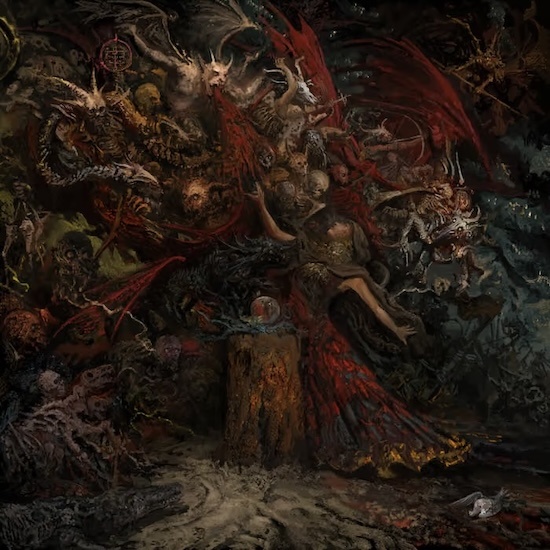
Godthrymmm – Projections
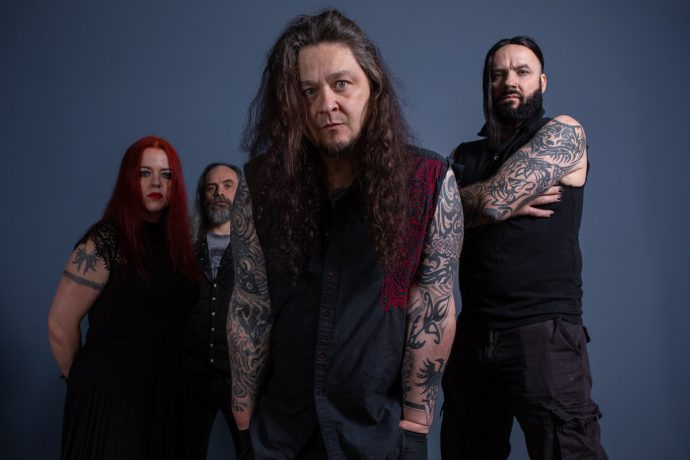
The career of British doom vanguard Godthrymm has been fascinating to watch. Launched by Hamish Glencross back in 2017, the group have evolved rather quickly over the course of three albums and three EPs from a strong proof of concept of dour mood and slow doom into something more all-encompassing of the genre as a whole. For a group whose chosen tempo lies along the general reaches of slow, their general output has been anything but.
The steadily evolving collective have proven themselves to be fiercely creative and even more so surprising. The continual evolution and exploratory path that the band have set themselves on has more than once caught people off guard. The core of Godthrymm is there and it is doubtful the band could ever fully let go of a guitar-tone seemingly built to heave earth into the other side of an arena, but each disc has shed new light and let the band discover new pathways. Perhaps the most-obvious thing about the group’s 2026 offering Projections is that the musical evolution remains just as steady as before, and yet the band still have a few different ways to surprise.
Though Godthrymm could still be considered a ‘newer’ band in the glacial aging that is heavy metal’s overall chronologic eras, they are a group constructed out of countless years of musical experience which allows them to recognize that everything stands on the shoulders of giants and that it is perfectly fine to construct a sound by reaching backwards in time to pull them forward into the now, with the occasional added sense of manic urgency. Godthrymm could’ve skated like a gold medal Olympian on pedigree alone but instead have proven themselves to be a steady engine of solid releases, and each one has had enough differences to it that there is a strong sense of individuality to their full-lengths.
They open and close on musical narrative arcs, and in the case of Projections a lot of that sense comes from just how up-front the vocal work is this time around. Alongside the towering riffs that seem to move with leviathan-stride, Godthrymm are stating that within the forty-nine minutes of Projections they have a few stories to tell.
Broken up across six songs – and a different closing number depending on which version you have for a grand total of seven, if you are like yours truly and find numbers difficult and words far easier – the average length of a song on Projections easily leaps the six-to-eight minute hurdle like nothing. Two of the songs – “The Sun Never Fell” and “Hope Is Eternal” – even share a similar enough run time of eight minutes and forty seconds, though neither takes the crown for hitting the nine-minute bar like “Endure My Skin” does.
A numbers obsession like this means about the same as a cup of water dumped into the ocean without wider context, and that is to say that if it isn’t obvious from the previous descriptions of the band’s sound it should be by now, with all of its bones and innards laid out for the world to see. Godthrymm enjoy a massive and often groove-heavy yet slow-tempo song – which means they have to work doubly hard to keep someone’s interest during the course of Projections without it seeming like they’re stretching simply because the format demands it, an act they mostly succeed at with only the occasional need to be nudged along.
Part of that aforementioned surprise with Projections is just how willing this album is to ‘rock’ in a few of its songs. Godthrymm have toed those waters before but have kept their ship steady with songs like the previously mentioned epic “Endure My Skin” – which has enough doom in it to satisfy the most ardent out there, and an assist from Aaron Stainthorpe certainly doesn’t hurt – and so they’ve become a bastion of a particular style that has been in creative stasis for a few years. Godthrymm have thrived in breathing life into their genre choices and have done well with a guitar-up-front approach for its releases prior. Yet, they demonstrate some serious power in an up-tempo double-bass roll during opener “Trenches Deep”, which is a towering mammoth of riff work and multiple vocalists resurrecting both the drama and psychedelics of the leather-bound trad-metal crews and early-doom forebears from a time when it was less outward misery and more amplifier worship.
Projections cycles around on itself, so that the front half of the release may seem a little frontloaded on the rockin’ atmospherics and then quickly, halfway through the album, turns inward and journeys back to the colder and depressive moods which are the bread-and-butter staple of this style. The presence of the aforementioned “Endure My Skin” is largely responsible for that impression but “The Sun Never Fell” just prior to it is responsible for the transition over as it hybridizes that up-tempo stomp with the slower-paced moodiness that intertwines itself with the back half of Projections. This lays the groundwork for the song “Jewels”, which features Catherine Glencross carrying the weight of vocal work on the song in a very mid-era Anathema maneuver. She even gets to do so again on the digital bonus track “Epilogue” for a haunting final few minutes.
Godthrymm are comfortable and well within their musical wheelhouse as a doom act, so while the surprises are pleasant the actual meat of the album being their chosen crawling tempo and roaring guitar solos turn out just as good. Closer “Hope Is Eternal” is almost oppressively heavy by comparison to its two preceding siblings as the double-bass drum feels as if it is slowly being pressed into your chest over the course of the song. Anytime it pops up behind a gigantic and imperial sounding riff it takes one’s breath away.
This is where Godthrymm find much of their success on Projections. The continual poking and prodding around the framework of their chosen genre keeps their music fresh even as the band members themselves have resumes that would easily allow for them to rest on their laurels. They’ve been a machine for soul-crushing music for a while now and Projections shows that they have little reason to ever let up. There’s vitality to Godthrymm’s music yet, and even though its inspirations may argue for the extinguishing of such through the emotional toll portrayed within each song, the band have an arguable creative fire that will likely be difficult to put out. Projections stands equal with its other full-length siblings in the Godthrymm collective and still maintains a strong sense of individuality.
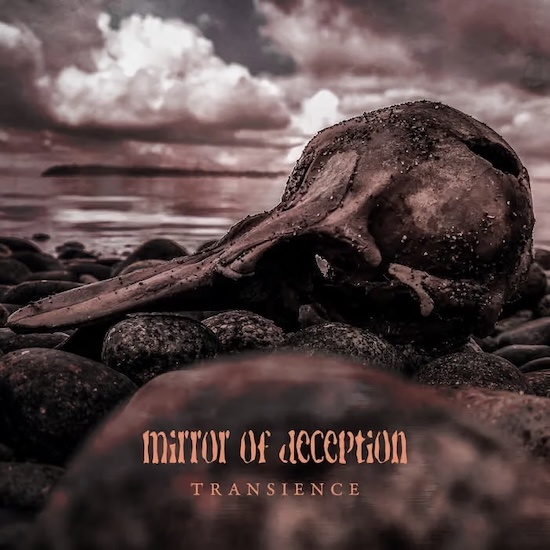
Mirror Of Deception – Transience
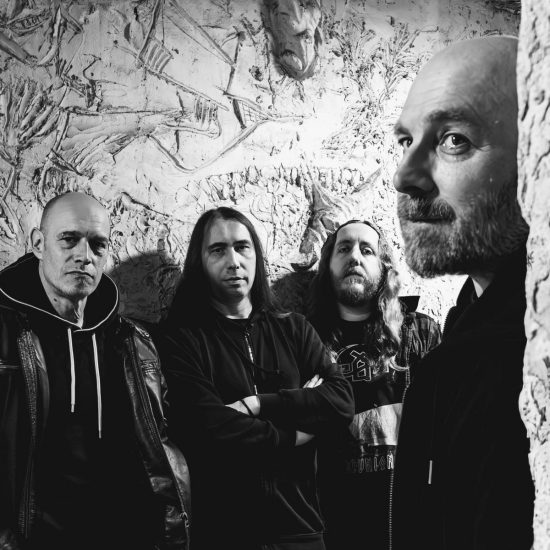
Mirror Of Deception hail from Germany and have had a long running career in their corner of the doom scene. We’ve often been two ships in the night in terms of listener and musician, which means that although I’ve seen the name a handful of times due to my predilection for sad-boy music, I just hadn’t found the time to give the band a chance in between my many tumblings into death metal and grindcore wormholes that often spat me out at other ends of the galaxy – about as far away as onecould imagine from a majority clean-sung, classic-inspired doom release.
Mirror Of Deception’s newest album Transience thus allows me to rectify a lot of those earlier mistakes and finally make time to give them the proper time of day, as well as to absorb a decades-long career for context, and cheerfully spread the word about a release that, while not the most unceasingly violent thing on the planet, does have songs with some of the most criminally infectious melodies that might otherwise be allowed in a sub-genre often flirting with smoke-haze and amp worship.
Daring to run contrary to our site’s name, the aforementioned clean singing is a large part of Mirror Of Deception’s sound here, though they do have a powerful yell within them that is used sparingly. Mirror Of Deception’s mastery of melody and hook-heavy lines is on display early in the album, and a song like “Death, Deliver Us” confirms that over and over again. Granted, Mirror Of Deception have had a long time to forge their mastery of such a thing and Transience is only the newest result. The album sports some new blood for the band on the rhythm section since their previous recording but they’re operating as a well-oiled machine from moment one of the album.
“Death, Deliver Us” is one of only seven songs on Transience but its hypnotic nature sets in early and the guitar leads that define the song slide into the top layer of it without them having to scream their way to the front to grab as much spotlight as possible. They drift into and out of the song as if they were ever-present figures, waiting quietly in the shadows. Yet the draw of those lead-guitar lines in just the opening number is enough to keep someone curious to find out what follows in “Currents” afterwards.
“Currents” is the more meditative of the opening two songs – a little on the shorter side by a minute – and propelled forward by a constantly downward aiming guitar riff. The steady pulse of the guitar arms the song with swaying footfall, as if wounded but moving forward by a refusal to lie down and let go. Again, Mirror Of Deception still flex that melodic lead guitar muscle, working a quiet melody into the back half of the song that dances in the background and evaporates behind the main verse but is still capable of catching a listener’s attention. “Currents” is about the same speed as “Death, Deliver Us” but it’s that consistent pulse that provides the song with a more mesmerizing nature than the first song.
“Haven”, following, is a straightforward radio single in comparison and could actually have a lot to offer to fans of a group like Khemmis; that group’s own recent outings lean more towards a bigger, rock sound than the opening amorphous, in between doom and traditional rock, sound they had gotten by with. “Haven” is three minutes of mostly clean-sung – yes, Mirror Of Deception let loose the occasional powerful roar here – and uncompromising morose rock in an album that is mostly consists of longer five-to-seven-minute songs.
A song like “Haven”, though, allows us to see what creatures lay in the belfry of the opposite end of the spectrum within the seven-minute songs “Consumed” and album closer “Meander”. Both are songs whose large appeal is going to be in an appreciation for a funeral doom pacing, though “Consumed” is the more traditional of the two in that regard. Seven minutes each gives the Mirror Of Deception team time to pick and choose where each moment will hit with maximum impact.
“Consumed” is a creature comprising moments wherein the percussion hits like it could leave cracks in the ground. Still as heavily hook-leaden as the earlier songs throughout Transience, “Consumed” is seven minutes earned the traditional way – in trudge and thud, harmony over the guitar, and morose mood – and will likely cause some whiplash after the high-riding “Haven”. “Meander” is more dynamic on that front; it doesn’t speed up as often but shifts its moods through differing approaches to its sound. There are multiple times throughout “Meander” in which the entire band isn’t present. You are floating atop echoing guitars, quieter acoustic bits, vocal-only segments, softer keys in the opening, and then a full release of a band. The song itself meanders from point-to-point, still steadily holding on different solos and lead melodic bits. “Meander” is a grand song with a lot contained within it, and as the album closer, Mirror Of Deception are putting forth everything Transience uses as an album into one song. It’s a fantastic bookend to the overall event.
Transience is an album that has the feel of a relaunch of a band to it, yet with the assurance and confidence that they are going to continue doing what they always do. Mirror Of Deception have experience on their side yet Transience is an album that has a lot of vitality to it. It’s tempting to look at it as expertly crafted doom with an air of the trad-metal old guard poking their foot in the door, but the band have expertly combined many different things together here, such that they just come across as well-practiced song craftsmen.
The seven songs present on Transience are slow but not nearly as outwardly depressing as you might expect; it’s a very introverted and meditative album by comparison, one built from strong guitar, strong rhythm, and a strong sense of vocal harmony that never loses track of how each song is moving. Mirror of Deception rock hard, drift as easily, and depress as well as you might expect a long-running doom band to do, but Transience isn’t doom of the oppressive emotion front. It feels like it gives a bit of life to the cold weather and grey clouds that hangs over its head, and in doing so, Mirror Of Deception have unleashed upon the world a very strong and incredibly infectious doom release upon the world.
Akem Manah – Threnodies
I cannot make the world colder, much as I may beg higher powers, creatures eldritch, and general universal entropy to do so. My favorite Mortal Kombat characters being Rain and Sub Zero are not necessarily evidence of me enjoying a good anti-hero or a fucking sick-looking eye scar but rather a subconscious desire for something other than endless sun, humid nights, and weeks of constant 100+. Also, to be fair, that is also a fucking sick eye scar.
Granted, given the global warming trend and the fact that I am a soft California child there are people in the immediate vicinity of my own country who have it much, much worse, but know that my desire to become Mr. Freeze is born more out of empathy rather than any particular desire to get into a measuring contest over just how hot it actually is. Perhaps, though, my latest attempt at metamorphizing myself into a creature of colder temperatures and slower-moving blood is why this particular grouping is so packed on the doom front, because I wound up vacuuming up a handful more bands outside of my usual handful of reliable go-tos and have felt that I must share them with you.
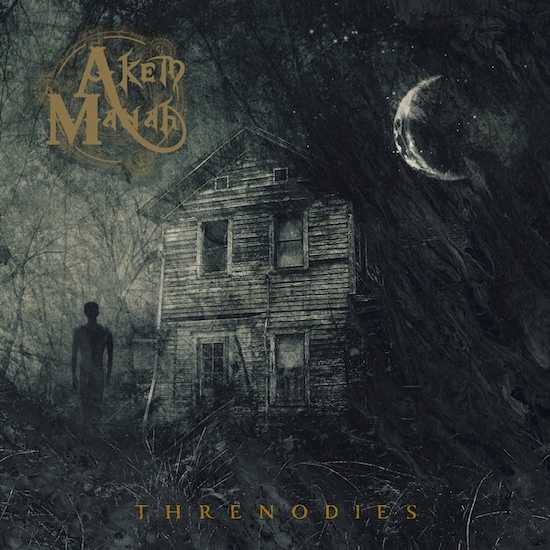
If, however, I were asked to pick a dark horse candidate for the one I found the most pleasantly surprising among the many that found themselves snagged in “the great DGR content maw”, then I would have to award that honor to Belgium’s Akem Manah, whose album Threnodies has managed to fascinate me since the moment I came across it.
The group’s sound is recognizable enough; an unholy combination of My Dying Bride, The Vision Bleak, and an occasional burst of black metal dramaticism by way of bus crash combines for an hour-plus of haunted house horror stores taking place over the course of ten songs. Threnodies paints itself as a creature of obsession, with each song dedicated to a different person “who, out of grief, faith, or hunger for meaning, reached too far into the Mythos.” What this boils down to as a listener is ten surprisingly distinct stories being told with an equal attempt to have every song stand on its own. It takes a lot of confidence in your sound to be this bought into your own ideals, and thankfully, Akem Manah are more than capable of backing up any claims made by it.
There is no guaranteed sweet spot for the length of an album, though thirty-to-forty minutes tends to be a pretty good one to aim for without having to put in extra effort to justify a listener’s time. An hour-plus and you’re going to have to work very hard to maintain a listener’s interest, but its both sides of the story are understandable when it comes to discussing the album length. Threnodies is a very theatrical doom album and so the longer song lengths are to be expected – some bands manage to reach this time in three songs for instance – and Akem Manah work very hard to meet the aforementioned justified listener expectation. While the album’s flow is consistent among its track listing, each song is its own ‘beginning to end’ journey to be undertaken with a small collective of interludes and segues breaking up the event.
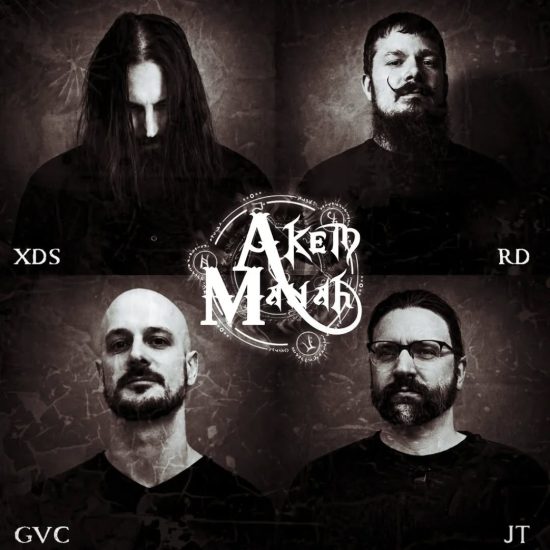
Also, Threnodies is only Akem Manah’s second full-length, arriving sixteen years after their first album and fourteen since their most recent EP. So, to put it politely, Akem Manah might’ve been a little pent up on the creativity front, and once the machine starts rolling again it can be incredibly hard to rein it back in. Stating up front that Threnodies is a weighty album doesn’t come from a place of warning but just a general suggesting that there’s a little bit of time investment involved here, something whose negative airs are immediately blown away once you hit the first grand-sounding organ stings and violin in “The End Of Earnest Hollow”.
The sense of drama that pervades the whole of Threnodies is impressive, and Akem Manah construct it so that the album has proper instrumental bookends – “The Inevitable Fate Of Francis Cobb” and “The Hanging Of Edward Hope” – and an instrumental middle segment in “The Undoing Of An Unknown”. On either side of the gates of those songs are four songs each, with a few impressive standouts on each side.
The opening half contains “The Burning Of John Briggs” and “The Journey Of Nathaniel Johnson” – two songs wherein the opening elements of Threnodies as an album begin to cohere. “The Burning Of John Briggs” is the ominous evolution of the music put forth in the aforementioned “The End Of Earnest Hollow” and, like much of the album, it continues to expand upon the lumbering footsteps that each measure of the song moves forward with. The touch of black-metal atmospherics and theatricality that worms its way into Threnodies as a whole begins to make itself more known beginning with this song, with the occasional raspy scream invading a space otherwise occupied by mournful intonation for much of the album.
“The Journey Of Nathaniel Johnson” is a grind song by tempo comparison with half of it swaying back and forth like a ship caught in a storm. “The Journey Of Nathaniel Johnson” does lure listeners into a false sense of security as a quieter acoustic guitar intro shifts the pace of Threnodies after “John Briggs” prior crashes to a halt, but the change of pace and brief mid-album breather actually happens during the aforementioned exotic adventure of “The Undoing Of An Unknown”.
The collective of unwitting individuals, philosophers, authors, poets, and others who meet their ends throughout Threnodies matches the eclectic nature of Akem Manah’s influence hybridizing. “The Sleep Of Eve Saldana” sounds like a mad opera due to the prominence of strings dancing their way throughout the song and “The Demise Of John Dunn” standing next to it is a complete funeral-dirge by comparison. That constant back-and-forth dynamic of a song’s core assists in the effort to keep events interesting throughout the album. If not interesting, then at the very least the sense of drama remains high.
It’s difficult not to look at Threnodies as both an album and something of stage play given that Akem Manah have prescribed themselves a cast of characters to play with and inspire each song. This is what helps maintain the fascination with Threnodies, in that sometimes if not on a full-album run hearing the tale of each particular song can be just as interesting. Still, as of this writing, the album reveals surprises that weren’t otherwise noticed when the full operatic grandeur of the album had settled in and made an hour pass surprisingly quickly for a disc whose ‘get up and go’ moments seem oppressively heavy due to how distant they remain from one another.
It’s a wild thought that we had an absolute wall of quality doom releases collapse on us over the course of late spring and the beginning of summer. It’s understandable as festival season is often the fire lit under many an album release, but still, an album like Threnodies is perfect for the impending darkness and cold that fall brings with it. Threnodies did a solid job darkening what seemed like endless sunlight as it was currently placed. It makes good use of its ongoing laments in each song, and the alternating mournful vocals, haunted intonations, and occasional bludgeoning differentiate particular songs well. The times when Threnodies descends into mad opera are exciting and, likewise, the haunting from beyond that each song hints at is enough to maintain a solid interest throughout.
Threnodies is oddly magnetic even when you feel as if you’re seeing exactly how the machine works, and yet this is a release that also deserves a ton of credit for being able to keep from dragging too much over the course of its many six-minutes-and-higher songs. It is not an easy act with the slow movement that these sorts of dirges ask for. Threnodies is an excellent example of gloom-infused hauntings in doom form done well.
Into Darkness – Route To The Other Side
The world cannot be entirely doom in our attempt to bring the temperature down, though. Plus, at a certain point we do tend to run out of ways to describe the gargantuan steps a doom song will take, as it slowly lurches forward and drowns its listener in reverb and feedback. We do, however, have our two old reliable teammates that if nothing else tend to guarantee a pretty good time: death metal and the wider cosmos. Combining the two for inspiration? Well that’s just a genius maneuver.
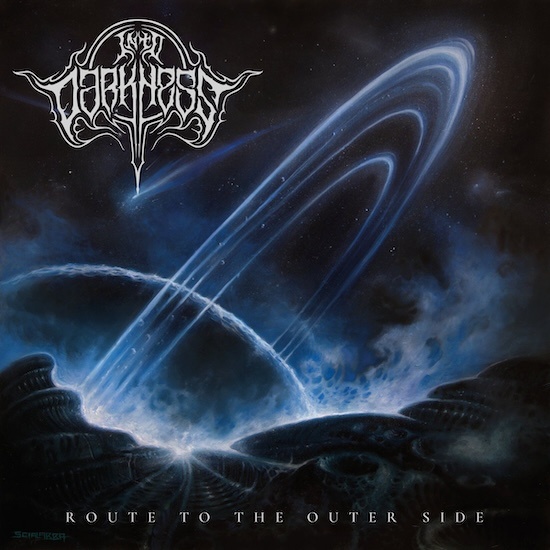
Italian group Into Darkness are the latest to realize and act upon this, and as a result have crafted their first full-length Route To The Other Side as a death metal journey through the outer part of our solar system, ranging from Jupiter to Pluto with a few stopovers in between for eight songs and forty minutes worth of bludgeoning music.
Into Darkness landed on my radar after we premiered a song from it in the lead-up to Route To The Other Side’s release. This will happen often, in that we premiere a song from the album and thus it finds itself part of an ever-growing queue to follow up on later when the full release happens. Into Darkness’ two songs at the time, “Uranus” and “Jupiter”, managed to capture my interest enough that the late-July release of Route To The Other Side was something I was keeping an eye on.
Again, I’m a sucker for space as a whole, and often when bands decide to use it as their font of inspiration for an album you wind up with something fascinating – even when those connections can be at their most tenuous. Into Darkness use it as their main driver for creating frosty and glacial death metal, with guitars that are both scratchy and crunchy enough to be well within the realms of earlier generations of death metal, yet manage to fly above any song to which they dedicate the briefest of lead melodies. Otherwise, Route To The Other Side is one of those albums that could be described as a constant barrage of guitar riffs and ideas that dart into and out of the listener’s blind spot at every opportunity.
Of course even a whipsawed tour through the back half of our solar system – accompanied by two instrumentals even – is going to generate some incredible bright spots that can be seen from our terrestrial shores. Though it has been long treated as a failed star, “Jupiter” ignites in song form on Route To The Other Side, with its immediate follower “Saturn” making use of its five-plus minutes to rumble through many mutated forms. “Jupiter” before seems like a near head-on collision of ideas when standing next to the slightly more melodically minded “Saturn”.
“Saturn” however is the song wherein Into Darkness show that they have a multitude of ideas in play for each song, as the bass crawls its way to the front of each moment just as the song transitions into something else. The near-feral howls emerging from vocalist/guitarist Doomed Warrior become the one true calling card of each song on this album. They’re the pillar that each song is built upon as the songs themselves careen through the time they ask of you.
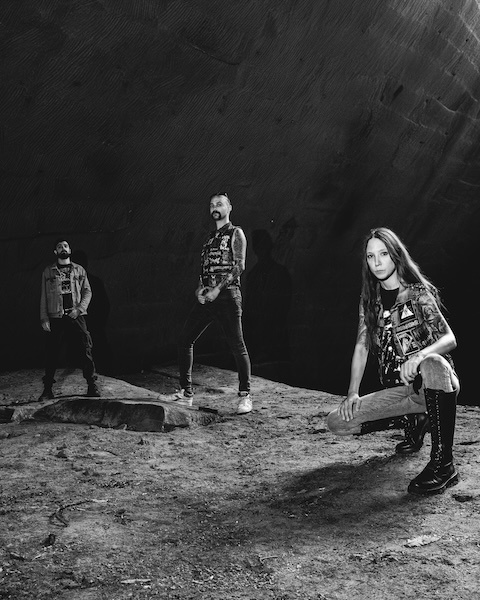
True epics like “Halley” and “Pluto” – which finally sees some justice in being one of the largest objects in something – lie in the back half of Route To The Other Side, broken up by the instrumental “Kuiper Belt” and followed by the titular “Route To The Other Side” as the closing song. “Halley”, you might guess, barrels through a bevy of inspirations, a vault of death metal cracked open just to assemble one song. It shares much with its galaxy-dwelling doom-metal brethren at first before picking up the pace with a variety of circle-pit-summoning guitar. Into Darkness conjure violence as “Halley” continues on, and the song itself eventually becomes as percussive as the drums themselves, everything focused on a constant hammering until a guitar solo basically tears the whole song down just to remind it that a solid tank-beat can carry a song just as well as a steady double-bass roll.
It will not come as a surprise then, given the cracking facade of stability that is present within each song on Route To The Other Side, that as the last fully realized song on the album, “Pluto” closes chaotically. It takes up the torch of having to package up all of the ground covered into seven minutes of hyperactive death metal whose final minutes sound as if they were recorded inside a hurricane. Into Darkness get as close as they can to booting their instruments out of a window in “Pluto”, which starts as close to composed as the band will let it get – including a surprisingly catchy guitar solo – and then by the end of it has descended into cacophony. “Route To The Other Side” closing things out on two minutes of straight-shot riffwork feels like mana from the heavens by comparison.
Route To The Other Side is not the most wildly inventive release out there but it is absolutely wild. There’s an animalistic urge being filled in its conjuring of the veteran death metal spirits. Even though its inspiration is an otherwise frozen cosmos, the music itself runs hot and mutates fast. It just as often assails you as it entertains, and though the mosh riffs are recognizable without the aid of a powerful telescope they often burn up just as quickly as they appear. Into Darkness are exceeding talented at the act of rumbling from one section to another, escaping out of a segment just before it seems to collapse on itself, and segueing the song into something just to the side of it.
It is a towering amount of razorblade-sharp guitar to scale throughout Route To The Other Side, but without it this release wouldn’t feel nearly as teeth-bared as it does. The rhythm segments that define the album are as cold and jagged as they come as well, and in combination with the rest of Into Darkness, manage to create a sizeable block of death metal that you shouldn’t let soar past your radar.