
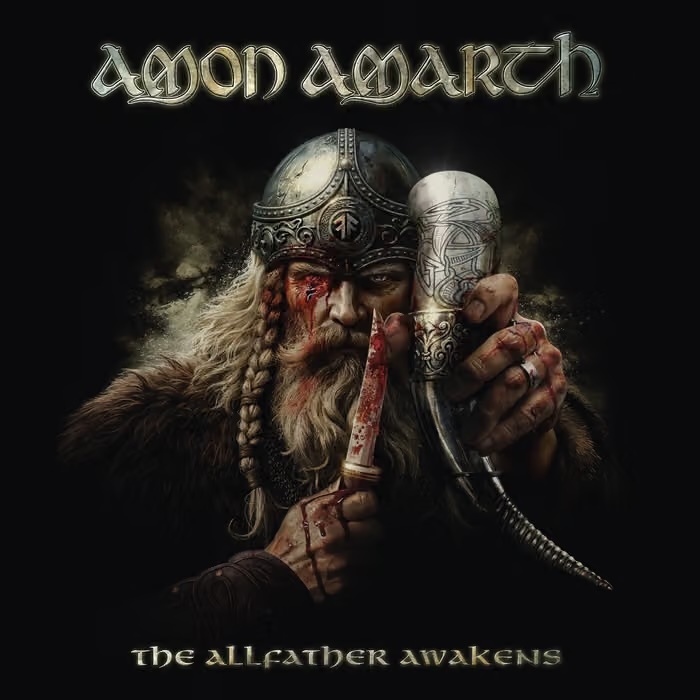
(Earlier this month Metal Blade Records released the latest album from Amon Amarth, and DGR decided to share his thoughts about it — below.)
Oddly, it did not feel as if close to four years had passed for Amon Amarth between the release of 2022’s The Great Heathen Army and their latest release The Allfather Awakens. Perhaps, because somewhere along the way we finally decided in our collective subconscious to elevate Amon Amarth to both meme status and as one of the bigger metal bands out there, it has felt like they’ve been ever-present. They seemed to tour very hard behind The Great Heathen Army as well, and a decent drip-feed of singles kept the band in the limelight.
It’s easy to see why, because at this point in their career – and thirteen albums in – Amon Amarth really don’t have to work hard to establish themselves. You could pick vocalist Johan Hegg by sound out of a lineup while you had leaf blowers aimed directly at your face at this point. They’re inescapable on any metal shuffle playlist that the internet’s beloved algorithms throw at you, having found such a steady median to exist on across a few different genres. You don’t even need to describe the band by the quality of their music anymore as they’ve become one of the few that’ve codified a specific sound, spread neatly among galloping riff work and power metal adjacent guitar leads.
They’re “the Viking band”, and for a lot of people that descriptor is entry-level enough that they don’t really need to devote much thought to whether that actually means anything. Amon Amarth certainly haven’t needed to, essentially locked in place since the days of Twilight of The Thunder God. A steady mechanism of solid music with the occasional fun experiment, with only The Great Heathen Army representing a dip in quality as the band went a little too hard into medieval times cosplay territory. The course correction is even an easy one for the group, and it is one they perform on their newest album The Allfather Awakens.
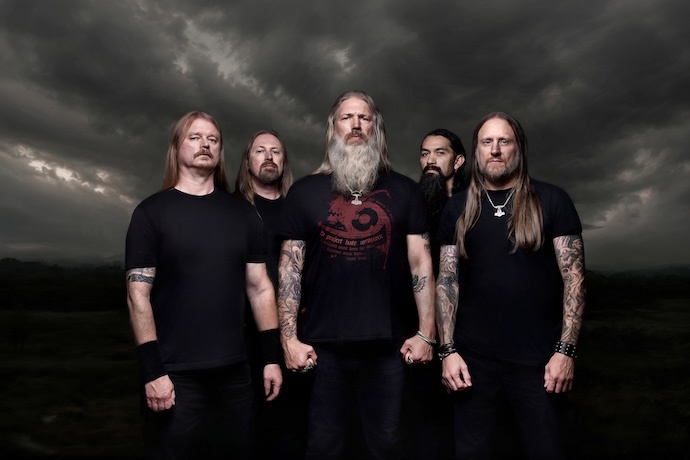
photo by Sylwia Makris & Christian Martin Weiss
The new album returns them back to that steady universal medium of solid-to-good, fantastic on overall song shuffle, and occasional experiment to break things up. By that same token, you’ve likely guessed by now that Amon Amarth directly in their comfort zone sounds exactly like the Amon Amarth of the last decade-plus. Thus, we gird our loins again for another trip into Viking mythology and history to sift the great from the decent on our latest edition of “the wider Amon Amarth catalogue”.
The Allfather Awaken’s early goings maintain a steady pace through what you would expect from an Amon Amarth album. If you’re taking the holistic view that every Amon Amarth album is going to be somebody’s first Amon Amarth release, then the opening four songs on the new one do a solid job welcoming people into the fold. “Gjallarhorn”, as you would expect, takes the traditional tact of being the opening shot in the arm that awakens the listener to the journey of Odin that serves as parts of the inspiration for this album.
When you hear people refer to groups like Amon Amarth as being incredible to just mix up and let run wild on your playlist for a few hours, a song like “Gjallarhorn” is a perfect example. Red meat for the Amon Amarth fans, comprising steady double bass that drummer Jocke Wallgren has had no qualms about providing since joining the band, and an anthemic chorus made for the more “yo-ho-ho” and waving your drinks around crowd to sing along to. Partially epic but mostly written to provide an early opportunity to circle pit, “Gjallarhorn” is Amon Amarth’s stock and trade.
“Eight Legs Of Thunder” could draw similar comparison if it weren’t for the light spaghetti-western soundtrack in some of the main guitar leads – cross-cultural horse riding then! – which it seems those that provided the music video for the song seemed to have noticed as well. Otherwise it’s a six-syllable chorus, and buddy, we’re on to the next galloping guitar part. Amon Amarth waste little time getting back to the legend-telling on this one.
“Kvasir’s Blood” takes the early title for being the mid-tempo stomp song – of which quite a few appear in The Allfather Awakens – much in the same vein of earlier “Guardians of Asgard” flag-bearers that’ve appeared on every Amon Amarth album since the initial titular reference. Whereas “We Rule The Waves” is one of the bigger crowd singalong moments and at this point is almost fated to be medley’d with “Put Your Back Into The Oar”. If Amon Amarth have any more boating songs in their catalogue coming up they’re likely going to have notify the estate of Jimmy Buffet.
“We Rule The Waves”, however, finds itself with the challenge of being the spiritual younger sibling to a song already out there and so starts a little on the back foot. “We Rule The Waves” favors the thunder of guitar rather than the low-end hammering of its predecessor, though both are more than happy to sway back and forth like a light pole caught in a steady breeze when it comes time for the big, epic, full-throated chorus. Denying the infectiousness of it is a little foolish but this is an Amon Amarth hallmark. We expect this, and we’d be more disappointed if we didn’t have the big power-metal adjacent singalongs every three or four songs on an album like this. It’s just the familiarity of it that holds it back from seeing its full potential.
The heavy intonations of “Upphaf” and its retelling of legend are interesting at least, breaking up the usual Amon Amarth flow for a song that is fully acoustic. They have a freedom to play with ideas like this when you know the majority of the release is going to be a big block of Viking glorification set to music. While it isn’t as shocking a change of pace from the Amon Amarth camp as “Heidrun” was, “Upphaf” does solid work in keeping The Allfather Awakens from getting too staid. Johan is still growling his way through the song but much lighter and obviously way more intelligible given the calmer nature of the song.
Afterward is one of the heavier songs on the album as a whole, which is “Die With A War Cry”, filled to the brim with recognizably heavy riff-work set to a medium stomp. The guitar leads are darker as a whole on the song, given the dedication to death, and almost land in the imperially militaristic realm that Poland’s Hate have mastered. Not quite as percussive as Hate have been, but that lead melody has the same serpentine attack that they’ve played with. At the very least, the earthquake-rumble of “Die With A War Cry” is new-ish to Amon Amarth’s overall cannon fire, and often when you’re dealing with a seasoned band, the back half of the later albums in their career tend to fall off hard.
The Allfather Awakens isn’t completely immune nor does it falter heavily enough to be noticeable. “Raven God” does its best to summon up specters of earlier blackbird-related songs in Amon Amarth’s collection and “Oden’s Hunt” is the late-album highlight by far, even if it is the most Amon Amarth song to be summoned in the album’s lineup. When they do their chosen formula and execute it well, it’s still great, it just doesn’t provide a tremendous amount of room to breathe creatively these days unless you take some wild swings, which Amon Amarth have no need to do at this moment.
Amon Amarth live the existence of their album protagonists, forever in search of glorious battle. Whether that be with mythology or their immediate album, Amon Amarth are going to be in combat whether they mean to or not. Given their nature of iterating and slightly shifting their sound, the only comparison point for the band can be the immediate predecessor. Otherwise we spin in circles forever to come to the same conclusion with The Allfather Awakens that we do with many Amon Amarth discs: It’s an enjoyable release, not particularly challenging or mindblowing but the Amon Amarth formula at its most basic still works to an extent. Who could fault them for having stumbled across an easy-going writing style that happens to work well enough that they’ve been able to move into AC/DC territory without anyone jumping all over them for it?
The Allfather Awakens is interesting in the sense that it is a lot less spectacle than The Great Heathen Army. Amon Amarth aren’t stripped down but they are at their most core-blueprint on The Allfather Awakens. No sudden surprise appearances, no guests, even the cover art is fairly straightforward. The album is Amon Amarth unleashing a steady-paced Amon Amarth album. A couple of great songs, an interesting experiment, and then filling out the rest with their standard M.O of “epic sound and solid groove” for the usual decent results. For certain, the band will have a few songs here that could battle their way into the live setlist for some time to come, but if they’ll have permanent staying power when placed in battle with twelve other albums beyond the initial support cycle? That’ll be a wait-and-see game.
https://lnk.to/TheAllfatherAwakens
https://amonamarth.bandcamp.com/album/the-allfather-awakens
https://www.facebook.com/amonamarth