
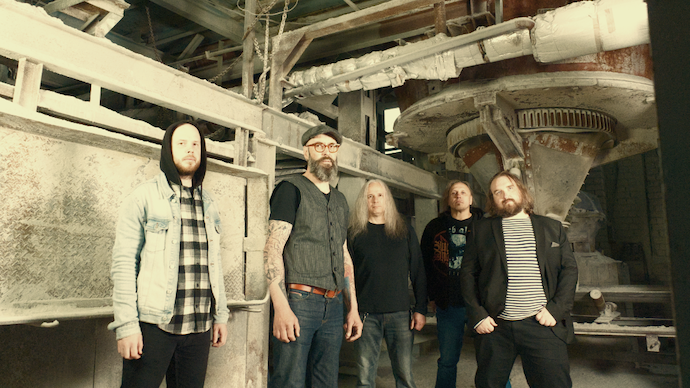
(Today we present Comrade Aleks’ interview of Kristjan Virma from the long-running Estonian band Taak, whose latest album was released last October.)
With the Estonian band Taak, things are both simple and complex. Formally, the band has been around since 2004, but in fact, that year the entire lineup of Estonia’s first doom metal band, Dawn of Gehenna, simply changed its name and, to a certain extent, its concept.
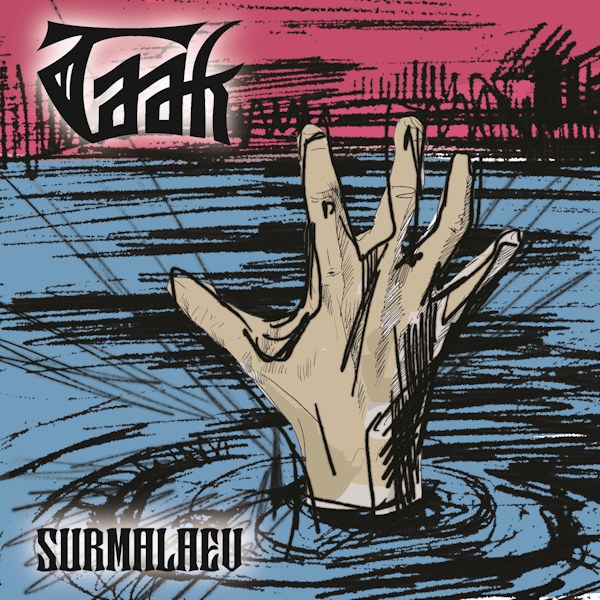
Taak (“burden”) took up more old-fashioned material, something akin to proto-doom, and began writing and performing lyrics in their native language. The result is authentic, melodic, heavy, and engaging. Meanwhile, you may remember all of this due to another “exception from rules” interview we did here with the band in December 2020. Time flies. Today, only Ott “Otipowitch” Oras (bass) and keyboardist Kristjan Virma (guitars, keyboards) remain from the original Taak lineup, but I must say, their sixth album, Surmalaev (“Death Ship”), sounds like it was written by a well-coordinated, experienced band that holds true to its roots and knows what to do with that legacy.
The forty-minute Surmalev features eight tracks of engaging, traditional doom with a slight stoner edge, retro keyboards, proper, pumping riffs, and captivating melodies. The clear voice of the new singer Ott Pabbo, formerly of the stoner band Jadira, while sounding different from that of original frontman Mart Kalvet, nonetheless lends itself well to the new mid-tempo hits. This doom exudes a pleasant melancholy and nostalgia, its traditionalism is truly enjoyable, and the songs’ thickness and drive connects Taak with bands like Lord Vicar. As for the changes in sound, it’s now slightly more doom-rocking, more fluid than what we heard on the previous album, Supersargasso. Taak sounds recognizable, powerful, competent, and it’s nice to know that some things get better with time.
In order to support this release we managed to commit this interview with Kristjan Virma, and I invite you to learn more about renewed Taak and their Surmalev.
Hi Kristjan! How are you? What’s going on in Taak’s camp nowadays?
Hello, Alexey.
Right now, things have calmed down a bit — the hustle and bustle around the new album release have started to fade. Our plan was to start rehearsing some older songs with our new guitarist, who recorded the new album with us, to add more variety to our live set. But since our longtime rehearsal room is currently in a strange limbo (against our will, it’s undergoing renovations with no clear end date), we haven’t been able to practice as actively as we’d hoped. We still have a few shows lined up, though, so at the moment it’s more of a planning phase for us.
Is it a problem to find a proper place for rehearsals in Tallinn? How regularly do you tend to rehearse during past years?
The difficulty of finding rehearsal spaces and suitable conditions depends on what exactly you are looking for. In Tallinn, there are a couple of so-called rental rehearsal rooms where the necessary amplification equipment is already provided on site. Simple – just find a slot online, book it, and show up.
However, most active bands prefer having their own space – either shared with a larger group of people or exclusively for themselves. So, if you want a space of your own, the selection of affordable premises with neighbors who can tolerate the “noise” is becoming increasingly limited. Capitalist rationalism, you know.
As for Taak, we generally don’t rehearse very intensively. In the past, our rhythm was to have 3–4 rehearsals before a show. Recent times, due to a change of guitarists, rehearsals have been more regular.
Well, a lot of everything happened in the band, and the lineup was updated critically. Can you summarize these changes? Who’s in the band now?
Yes, over the past few years there have been quite a few changes in the band’s lineup. It started when Mart left the band at the end of 2020. We found a replacement for Mart a little under three years ago. Not long after that, our guitarist Urmas also stepped down and then at the beginning of 2024 we had to start looking for a new guitarist to replace Urmas.
We brought in Mihkel Maidla (formerly of Desert Queen), but a year later he also left the band after moving back to his hometown, which made continuing with the band in Tallinn logistically impossible.
As of today, the lineup looks like this: vocals are handled by Ott Pabbo, who has previously been active in bands such as Smõuk (a legendary Estonian psychedelic stoner rock act) and Jadira (also stoner rock). Guitar is played by Raiko Parts, who has also played in Jadira and is currently active in Külmking (modern metal with a pagan touch). The rest of the lineup has remained unchanged for the past ten years: Ville Veering is still on drums, Ott Oras holds down the bass, and I take care of keyboards as well as the more rhythm-driven guitar parts.
Such changes always influence any band’s chemistry for good or bad — how did new lineup work on Surmalaev? How much changed in your approach to songwriting?
Yes, a change in band members is always a bit nerve‑racking — on a personal level, we didn’t know Ott or Raiko beforehand, and you can never be sure what someone’s personality is like or what might cause friction. At this point, though, I dare say we’ve got a solid and productive lineup, and things are running smoothly. With Ott and Raiko joining, the band’s average age dropped quite a bit, but that’s only a good thing — fresh perspectives and so on.
As for songwriting in relation to the Surmalaev album, there weren’t any major changes, because the songs were already essentially finished in terms of the music. Half of the tracks actually date back to 2021, but we started learning the new album’s material together at the beginning of last year, when Raiko joined the band. The final arrangements grew naturally out of playing the songs together and figuring out what felt right. We had tried one or two songs earlier with Mihkel and Ott (Pabbo), but nothing was set in stone.
So, in that sense, the new lineup was able to start almost from a clean slate, and the whole process didn’t bring any surprises.
From a first glance the new stuff sounds more doomy than probably the two previous ones, which tend to more authentic, out of genre directions. Did you aim to stick to a certain style this time?
Yes, I think I understand what you mean. In hindsight, the new album does evoke a much clearer connection to the traditional doom‑metal aesthetic. On average, the overall tone leans more toward heavier and more oppressive atmospheres. Considering that a couple of tracks were left off the album and remained in the drawer — and some of those were actually more experimental and faster — the end result is quite expected, and very much in line with what you’re pointing out.
Stylistically, we made a conscious decision not to stray too far from the general direction established on the previous album, simply because there were already enough changes happening. Especially with a new vocalist, who naturally draws attention in such situations. In that sense, this album was indeed the result of a deliberate ‘style choice’ — something we hadn’t really imposed on ourselves before. Previously, we just wrote whatever came naturally and felt right in the moment. This time we tried to keep the musical side a logical continuation of the previous record, so there wouldn’t be too many new variables at once.
The only area where we aimed for a notable shift was in the production — the material demanded a dirtier, richer tone compared to Põgenemiskatse, which was intentionally cold, bleak and machine‑like in its atmosphere.
Was this propensity towards dirtier and more oppressive atmosphere influenced by some external influences? I mean that even though you started compose the songs during COVID with all its gloom, recent times seem to be even darker.
Yes, the times and circumstances around us really are becoming darker. Interestingly, for several years now we’ve been in a situation where the whole society (at least in our small world) is captivated by topics that, in one way or another, affect us all. And unfortunately, those topics are not positive.
Personally, I tend to believe that art, in a broader sense, doesn’t have to mirror these ‘situations’ or follow their lead. Perhaps quite the opposite — maybe in such an environment art should focus more on ‘timeless values’. Or alternatively, it could offer a stronger sense of escapism as a counterbalance. In the sense that so much gloomy crap keeps pouring in from reality that one simply gets fed up with it.
As for the album Surmalaev, I wouldn’t say that the material as a whole was directly influenced by the pandemic. Perhaps some allusive elements reflecting the situation found their way in, because in the end we are all products of our environment. But consciously and deliberately – no.
The darker overall atmosphere of the record is primarily the result of its core being built around slower songs and the themes they carry. Taken together, this led us to the realization that the emotion we wanted to bind the songs with was raw anguish and the brutal indifference of inevitability. We tried to achieve that feeling by shaping the soundscape accordingly, and also by intentionally leaving certain rough edges intact to preserve a sense of rawness and immediacy.
There is, however, one track directly connected to the pandemic: “Ajatu ootus” (“A Wait Beyond Time”). It was meant to remind us that there are still forces in this world whose vastness and might we cannot truly comprehend. That song was indeed written with the specific situation in mind.
Meanwhile the new material sounds like Taak does (despite all odds), so you managed to keep your identity. How do you define the integral parts of the band’s sound?
The sound of Taak… Well, having a specific sound has never really been an end in itself for us. A kind of ‘signature sound,’ so to speak — it’s never been a deliberate goal. The musical character of today’s Taak (the last four albums) comes from the idea that we don’t try to create atmosphere through sound design, but through melody. At the same time, in our music melodies, riffs, and vocal lines all compete for space. For this to work, everything has to be in balance, and each element needs its own room — so the playing field is actually quite limited.
Over the years we’ve developed certain arranging principles and instrument‑level sound‑choice rules that, in our experience, work for us and that we’re able to achieve with our abilities and the tools we have. In short, the guiding principle is to keep things simple and leave space for every instrument. So, there’s nothing particularly complicated about it — I’d say our ‘sound’ has evolved organically and found its natural path over time. So, it is hard to lose it if you are not trying to do it deliberately.
Mart Kalvet wrote the most part of the lyrics for previous albums alongside you, and it looks like both of you always had an authentic and poetic vision of how should it be. How did you deal with the lyrics for Surmalaev? What’s it about?
Let me clarify — if this is what you meant — Taak hasn’t used any lyrics written by me on the earlier albums…
Sorry for interrupting, but yes, I thought the same, but I found it in discogs accidentally!
Yes, Mart and I have discussed certain images or themes when shaping the lyrics for some songs, just to make sure the words connect better with the music as I feel it, but I haven’t previously written lyrics for Taak that Mart would have been willing to sing.
Taak has been a part of my life for a very long time, and for even longer I’ve been lucky enough to create music together with Mart — let’s just say that over such a long period some things inevitably rub off. On top of that, we both enjoy philosophical sci‑fi and we both find the Lovecraft Mythos an intriguing source of inspiration. And existentialism — which is essentially one of doom metal’s core themes — runs through Taak’s lyrics. I don’t see that disappearing anytime soon. So, stepping into that role, picking up the baton of ‘what the songs should be about,’ wasn’t really difficult.”
Ott Pabbo: “I don’t think there was any conscious effort on my part to continue on the same road when it comes to the lyrics on the new album. I believe that Kristjan and myself, and Mart before me – we all share a certain deep admiration for language, especially for the Estonian language, and we all also appreciate the way lyrics can be used to tell a story in conjunction with the music. So, any poetic similarities in the lyrics I have produced probably come down to that. And of course, the sources for telling a good story are limitless in a doom rock setting, be it made up or from real life itself.”
Kristjan: “‘Surmalaev’ — literally ‘Deathship’ — isn’t a conceptual album in the strict sense, something you could sum up with a single sentence. Still, it somehow turned out that the word ‘death’ appears in the lyrics quite a lot. And since it had been used very sparingly in our earlier lyrics, we decided not to hold back this time and make an album that ‘talks about death’ — using it allegorically to explore themes of transience, inevitability, redemption and change.
So, there you have it — I guess in the end we did manage to sum up the album with one sentence after all.”
I just read a biography of one metal band who used English for their first two albums because it’s the “international metal language”, but you didn’t change your mind, and continue to use lyrics written in your mother’s tongue. Didn’t you think to change your approach to the songs’ lyrics when you recorded Surmalaev?
No, not for a moment. Of course, even we — all the current members of Taak — have gone through a period in different bands where, in the hope of reaching a wider international audience, we wrote or performed songs in English. The band name Taak was adopted specifically for performing music in Estonian, and Taak simply wouldn’t be Taak if we switched to English. Using Estonian is coded into this band DNA.
If there were ever a desire to release music in English, it would have to be done under a different name — or by using the band’s previous name, Dawn of Gehenna, which, by the way, released an EP in 2007 that included a selection of Taak songs translated into English.
By the way, how did you organize the recording of Surmalaev technically? Do you have a favorite studio in Tallinn? Or do you skip the home-recording mode totally?
We still prefer to use professional help for recording and not waste time and energy messing around in a home studio. When it comes to recording, we favor the classical approach of tracking instruments separately. This allows for a calmer workflow and, in principle, is still the fastest way to achieve the wanted end result. It also gives us the opportunity to see where the material is heading and to rearrange things on the fly.
Yes, it would be fun to try a so-called live recording someday, which would probably capture better energy, but I’m afraid it would be technically more challenging and ultimately more time-consuming to achieve a satisfactory result. In addition, everything would have to be 100% ready beforehand.
This time around, we teamed up with Are Kangus from Sügis Productions. He recorded all the instrumental parts and took care of the mixing and mastering. For the vocals, we went back to Keijo Koppel at KO Stuudio, who had worked on our previous three albums.
I remember that your fourth album Supersargasso (2016) was deemed the best metal album of the year by the jurors of the Estonian Music Awards. Did the previous one, Põgenemiskatse (2020), get its portion of recognition?
The Estonian Music Awards focuses on releases in Estonia and works by Estonian artists. All six Taak albums released to date have been nominated in the ‘Metal Album of the Year’ category. So, the same happened with Põgenemiskatse. But since that album came out at the darkest hours of the COVID pandemic and when Mart decided to leave the band shortly after the album’s release, there wasn’t much we could do to promote it or move the band forward. It essentially became a ‘lost record’ for us — marking a five‑year gap in the band’s activity.
The album itself received positive feedback and was well‑received, but in the long run, for a while there simply wasn’t a band to support it. And that’s how it went…
How often do you play live nowadays? How would you resume the condition of local scene?
We essentially spent all of last year recording the album. Only toward the end of the year did we play a couple of release shows, and then a few more shows at the beginning of this year. In the past, our rhythm has usually been around six to ten shows per year, which feels like the right amount for a small Estonian audience — especially since we’ve always seen ourselves primarily as a band focused on the local scene. So far, considering the relatively small size of the Estonian scene, that pace feels about right and pretty much expected.
Looking at what’s happening now and at the role local bands play on local events, it seems people’s habits have changed, and drawing audiences to venues has become more difficult. I won’t speculate about the reasons here, but it does feel like some kind of paradigm shift is taking place. And honestly — having seen both better and worse times in the scene over the decades — I don’t feel particularly optimistic about the near future for local metal fans. I hope I’m wrong.
When it comes to the bands themselves, though, it’s quite the opposite — the new generation is active, ambitious, more focused on results and breaking onto the international stage with splinters flying. Maybe it’s time we started looking outward a bit more as well.
How do you think why this shift happened? Do older folks tend to ignore gigs? Do younger folks focus on younger bands? Or is it your habit to self-isolate?
I wouldn’t say that the older generation doesn’t attend concerts at all. Things aren’t that bad in that respect. Over the decades, a certain crowd has developed that still has the habit of going to smaller club shows.
As for younger audiences, it does seem that they have their own fairly specific taste preferences to a certain extent. But that isn’t necessarily connected to the age of the bands themselves. It feels like the main factor is that people’s entertainment habits have changed. During COVID, people learned to entertain themselves. Drawing them back into clubs has proven difficult, and this isn’t a challenge faced only by metal venues. I think that’s one of the main reasons — among several smaller but still significant contributing factors.
What about metal festivals? Do you have some still?
Summer in Estonia is short, and people try to fill it aggressively with different recreational activities. Respectable family men want to “let the beast out” every once in a while, between family vacations. Rock festival is one way to do that. So, in summertime there’s some small rock-festival-sized event happening behind nearly every bush.
That said, the flagship of Estonian metal festivals is, and remains, Hard Rock Laager. It’s still going strong and — if I understand correctly — enjoying steadily growing audiences. In addition, there are plenty of smaller outdoor festivals, each with its own unique character — for example, Käbliku Beer Camp & Rock’n’Roll. There are also indoor events, like the DIY festival Aprillikivi, which takes place somewhat sporadically.
Last year Tallinn Rock Festival also added to the summer roster, offering more of a city-festival format. In winter, there’s Howls of Winter.
And certainly, at least another dozen larger and smaller particularly cool festivals — for not mentioning them here, I sincerely apologize.
What are your plans for the rest of 2026?
As I mentioned, last year was entirely dedicated to recording and releasing the album. There wasn’t much energy or time left for anything else. Now that we once again have a fully functioning lineup, the next step is to use that momentum to look for new opportunities to ‘preach the gospel of Taak’ — to explore shows and projects that can help move the band forward.
And the new year will likely bring new songs as well, because creating — and creative self‑expression — is what we exist for.
Written in February 2026