
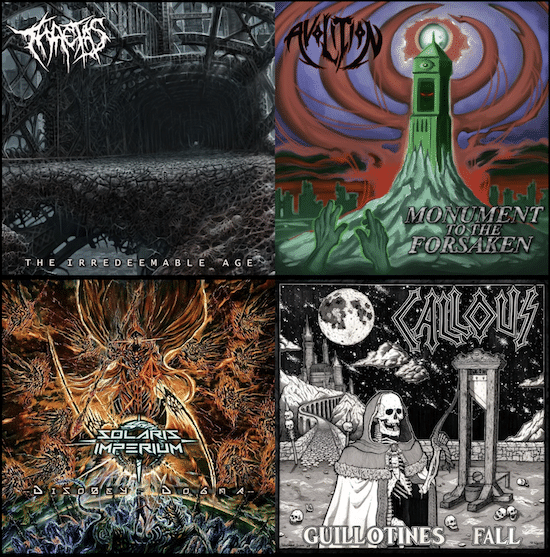
(Our writer DGR has been playing catch-up on records released earlier this year when other distractions interfered with writing about them. Beginning in mid-July he has delivered four Issues (which you can find here, here, here, and here), and now we have Issue Five bringing together extensive reviews of four more records released in preceding months
For a brief period it did seem like there was light at the end of the tunnel of this experiment in trying to catch up with everything I’d been listening to and then trying to write about it here. Obviously, and as mentioned before, it has gotten out of control, but it has allowed me at least to keep up a steady pace of reviews. It looks like my overall “quantity” of reviews year over year will remain about the same, which has at the very least assuaged some of my concern that I have been slowly losing it as life has been taking turns beating the shit out of me on the other side of the virtual space.
My problem of course is that I have still kept finding new things, so I am now at a weird point where every four or five of these smaller writeups – insert laugh track here – I find some new thing that I want to tell the world about.
I’ve even seen a few of the ones that I’m intending to cover show up in other people’s musical collections that are posted here, which has lit up the center of my brain that likes to make me think that I’m smart and I am in fact on to something here. Whether this trend keeps up as I continue to carve my way through the year’s musical releases with the grace of a drunk elephant, I won’t be able to tell you, but 2026, in spite of so much of the year resting on the comfortable side of flaming dogshit, has produced a bumper crop for musical discovery.
A lot of our veteran bands may be playing it too safe and the “music as product factory” that dominates the upper part of heavy metal hasn’t done much interesting this year either, but the many bands I’ve been taking a gamble on seem to be working out in my favor. Or maybe it’s just self-hypnosis so I don’t fall into an existential crisis about what else I could have actually been doing with my time.
We still haven’t fully gone through the releases that I picked up prior to May’s festival adventures and attempts to backlog the site either, but you’ll note that at least they’ve become far less frequent a theme.
Thaetas – The Irredeemable Age
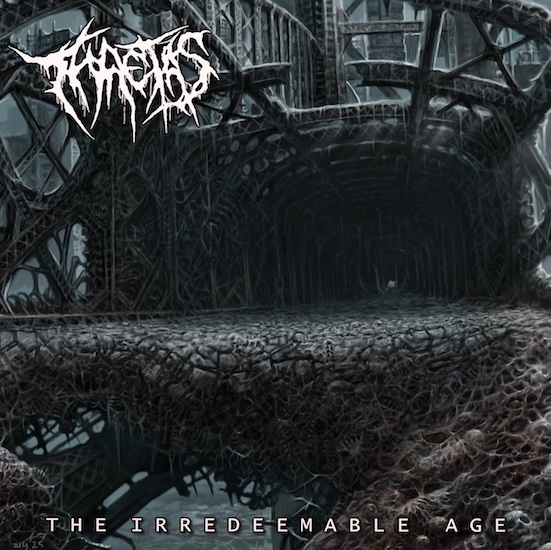
New York’s Thaetas are one of many standard bearers in the world of brutal death metal. Their latest album The Irredeemable Age hit in late June of this year and was one that was quickly added to the collection, if not just for the sheer nature of how surprisingly ugly it was. Released on Profound Lore, The Irredeemable Age seems to have slipped past people. It’s semi-understandable given the sheer flood of music that seems to have caught us all by surprise over the course of the summer months, and when yours truly winds up feeling like he’s sharing stuff other people may not have noticed, then that means there was a metric-fuckton of music out there. Because I’ve only ever felt like I’m drunkenly ice-skating across the surface of heavy metal as a genre-whole.
Brutal Death Metal in its rawest form may as well be probes launched from space with as surface-level as I’ve ever felt when diving into the genre. So long as you can sound like two cinder blocks scraping together and have a gnarly and massive groove every other song, I tend to walk away pretty satisfied. It is not a genre known for its overwhelming brilliance in spite of how complicated and quickly played its guitar parts actually are. The sheer talent involved in making something that sounds like an instrument being skinned alive cannot be understated, and likewise, when it comes to an album like The Irredeemable Age we can only scratch the surface of just how ugly this creature actually is.
Dealing in brutal death metal differentiation is often an act of dealing in incremental differences that somehow have a much larger impact than you might expect. That’s not an instant declaration that everything sounds the same, but more an acknowledgment of the fact that in order to be some semblance of an arbiter and not, say, some goofball in California with imposter’s syndrome, then you need to have something of a trained ear.
What one expects from brutal death can be entirely different from what one gets, and the target miss may have only been a matter of inches. The sort of thing that your average golf player would launch their gear off the side of a mountain over, yet the same difference between minor fender-bender and massive tragedy in a car crash. What has been learned, though, is that certain sects of the brutal death world ascribe to one particular philosophy in their quest for absolute violence and abrasiveness, and that is the idea that there must be a sort of sloppiness to it. The music must sound “wet”, a production approach that would be excited to sound as close as possible to a jar of mayonnaise flipped over and dumped onto a counter top. The over-complicated, sandblasting riffs, the ceaseless drum hammering, the concrete-scraping vocals, and a bass tone that could be picked up on an earthquake sensor can then be allowed to do their work. In concert, all of this becomes a brutal death “sound” for an album and Thaetas’ The Irredeemable Age is basically right on the money for “one of those”.
There is an element of barely controlled chaos that has been integral to the darker subsets of death metal for some time now. This is music that is often very intricate for the sort of caveman facade it puts on, and that leads to a weirdly ardent vein of avante-garde approach in many brutal death and yes, even slam bands. You could expect a group to coast on waves of auditory violence for the course of their thirty minutes but then you’ll get unhinged experiments with all manner of guitar effect, genre-style, and approach within a song that seems to arise from nowhere often running in contrast with the song it would otherwise be attached to.
There are moments in particular on The Irredeemable Age that have kept this thought at the forefront, as Thaetas descend into a semi free-jazz meltdown, pouring acid over their own song and listening to it slowly disintegrate in order to close the album out. It’s a surprising turn given just how overwhelmingly brutal most of The Irredeemable Age is otherwise, focused solely on that sewage monster explosion of sound and all of the collateral damage that would otherwise be left in its wake. Times like that are the moments on The Irredeemable Age that keep things interesting, a passing inspiration of “art where there is none”. Otherwise, Thaetas are building monstrous songs that sound like continuous sonic avalanches.
Case in point: The Irredeemable Age begins with “Dhuka”, whose opening seconds do a surprising amount of work in introducing the chaotic approach that Thaetas take to their songwriting. Within the first twenty seconds of the song, you’re already thrust into a sort of militaristic stomp, relentless guitar chug, and then what sounds like – and something of an overall theme – the guitar itself melting. The guitars take up a large amount of the spotlight throughout, as it seems whenever Thaetas are giving over to slam and brutal death tendencies, some sort of violence is ready to come crashing into the next room over. The song’s composition spins itself into a whirlwind, wherein there is no part to reliably grasp onto, and that aforementioned violence will often be some sort of way over-complicated-sounding lead guitar sweep that completely shreds any semblance of rhythm the song might have.
“Dhuka”, in a way, is all the parts of Thaetas’ musical approach refusing to coalesce into an ambulatory form and we are all witnesses to it tearing itself apart. Things clean themselves up for the slightly more head-on approach of “Summers Of Hate” and “The End Of History”, but this is an album that has made itself known as a creature that will fall apart at the whims of its musicians, and the next few songs after will be the act of reconstructing the body so that it moves again. Whether that be by way of haunted guitar note, constant screeching, or a freewheeling drum section intent on bashing its way into and out of each song, the monster that Thaetas have created will move again.
This lends credence to the idea that this is ugly by even ugly’s standards and it is made that way with a sense of purpose. Many of the songs on The Irredeemable Age are three-minute balls of vitriol that shift constantly in mercurial form. Every glance you have of it at one moment will not reflect the creature looking back at you within twenty or so seconds. That’s not to discount the earth-rumbling roars of the vocal work either, it’s just that Thaetas have an avante-garde strain in their music that tears its mask off more often the deeper you get into the group’s newest release. By the time you reach its last few songs – the closing acts of “Daytime Lantern”, “Pillars Ov Fault”, and “Digital Locusts” – it’s hard to remember what form the band took in the opening moments, so often is any semblance of recognizability sheered away within each song.
It’s freeing in that sense, and everything “makes sense” as a result, even as Thaetas are surfing by on a wave of straightforward brutality. The sort of free-jazz-prog meltdown that is the last minute of The Irredeemable Age as the album itself seems to finally disintegrate, unable to hold together any further, becomes the perfect choice when freed of all context or sense of immediacy surrounding it. It would be jarring if “jarring” weren’t modus operandi from the start of the album.
The Irredeemable Age is then defined by a steadfast stubbornness of what it is not just as often as what it is. It is brutal death, but not. It is slam at times, but not. It is avant-garde dissonance, but not. It is increasingly smart just as often as it is willfully stupid. It is a good and enjoyable release just as often as it wants to be abrasive and head-turning. The overriding sense of The Irredeemable Age is that it is the experience of brutality being bent and contorted into twisted forms barely recognizable, and that is the event you’re signing up to see. The songs themselves are held together with butcher’s twine and rivets, and at any particular moment will either fall apart or are one good monstrous spasm from blowing themselves to pieces.
There are definite and clear-sighted moments of recognizability here, and those who on the constant quest for the latest and sickest releases from the death metal world will be more than served by The Irredeemable Age, but it is that monstrous ugliness that provides much of the mystique which keeps drawing a listener back. It is something to witness just to hear the moments within each song wherein the band lose control of themselves just as much as they lose control of the music. The wild attempt at blending so many ideas together by sheer force is more than enough to fascinate for at least one trip through this release. Will you feel good about it at the end? Probably not. Will you be stronger for the challenge? Definitely.
Avolition – Monument To The Forsaken
Sweden’s Avolition are obviously a newer band, having only formed in 2023 and then getting their start on releasing material earlier this year. We’ve been able to get in on the ground floor with many bands over the years, and over time you begin to recognize when a group is growing into their own sound and still playing with ways to achieve their artistic goals. The bands that spring from the womb up to par with truly impressive debuts are ones to be treasured, as they are few and far between.
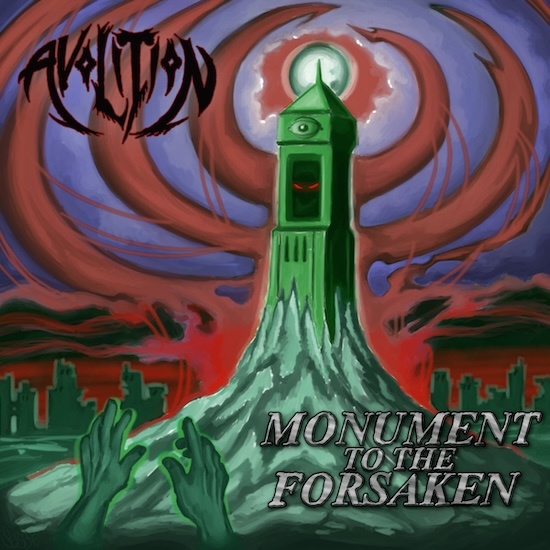
More likely, you will watch a band like Avolition promise a ton of potential working their way through a buffet of ideas and influence worship starting out, to then forge themselves into a sleeker and sharper sword by the time their third or fourth release comes around. Metal dodges a lot of the sophomore slump this way, with steady growth originally budding off of a wilder and more freewheeling start. That doesn’t translate to approaching everything with kid gloves, but there is a knowing sense of “I see why the song went this way” when you’ve also been on a multi-decade journey through a musical style at this point. Monument To The Forsaken is Avolition’s first full-length release, let loose into the hoary frontier of melodeath in its current era, constructed upon a strong foundation of practiced blueprints and generational altar visiting.
Avolition are an interesting prospect then, as their album Monument To The Forsaken is a pretty straight-shooting melodeath release. Well-practiced and well-versed in the style, Avolition are effectively racing through checkpoints fast enough to make rally drivers jealous. With nary a crash nor a misstep involved either, Avolition’s “youth” as a project does not betray them. What it does do is present a variety of thought exercises well outside the context of the album itself, with multiple listening sessions often leading down the same labyrinth of “it is fun that we have circled back around to this point and surprisingly, how did we get here?”, because there is one feeling that is tough to shake when listening to Monument To The Forsaken: Mostly, it is that whether intentional or not, Avolition somehow have managed to sound like a young Soilwork, transported through time and thirty years into the future.
Avolition existed as a being of singles prior to this album. All of those singles have found their way into the album’s overall tracklist but they were not ones being pulled out in advance of the release. Instead, Monument To The Forsaken has a compilation air to it, as it bundles up those singles alongside material for the album – which results in the phenomenon you do get to occasionally witness in the world of metal, that of a band experimenting and growing into their own sound. Does that translate into Avolition being a forged and matured band by the time of their debut? Not really. Like any “young” project there is just as much promise of potential as there is concrete evidence that the band are already in a good place. What is noticeable as you work your way through Monument To The Forsaken is how their approach to songwriting grows, while the band themselves still sound as if they are scrappy bare-knuckled upstarts.
Of course, without sounding too reductive there is a certain amount of charm in that scrappiness of a new band. You know from experience that there will likely be things that work just as often as they don’t as a group finds its way through their artistic pursuits. You never fully want to get out of the critical mindset and let the new guys have their fun with their newest endeavor, but by that same token, it does take a certain amount of intangible charisma – which Avolition have – that can make their veering through the genre just as charming as it is interesting.
It’s not too surprising to learn that the occasional clean-sung experiment doesn’t quite work yet for the Avolition crew, but again, there’s a strain of Soilwork’s DNA that seems to be working through the band decades later that will likely see them getting to that point, and likewise, it wasn’t too surprising to hear everyone’s favorite first two-step melodeath riff pop up within the same song. It’s primordial in that way, as you’re experiencing Avolition from near-embryonic at points on this album and guiding themselves into songs that are more matured and focused. It’s a brave maneuver daring to unleash a full-length at any point starting out, and Monument To The Forsaken is one that will position Avolition as a band who will be growing into their sound rather than one that has been the lucky lightning-struck individuals who seem to nail everything first go-around.
In the spirit of Monument To The Forsaken playing out as a sequenced collection of singular experiences, it is a lot easier to just bounce from song to song than approach it from any order. It is freeing in that way because, again, these are just as much experiments and ideas all being expanded upon than a fully tied together, intricate work. There’s space for many approaches in the metal world and this one works fine for a debut, but it also leads to highlights that can shine so brightly in comparison to others that you feel criminal cherry-picking the best of the best.
Credit to Avolition though, they started on a strong foot with an early single like “Promise Of Paradise”, which, while not the most boundary-breaking, commits the same sort of act I’m accusing myself of here in building itself out of the recognizable yet still enjoyable genre staples. “Digital Decay” has an air of mid-tempo Nightrage to it that is hard to shoot down, especially when you have a meditative acoustic intro to it, and the song itself is zeroed in more on its melodic mindset than aiming for the quickest ways to “ye olde two-step” – though eventually the song finds its way there.
“The Malevolent One” that lays at the midpoint of Monument To The Forsaken is one of a few that are razor-sharp in their approach, all hefty guitar chug and quick movements with zero pretense. Avolition use songs like “The Malevolent One” and “False Ascension” – another earlier, thrashier single – as the quickest pathways to the circle-pit on the album, and these are the moments wherein Avolition have the clearest objective in mind. They are at their sleekest and most supercar-resembling form when they’re tearing through melodeath staples like practiced gladiators and these are a just a collection of those across an album chock-full of them. Sub-four minutes – save for “Chains Of Torment” as the album opener – is Avolition’s best battleground from which to wage war. Give them a quick tempo, an array of blastbeats, and a one-two head-beating guitar riff afterward and they can run marathons.
Monument To The Forsaken is as solid as solid comes. It won’t blow open the doors of the melodeath genre by any means but there’s always room in the musical world for a group taking a swing at practiced genre-fare, especially when it seems like the genre’s foundational blueprint has calcified to the point where it could be kept in a museum. It’s impressive that groups keep finding ways to breathe new life into it and get the machine to move again, which is what Avolition are doing here.
Monument To The Forsaken has a ship’s worth of recognizable influences and choices being made, but Avolition find enough individuality in how they shuffle it up that they have an underdog’s charm to them. They’re battling it out with genre greats and legends but the fact that they have found their way into the arena by way of this album and manage to land a few punches is exciting. It means that there is something worth chasing in Avolition’s musical endeavors and they could very well land a knockout punch that puts us all on our asses within a release or two.
Solaris Imperium – Disobey Dogma
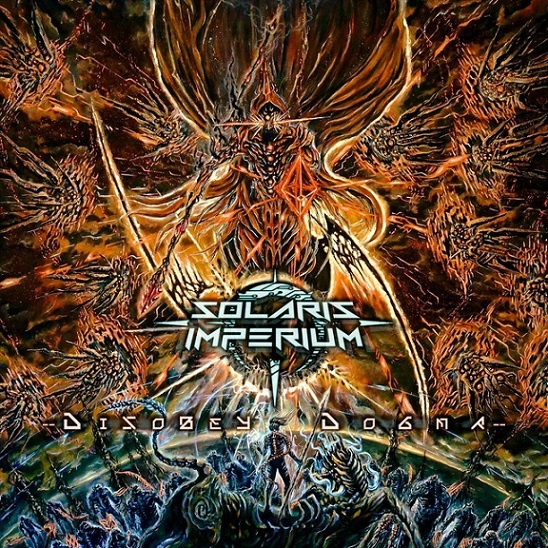
Mexico’s Solaris Imperium are an ambitious band. The group’s latest album Disobey Dogma is one of the more densely packed releases out there in the modern melodeath sphere. The group aspire to meet their science fiction aesthetics head-on in nearly every song, and as a result you have big, sweeping, tremendously heavy movements of music backed with ominous keys and equally gigantic guitar. Solaris Imperium are looking well beyond the stars with Disobey Dogma and are attempting to build a space opera of sorts with their second full-length release.
When you have an eight-year gap between full-length releases this sort of massive artistic explosion will often happen, and it is safe to say on Disobey Dogma Solaris Imperium did not manage to get out of the inspirational blast radius. As a result, the new album presents Solaris Imperium as if they were a newly reborn band, effectively placing them in the unenviable position of soft-relaunch territory. The question then becomes, for all of their aspirations and ambitions, do Solaris Imperium make the fifty-one minute journey that they’re asking of us one that is worthy of undertaking?
Albums like Disobey Dogma are somewhat uncommon; a certain combination of ambitions that races ahead of the band by a bit, grandiose ideas for songwriting, a desire to remain melodic while still existing on the weighted end of the “heavy” scale, and a chosen subject matter that allows for infinite possibilities should the artist choose to chase it. When you effectively blast your blueprint wide open via controlled explosives, it can be very difficult to reign it in – we cannot reconstruct a mountain once it has been destroyed. Solaris Imperium are taking a sound that lies on a dividing line between death metal proper, melodeath, and somewhere a hair on the progressive side for their backing synths, and writing something close to space-opera in music form.
What is interesting is that the few bands who have attempted this over the years arrive at a relatively similar point, even without knowledge or contact with one another. That’s why even though they are separated by thousands of miles, continent, ocean, and language it’s eye opening to see that Solaris Imperium have distant musical kin in Germany’s similarly space-obsessed keyboard-heavy underrated melodeath crew Aeons Confer.
We focus a lot on time and temporality here in the NCS halls when discussing bands, but it is something that while on its face is a bunch of nerds having fun with statistics and watching numbers fly, there is almost a secondary language when you’re discussing musical genres and can translate to different things when put through genre filters. So when we say that Solaris Imperium’s Disobey Dogma is largely built of four- to five-minute melodeath songs, a practiced ear can translate that into the idea we’ve been discussing at length since the start of this writeup — that these are big, dense songs that are written to sound gargantuan. If it were a doom band, you’d know they were likely interstitial or almost grindcore by comparison, but as melodeath songs you know that Solaris Imperium are taking the space opera idea to heart and they are writing songs that sound vast.
Opener “Harvest” is the key to the whole album as it moves at a glacial pace for a bit and every melodic change comes with heavy footfall. The music behind it becomes raucously heavy but you’ll note that behind the ground-shaking growls the guitars are consistently at hovering pace, big, meaty chords and the vibrato carried within. That the whole song is backed by swelling keyboards will almost seem second nature by the time your brain notices it. Big, ominous keyboard melody is second-nature to songs like this.
Disobey Dogma has its fair share of highlights as well. The heavily melodic “Synthetic Flesh” could likely keep a lot of Mechina fans happy as it rumbles through its five minutes. The song has a heavy melodic focus but multiple elements run concurrently throughout the song that you won’t notice until a couple of listens in, easily marking it as one of the songs in which you’ll continually discover stuff after the initial heaviness wave envelops you.
“Imperian” and “Altars Of Fate” are both some of the bigger songs on the album, bursting at the seams with choral stings and mechanical percussion. “Imperian”, especially, has a solid Fear Factory guitar chug in its opening before the song folds itself gently back toward what has become the M.O of Disobey Dogma by that point: a solid, hefty march with melodic keys in the background. Over the top, Solaris Imperium’s vocal work sits remarkably clear even as the group descends into Septicflesh-esque blast-furnace heaviness, and that is just within “Imperian” boundaries.
“Altars Of Fate” by virtue of being one of four songs that sails well past the five-and-a-half minute mark has a lot of room to breathe, and Solaris Imperium continually bend the track across multiple different pulse checkpoints. The movements within “Altars Of Fate” are distinct but Solaris Imperium do well in crafting each change so that it is organic enough to seem as if they are chapters within a book.
As a personal soft spot, I found myself drawn into the heavy electronics of “Downfall”, which is probably the most keyboard-laden of the songs on Disobey Dogma. “Downfall” is the traditional melodeath song in an album of gigantic songs, and while it is still massive, it is straight-laced and sleek enough not to require as deep a mental dive as many other songs on Disobey Dogma require. There’s room for simplicity on an album like this, where the heavy is there for sake of “heavy” and the keyboard melodies are just catchy as hell, even if they dominate the guitar work like a UFC fighter put up against a toddler at times.
Plus, on the opposite side of the equation you do have the immensely intricate “Rhemina Sadathra” closing the album out at seven-plus minutes of music. You cannot compress a release like Disobey Dogma easily but you can do a fantastic “in summation” approach when you’re closing out your big sci-fi concept release and Solaris Imperium have a solid approach to that on “Rhemina Sadathra”.
Disobey Dogma is an expansive fifty-one – you’ll have to forgive my napkin math here – minutes worth of music. At times it can seem like Solaris Imperium are a little lost in their explorations of the vastness of space but they quickly enough will find a new star to orbit in their sci-fi-inspired epic. With an album like this you’ll know that the definition of “a lot” will be pushed to its absolute maximum, and like we’ve hammered on before, there is “a lot” of music within the bounds here. Partially orchestral, partially full-on synth electronic assault, partially death and equally just as melodeath, Solaris Imperium have created a musical adventure that is impressive for only being a sophomore release. If you missed this one way back in April, now is a great opportunity to explore it before the back half of the year’s expected torrent of releases hits.
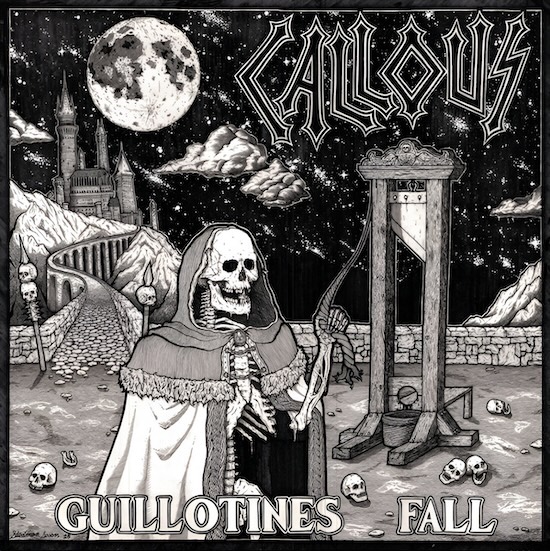
Callous – Guillotines Fall
Black, death, and thrash metal hybrids have always struck me as something of a wild man’s genre. It has long been part of metal’s artistic blood to feature wild-haired, inhibition-free, zombie-like characters on its posters and album artwork, yet it has rarely felt like the genres involved ever captured the sort of nihilistic freedom that is insinuated with that sort of character until black metal and thrash started colliding more often.
The genre term itself is as opaque and nebulous as they come, because for a long time music such as what Callous have on offer here would’ve been placed into the dirtier side of a speed metal collective, with a lot of hedging and hemming and hawing along the way. Thrash is already a high-energy genre and when you add the sort of reactionary defiance of black metal to the mix, the result is sort of a crazed and snarling animal – not too far off from Callous and their January 2026 release Guillotines Fall.
It’s not that many of us willingly want to remember the beginning of the year at this point, but talk about a hell of a confident swing jamming out an EP like Guillotines Fall in the “quiet part” of the year. Admittedly there is a charm to Guillotines Fall, for all of its evil and intentionally raw as freshly killed meat approach to music. The opening is essentially the vocalist shouting out the EP’s name and the band name a handful of times as the band themselves create barely coherent, crashing riffs of music that would otherwise be categorized as caveman in its primordial approach were nary of it to actually cohere, but there’s a sense within that opening introduction that it is meant to sound as if the band are crashing from wall to wall instead of beginning with a full song.
Metal has a yearning in its underground to preserve, pay tribute to, and bring back times when metal seemed truly dangerous and wild. The distances in aesthetic and production for metal as it fractured into its extreme iterations are wild, yet looks-wise it moved along a fairly gentle gradient. As a sort of codified unspoken language we can semi-recognize and place pretty good bets on how a group is going to sound on looks alone, and a release like Guillotines Fall and its rebelling against the world does not betray its aesthetic at all. It has the wobbly yet fangs-bared extremity by way of intensity and passion vs a dedicated and directed form of destruction. Music by way of explosion, if you will, rather than aforementioned targeted destruction.
So, if it seems like Callous‘ music is catching you by way of collateral damage then that is the only thing by design. Every other accomplishment is achieved through passionate earnestness for their Wildman wanderings in music form.
Guillotines Fall doesn’t exactly push forward the genre of two raccoons battling it out in a burlap sack, but there’s no need to in the case of Callous’ music. What you get with Guillotines Fall is a twenty-minute expulsion of energy that puts its thumb on the scale to tilt everything back toward when metal was on the crazed side of things and didn’t care for maintaining its composure much. It is five songs that careen their way through the extreme metal underground and by the end have scorched themselves to ash.
Opener – and brilliantly named – “Intro/Callous” has already been referenced above, but we’re not joking when we say that the song is mostly an exercise in animalistic howling of the EP’s name and no interest whatsoever in maintaining composure. It lays out the terms of service for Guillotines Fall, which is mostly that “this is callous” and that every song afterward is going to be a three-minute whirlwind that will feel as if you’ve been rushed through a hallway full of knives and nails by the time each song wraps up.
Black T-shirts and battle gauntlets armed at the ready then, Callous tear their way through the titular “Guillotines Fall” – which pulls from the some of the best stock-in-trade red meat black-and-thrash riffs the butcher has to offer – soon after, launching into “Agonized Dreams” with a semi-slower approach and a truckload more crashing cymbals to make up for it in the first half of the song. “Agonized Dreams” comes across as staid and meditative in comparison to its immediate brother with its straightforward march, but then Callous crawl their way into a chaotic solo and a closing double-bass roll that picks up the tempo at the end of the song for one final howl.
“Chasm Temple”, then, is the one that is most notable for the specters and spirits it conjures forth. It is the most cohesive of the songs on Guillotines Fall if only for the benefit of its focus on its guitar lead. It wraps its jaws around and refuses to let go and so Callous take every opportunity to bring back that specific melodic line over and over again. “Chasm Temple” is Callous dancing on the knife’s edge of the occult, and by comparison “Mythic Barbarity” is the prog-rock epic, though its first few passes seem as if it’s a fantastic excuse for the group to yell at the sky instead. It is a song that builds in recognizable intensity before giving over to the promise of chaos in its last minute.
Callous’ Guillotines Fall is a fun tear through a blackened thrash and death metal underground. Callous remain hyper-kinetic over the course of the EP’s twenty minutes and refuse to sit down long enough to be fully pigeonholed into one genre. We can recognize them as creatures of the underground of heavy metal and they certainly run down the checklist of ideas and inspirations in a marathon sprint, but it is in the unexpected way Callous develop each song that keeps the group as if they themselves were barely holding it together. It’s just as much wild thrashing as it is spasmic brutalizing on Guillotines Fall, but much of it is in service of animal nature and diseased roaring in equal measure.
Callous live up to the wild creature tendencies mentioned above on Guillotines Fall, and as a first release it shows that the group are already one foot well in the door – and unable to be easily pushed out – of death metal and black metal’s more raw underground.