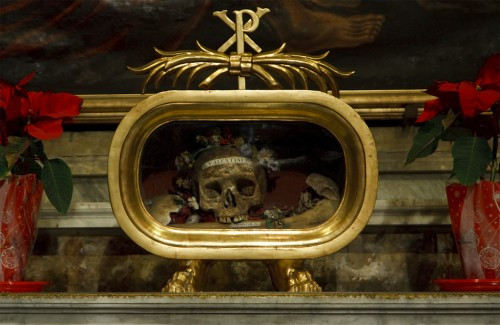
Nice photo, huh? And so appropriate for this day, particularly as adornment for a metal site. It’s the flower-crowned skull of St. Valentine exhibited in the Basilica of Santa Maria in Cosmedin (Rome, Italy). And with that intro, we’re going to provide a little history lesson which convinced us (and maybe it will convince you), that Valentine’s Day is metal, despite what we used to think. We will also have music, of course, as a Valentine from us to you.
Now, back to that skull. Who did it really belong to, back when it was covered with warm flesh? What we now call Valentine’s Day was originally established in honor of an early Christian martyr, Saint Valentine. But according to the Catholic Encyclopedia, there were at least three martyrs by the name of Valentine: they were from Rome, Terni, and Africa. Each was said to have died on February 14.
It’s probable that Pope Gelasius I, who established St. Valentine’s Day in 496 AD, had in mind the Valentine who was beaten with clubs and stones and then beheaded in Rome in 269, 270, or 273 AD, supposedly for performing marriages. Now, that’s a metal way to meet your end.
To elaborate, some historical accounts report that Emperor Claudius II (“Claudius the Cruel”) banned marriages when Roman men began refusing to go to war in order to stay home with their wives. Valentine allegedly chose death over renouncing his religion and his performance of weddings. Legend has it that on his last day he wrote a message for his guard’s daughter (whose blindness he allegedly cured) signed, “From Your Valentine” — though there appears to be no historical basis in fact for the story about the girl, the blindness cure, or the note.
Like many Christian celebrations, what we do on Valentine’s Day has its origins in ancient Rome. Lupercalia was a Roman festival held on February 13-15, at least partly in honor of Lupa, the she-wolf who suckled the infant orphans Romulus and Remus, the founders of Rome. That’s why it was called Lupercalia — the “Wolf Festival”. That’s a metal name, for sure, but wait ‘to you see what the Romans did during that festival. (more after the jump . . .) Continue reading »
 Maybe other people don’t find lorises as amusing as we do. Or maybe other people are happy just to look at lorises without treating them as fodder for “icanhazcheezburger” captions. Or maybe other people would rather we just stick to metal and leave bug-eyed animals to The Discovery Channel.