Oct 252013
 

(In mid-September we posted the first of two reviews of the new album by Scotland’s Man Must Die, and now we bring you the second one, by Andy Synn.  Some albums just just demand this kind of attention.)

Absence makes the heart grow fonder. Hard times make the heart grow harder.

It’s been four years since these Scottish bruisers last brutalised our eardrums with their sickening sonic stew. Four long fucking years of pain and struggle and bloody-minded perseverance. So it’s no surprise that the fourth album by the Scottish juggernauts might just be their most abrasive, most lethally focussed, and most viscerally aggressive release yet.

To those unfamiliar with the band, their sound is a devastating mix of Cryptopsian chaos and Kataklysmic groove, delivered in a manner so utterly merciless, so utterly unforgiving, that its use in certain countries has been declared a war crime.

Fuelled by fire and frustration, each song is a demanding (at times exhausting) sequence of technical, pandemic death metal riffs, frenzied and punishing drums, and rabid, venomous vocals, all tied together by a subtle undercurrent of seditious melody and a grim atmosphere of malevolence and paranoia. Continue reading »

Oct 242013
 

Sweden’s Blood Mortized are back with a new album, and as you might guess from that album cover, they’re not fucking around. However, as you might not guess from that cover art, there’s a lot more going on in The Demon, The Angel, The Disease than maniacal serial killers and a big unholy whiff of cemetery rot.

The resurgence of Swedish-style death metal in the blood line of Grave-Dismember-Entombed proves the adage that, in time, everything old is new again. But frequently the new releases in this vein just sound old, old and tired, even to people like me who are addicted to this style. It’s not enough to simply capture the tone and the atmosphere. Make no mistake, you do need that, but you need more to make a great album that will put smiles on the faces of the hellish faithful and cause them to slobber in ghoulish glee. I’ll tell you how Blood Mortized have pulled off that trick.

We begin with the essentials. The production job on the album (by Linus Nirbrant of Sweden’s This Ending) makes it sound absolutely massive, not too murky or raw but still corroded and corrosive. When heard at the proper volume (i.e., the level that will leave you with tinnitus for days), the music is overwhelmingly powerful. The drums (performed by Norway’s Brynjar Helgetum) go off like cannon volleys, like nearby thunder, like heavy caliber machine guns on full auto. And listening to the guitars and bass, tuned low and deep and shrouded in distortion, is like being trapped inside a giant chainsaw or a titanic tunnel boring machine. Like these things: Continue reading »

Oct 242013
 

(In this post, NCS writer DGR reviews the latest album by New Zealand’s Ulcerate.)

Ulcerate were one of those bands who for a long time had a firm spot on my metal radar, but I never really got around to checking them out. The group got my attention around the time of their Willowtip release Everything Is Fire, mostly because I’ve always tried to keep up with that label after they gifted us with Arsis’ first couple of releases in the early aughts. However, where Ulcerate really made their impression was with Destroyers Of All, which it seemed like I listened to at first by gunpoint, with every metal listener I knew screaming from the mountaintops about it.

Destroyers Of All was a massive disc, a gargantuan, lumbering beast that you don’t really hear in death metal outside of the Polish scene or the more doom-oriented bands, yet Ulcerate had created an album that made me picture the band as one of the few who would be playing when the apocalypse happened. There was such a cavernous sound on display that it pretty much became an unspoken rule that anything the group did henceforth would be hotly anticipated. And so, as the group geared up to put out their 2013 release Vermis, I disconnected from most press outlets in a desire to go in somewhat unspoiled.

The album has been out in the world for a month at this point, and the reason that we’re only now getting around to a review is because Vermis is a dense, dense album. It feels like a brother to Destroyers Of All but with a bigger emphasis on the doom atmosphere. While the group had already been making long songs, Vermis extended them into the hopeless territory, with the listener being dragged almost unwillingly behind the band. It makes Vermis a difficult and challenging album to fight through, yet it is also one of the most intense experiences released this year. Continue reading »

Oct 232013
 

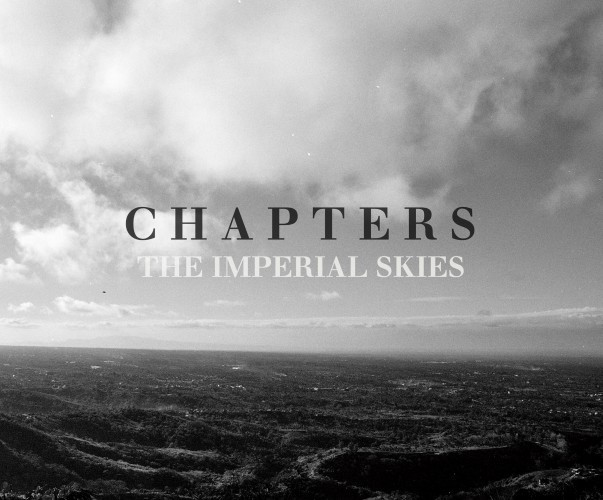
(In this post we present our second review of the new album by Chapters — this one written by TheMadIsraeli — as well as the premiere of a combined song from the new album: “March of the Puritan/Arising”.)

This review comes later than I had planned. I was going to publish something I had originally written but it just didn’t convey the passion I have for this album.  Neither did I feel, in hindsight, that I gave Chapters their musical due, or rather, I was missing the target as far as what they do.  The thing is, Chapters channel a musical era of metal that I was passionately into and couldn’t get enough of.  The fact that a band like this existed when I discovered them back in 2011 excited me, and that excitement hasn’t waned one bit.  Their new album The Imperial Skies is one of the best releases of the year, no doubt, and it re-captures the excitement of a musical movement that unfortunately got trampled underfoot by the bullshit metalcore explosion that occurred from 2005 onward.

Chapters are, ironically because of their British origin, New Wave of American Metal.  I don’t say this solely as a matter my own speculation or opinion, mind you. In the friendships I’ve developed with masterminds Joe Nally and Angus Neyra, we’ve discussed this and they pretty much agree.  While they do draw influences from Death and from Bay Area thrash, it’s bands such as Shadows Fall, Lamb of God, God Forbid, Himsa, and early All That Remains who are the foundation Chapters have built upon.  Whether you want to call it metalcore (which I argue that stuff was) or not, Chapters fully embrace the thrash/hardcore/melodic death metal combination in which those bands fully entrenched themselves.

As such, you get all the expected elements: Melodic technical guitar work, driving emotive melodic passages, vocals with a great deal of passion behind them that sound like they’re being delivered at the risk of the vocalist’s voice, and beautiful acoustic interludes.  I eat this shit up, always have and always will, but Chapters deliver it exceptionally well, leagues beyond anyone else who’s tried to capture this sound since its heyday. Continue reading »

Oct 222013
 

A personal note: I have a soft spot in my heart for The Brown Book. I’ve been following them since March 2010 when this site was a whopping four months old. I’ve reviewed nearly everything they’ve released, beginning with Thirty-Nothing (2009), and then Pyramid Scheme, (2011), and then a track named “Queer Street” (2012), which turns out to be a precursor to the album I’m about to review — though I did miss their live version of Pyramid Scheme. They’re completely DIY and lo-tech in their approach to recording, they’re scattered around the country (Boston, Brooklyn, San Diego, Cookeville, TN), they’re hardly prolific, and they don’t seek or get much attention when they put out new music apart from friends and the small scattered cadre of people like me who get excited when word of a new release reaches their ears.

I also have a soft spot in my head for The Brown Book. It’s that place where, over the years, their music has hammered away until the skull has been shattered with micro-fractures and you can feel the sponginess underneath. Their latest cranial demolition job is this year’s III: America’s Guest, and it’s their best work yet.

The new album is one long song, weighing in at 20:26. Unlike their previous releases, this one includes vocals — despite the fact that in my previous reviews I wrote that adding vocals would be a mistake. I’ll come back to that later, after I’ve mustered enough grit to admit I was wrong. Continue reading »

Oct 222013
 

(NCS contributor Austin Weber reviews the new album by Reflections from Minnesota.)

For me the best way to find good djent in a sea of boredom is to apply a four-fold set of criteria. Most important is to find the bands who are interesting songwriters, then look for the most unique grooves/groove patterns, followed by interesting and creative lead guitar-work, and lastly search for the bands who bring in outside influences and plenty of tempo changes to break up the mid-paced chugging. The new album Exi(s)t by Reflections satisfies all four of those criteria, and then some.

“Exit” starts off the album and lulls you into believing it’s merely an opening instrumental, until a terrifying wall of dissonant heaviness emerges in a way that’s reminiscent of The Tony Danza Tapdance Extravaganza. In fact, a liberal dose of squeals, taps, and noisiness that reflect a strong Danza influence pop up and flavor many parts of Exi(s)t. By incorporating such touches, Reflections have found a sub-niche within djent to explore, and the effect is to grace their music with a palpable ferocity that often escalates into sheer hateful peaks. Continue reading »

Oct 212013
 

(Andy Synn reviews the debut EP by Seelenmord, which is now available for free download on Bandcamp.)

It’s important to start off your week right. Most of us are heading back to work, and the Monday morning blues can easily get you down. So what better than a slice of darkly melodic, spirit-crushing black metal from Argentina, whose name roughly translates to “Soul Murder”?

And it’s free too!

The five tracks that make up this EP pick and mix a variety of influences from the black metal spectrum, melding the earthen grandeur of primordial Ulver with the relentless dominance of Anaal Nathrakh and the raw ferocity of early Gorgoroth, taking the listener on a wild journey of penitence and paranoia.

Though all the more overt trappings of the genre are present and correct – blitzing tremolo guitars, sacrilegious snare blasts, a raging undercurrent of bile and scorn – it’s the more subtle and artful touches which really make this EP stand out. Continue reading »

Oct 212013
 

Consider the idea of a Czech black metal band creating an album in homage to the Goddess Kali, the Aghoris, and Hindu funeral rites. With the album and song titles in Hindi. And they perform in embroidered robes and a striking array of strange hoods. Who wouldn’t be at least a little curious about the music? I certainly was.

मृत्यु का तापसी अनुध्यान (“Ascetic Meditation of Death”) is Cult of Fire’s second album, and is due for release on November 30 on the German label Iron Bonehead Productions. From the opening moments of the first track, it’s apparent that the band set their sights on creating something more complex and more artistically ambitious than a straightforward black metal blitzkrieg.

The music is in constant motion, transitioning between moods of light and dark, alternating the pace between hard-driving rhythms and stately progressions, crossing boundaries between incendiary assaults and gorgeous panoramas that more closely resemble post-rock than black metal. The melodies range from the bleak and heart-broken to the shimmering and soaring, but the overall atmosphere is one of epic grandeur, dramatic and impassioned. Continue reading »

Oct 182013
 

(TheMadIsraeli reviews the new album by Hail of Bullets.)

“In a man-to-man fight, the winner is he who has one more round in his magazine” – Erwin Rommel

Hail of Bullets really are the sonic incarnation of war at its most savage and horrifying. Their dedication to concept albums about real events, events that played out like a ballet of death, has proven effective, not only musically, but in their ability to capture the mood of the solider in the thick of war. No band has channeled the deadly precision, the zealous dedication to completing the objective and killing the enemy, or the rush of frantic horror in the last seconds of life, quite like Hail Of Bullets.

What accounts for this? Besides the lyrics, I don’t know if it’s the guitar tone, which sounds like the corpses of freshly dead soldiers being churned into putrid meat by tank treads, or van Drunen’s vocals, which sound less like an attempt to be brutal and more like an attempt to capture the sensation of a soldier frantically stabbing his enemy to death with a bayonet. …Of Frost and War summoned the bitter cold of winter warfare on the Eastern front, the imminence of death, and bitter defeat. On Divine Winds channeled the fanaticism, the fervor, and the imperialistic arrogance of Japanese forces in the second World War.

III: The Rommel Chronicles is more interesting, as its subject is someone who was a more ambiguous figure. I find it intriguing that they chose to make an album about Rommel, who was both a badass German tank commander and one of a group of conspirators who attempted to overthrow/assassinate Hitler himself. Continue reading »

Oct 172013
 

(In this post BadWolf reviews the new album by Finland’s Oranssi Pazuzu, which is out now via 20 Buck Spin in the US and Svart Records in Europe.)

In the first seconds of Oranssi Pazuzu’s new album, Valonielu, I knew I was in for something different. “Vino Verso” opens with a swell of synth and guitar, like something out of my favorite 80’s Judas Priest record—but wait, I thought, Isn’t this a black metal album? The dirty guitars kick in, but they work at a slow, syncopated, doom-sludge stomp. Then the synths break back in, reminiscent of Sanford Parker’s blackened-dance accents on Nachtmystium’s Addicts album. It’s was one left turn after another, and then I looked at my iPod—I was only two minutes into the album. What. The. Fuck.

I like weird black metal. Something about the genre lends itself to unexpected twists in the music—perhaps it’s because the basic building blocks of the genre, blastbeats and tremolo picking, are both simple and versatile. And pretty optional. Oranssi Pazuzu seldom do either, which begs the question: Is this black metal, or have we gotten so lazy with genre tags that we just lump any two things with tangental similarity together? There is a downside to resisting new subgenre tags for a band like this. Continue reading »