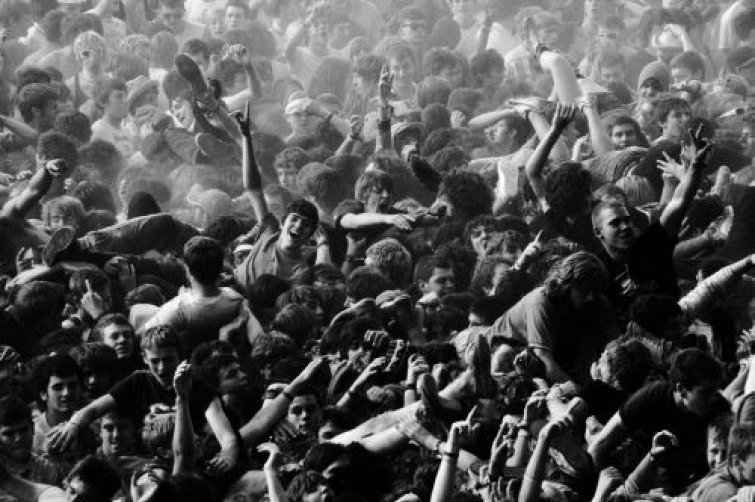
“Human collective behavior can vary from calm to panicked depending on social context. Using videos publicly available online, we study the highly energized collective motion of attendees at heavy metal concerts. We find these extreme social gatherings generate similarly extreme behaviors: a disordered gas-like state called a mosh pit and an ordered vortex-like state called a circle pit. Both phenomena are reproduced in flocking simulations demonstrating that human collective behavior is consistent with the predictions of simplified models.”
Thus reads the abstract for a scientific paper published today with the title, “Collective Motion of Moshers at Heavy Metal Concerts”. The authors are four gents at The Laboratory of Atomic and Solid State Physics at Cornell University in upstate New York. To avoid confusion, allow me to repeat: This was written by actual scientists, not stand-up comedians.
The authors described pit action as follows, “Often resulting in injuries, the collective mood is influenced by the combination of loud, fast music (130 dB, 350 beats per minute), synchronized with bright, flashing lights, and frequent intoxication.” Stunningly, they observed that “[t]his variety and magnitude of stimuli are atypical of more moderate settings.”
They expected to find a broad distribution of speeds and chaotic movement that could not be “well described by simple analytic expressions.” Instead, they found that mosh pits closely resemble the equilibirum state of molecules in classical gases. Continue reading »